
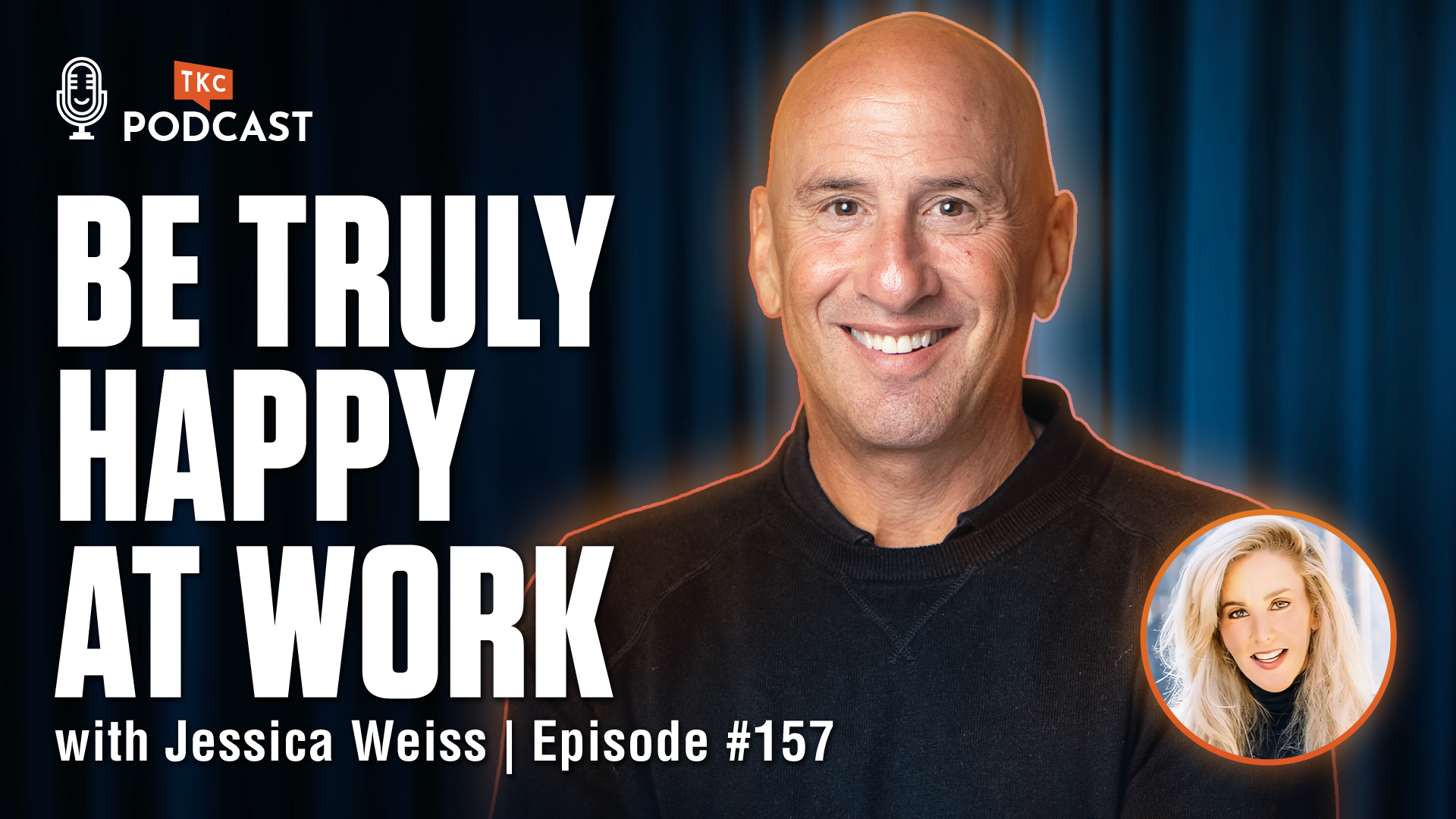
February 26, 2026Happiness at Work Is the Performance Strategy You Need, with Jessica Weiss
Happiness at work is a performance strategy, not a perk. Learn how Jessica Weiss helps teams build real, sustainable happiness.
What if the thing your team is missing isn’t a better process, a cleaner org chart, or another all-hands meeting — but happiness? Not the forced, sloganeering, pizza-party version of it. The real kind. The kind that shows up in how people treat each other when the pressure is high, and the AV is broken, and the quarter is closing harder than anyone expected.
Keynote speaker Jessica Weiss has spent fifteen years embedded in Fortune 500 companies researching exactly this, and her conclusion is both simple and inconvenient for anyone still treating culture as a line item: happiness isn’t a perk you offer after performance. It’s the system that makes performance possible in the first place.
🎧 Watch and listen to the podcast episode: YouTube • Spotify • Apple Podcasts • Amazon Music
Why Happiness at Work Is a Performance Strategy, Not a Vibe
The resistance to happiness as a serious workplace topic is understandable. The word carries baggage — it sounds soft, subjective, and suspiciously close to the kind of thing that ends in a mandatory gratitude workshop nobody asked for. Jessica’s entire approach is built around dismantling that association.
She is, by her own description, the least woo-woo happiness expert you’ll ever encounter. There are no affirmations here, no vision boards, no instructions to simply choose joy. What she brings instead is research — fifteen years of it, drawn from work with global brands including Coca-Cola, Johnson & Johnson, and American Express — and a frank, direct communication style that treats happiness the way any serious operator would treat a core business function: as something that can be measured, built, and sustained deliberately.
The data she works with is hard to argue with. Happy teams outperform unhappy ones across virtually every metric that matters — productivity, retention, customer satisfaction, innovation. The question was never whether happiness drives results. The question is whether leaders are willing to treat it with the same rigor they apply to operations, strategy, or financial planning. Most don’t. And that gap is exactly where performance quietly erodes.
For anyone working in employee engagement or trying to understand why an otherwise capable team keeps underdelivering, this framing is a useful place to start. The problem isn’t talent. It isn’t effort. It’s often the invisible infrastructure of how people feel about the work — and whether that infrastructure is being actively maintained or quietly neglected.
What Sustainable Happiness Actually Looks Like
One of the most important distinctions Jessica makes is between sustainable happiness and performed happiness. The performed version looks like relentless positivity, a “good vibes only” culture, and a collective agreement to never name what’s actually hard. It feels supportive on the surface and it is, in practice, exhausting and ultimately corrosive.
Sustainable happiness includes the hard weeks. It includes the tedious tasks that belong to every job, the stressful sprints that belong to every meaningful project, and the moments of genuine frustration that belong to every honest team. It doesn’t require that any of those things disappear. It requires that people have enough capacity, connection, and clarity to move through them without losing themselves in the process.
This is a critical reframe for leaders who conflate happiness with comfort. A team that never disagrees isn’t a happy team — it’s a fearful one. Healthy conflict, openly navigated, is a green flag for corporate culture health, not a symptom of dysfunction. When people feel safe enough to push back, raise concerns, and advocate for different approaches, that’s not friction. That’s the sign of a team that trusts each other enough to be honest. Eliminating that friction doesn’t create happiness. It creates a performance of harmony over a foundation of silence.
Jessica’s work helps leaders tell the difference — and more importantly, build the kind of environment where real happiness becomes structurally possible, not just individually aspirational.
Progress Is the Fuel, Not the Finish Line
One of the most practically grounded ideas in this conversation is Jessica’s reframe around burnout. The common narrative is that people burn out from working too hard. Her research points elsewhere: people burn out from feeling stuck. From doing effortful work that seems to go nowhere. From showing up, spending energy, and having no clear sense that anything is actually moving.
Progress — visible, acknowledged, meaningful progress — is one of the most reliable drivers of workplace happiness. It’s the dopamine that makes effort feel worth it. When people can see that their work is contributing to something real, when milestones are recognized rather than immediately replaced by the next target, when leaders take time to connect daily effort to a larger purpose — that’s when teams sustain their energy across the long haul.
This has direct implications for how business leadership is practiced daily. It’s not about grand gestures or elaborate recognition programs. It’s about the micro-moments — the check-in that acknowledges someone’s contribution, the meeting that starts by naming what the team just accomplished before pivoting to what’s next, the manager who connects a routine task to the larger outcome it serves. These things are small and they are, cumulatively, everything.
For professional development conversations, this is worth dwelling on. The skills that drive sustainable high performance aren’t just technical. They include the ability to notice what’s working, name it clearly, and give people the experience of mattering in the work they’re already doing.
The One Work Friend Who Changes Everything
Of all the research-backed ideas Jessica brings to this conversation, the one that tends to land hardest with audiences is also the simplest: having one real friend at work changes everything.
Not a Slack channel. Not a team that describes itself as a family. Not a monthly social event with a catering budget. One actual person you can text when things go sideways. Someone who knows your context, has your back, and doesn’t require you to perform for them. The research on this is remarkably consistent — people who have a genuine friend at work are more engaged, more productive, more resilient under pressure, and significantly less likely to leave.
This matters for event professionals and health and well-being advocates in a specific and immediate way. When the unexpected happens — and in live events, it always does — the teams that hold up are not necessarily the most technically skilled. They’re the ones with real relationships underneath the professional surface. When the AV fails, and the speaker is running late, and registration has hit an unforeseen wall, capacity comes from connection. And connection is built before the crisis, not during it.
Jessica’s point is that organizations can actively support the conditions for real friendship to develop — through intentional pairing, through giving people time and space to talk about something other than deliverables, through creating environments where it’s safe to be a person rather than just a function. That’s not soft programming. That’s change management at the human level, and it produces measurable results.
The Joy Journal and the Science Behind Small Habits
One of Jessica’s most immediately applicable tools is what she calls the Joy Journal. The practice is straightforward: for two weeks, write down three moments of joy each day and note why each one registered. That’s it. The commitment is small. The neurological impact, as the research supports, is not.
What the exercise does is train the brain to scan for a positive signal. Most people, left to their default patterns, are wired toward threat detection — noticing what went wrong, what’s at risk, what needs to be fixed. That bias is useful for survival and exhausting as an operating mode for daily life. The Joy Journal systematically interrupts it. Over two weeks, the brain builds new grooves. The scan shifts. Not because reality changed, but because attention did.
For leaders thinking about personal development at both an individual and organizational level, this is a useful model for how small, consistent behavioral shifts produce meaningful change over time. The happiness skills Jessica teaches aren’t one-time insights. They’re practices — repeatable, buildable, and increasingly automatic the more they’re used.
This is also what makes her content valuable in a keynote format specifically. She doesn’t just give audiences a feeling in the room. She gives them a tool to take home and actually use on a Wednesday morning three weeks later. That’s the attitude shift that has lasting impact — not the inspiration alone, but the practical pathway that follows it.
How to Spot a Happy Workplace Versus a Toxic One
One of the more clarifying sections of this conversation is when Jessica gets direct about the signals that distinguish genuinely healthy cultures from ones that are performing well while quietly suffering underneath.
The markers she points to are behavioral, not cosmetic. Healthy workplaces have teams that can disagree openly and recover quickly. They have leaders who acknowledge difficulty without catastrophizing it. They have people who talk honestly about workload rather than performing invulnerability. And critically, they have a tolerance for imperfection that makes it safe to try things that might not work.
Toxic workplaces, by contrast, often look fine from the outside. The metrics are acceptable. The messaging is positive. But there’s a low-grade anxiety underneath everything — a sense that honesty is risky, that admitting struggle is weakness, that the culture only works when everyone performs the right version of engagement. That kind of environment doesn’t just make people unhappy. It actively degrades the quality of decision-making, because people optimize for looking capable rather than being capable.
The implications for future of work conversations are significant. As organizations navigate hybrid structures, generational shifts, and the growing complexity of distributed teams, the cultures that will hold together are the ones built on actual trust rather than managed appearances. Building that trust requires the kind of leadership that Jessica’s work directly addresses — and it requires starting before things are broken, not as a response to crisis.
Why Happiness Is the Right Keynote Topic for Your Next Event
If you’re programming content for a leadership summit, a culture reset, a team offsite, or an all-hands built around engagement and retention, happiness is not a soft topic. It is a strategic one, and Jessica Weiss is one of the clearest, most research-grounded voices making that case to audiences right now.
Her TED speaker background and Columbia MBA give her academic credibility. Her fifteen years inside Fortune 500 organizations give her operational credibility. And her humor, her directness, and her genuine investment in the people she speaks to give her the room credibility — the kind that makes an audience lean in rather than check their phones.
What she leaves behind isn’t just a feeling. It’s a framework. A way of thinking about workplace happiness that leaders can actually apply — in how they run meetings, how they structure recognition, how they talk about hard things, and how they actively build the conditions that make sustained performance possible. For inspirational and motivational content that delivers beyond the moment, Jessica Weiss belongs on your shortlist.
🎙 Watch the full interview with Jessica Weiss on happiness, performance, and what your team actually needs.
If happiness, leadership, or employee engagement is on your agenda, we can help you find the right speaker for your room. Schedule a 15-minute strategy call and let’s talk through your event goals — or email us directly at info@thekeynotecurators.com with your audience and theme, and we’ll tell you whether Jessica is the right fit.
Discover More Insights





Get in TouchContact US
Fill out the form so we can best understand your needs.
A representative from The Keynote Curators will reach out to you.