
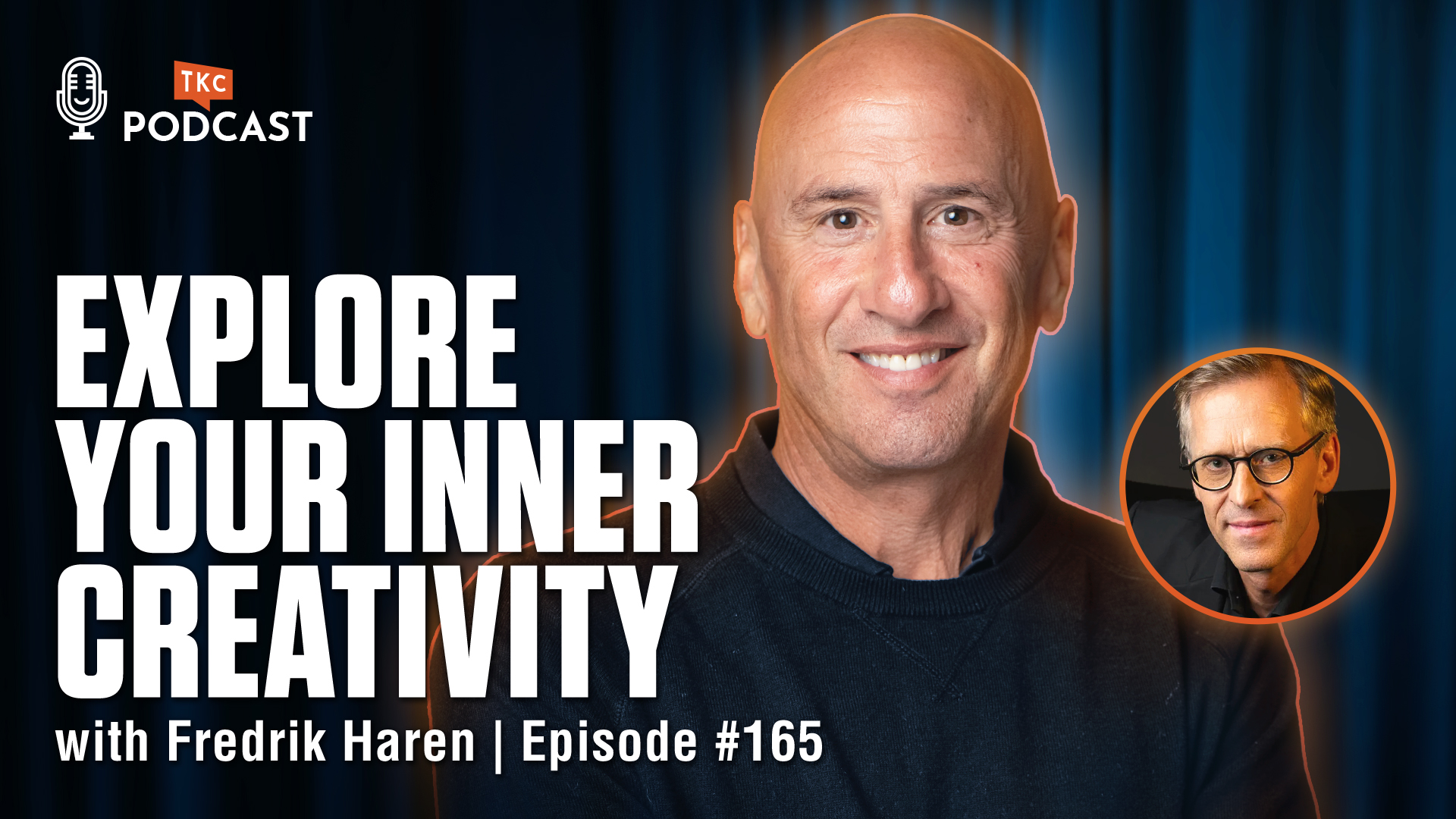
April 23, 2026Explore Your Creativity with Everyday Actions, with Fredrik Haren
Creativity is a trainable mindset, not a talent. Learn how keynote speaker Fredrik Haren helps businesses unlock everyday creativity for innovation.
What if the biggest lie holding back your team isn’t about strategy, budget, or talent, but three small words repeated so often they’ve become almost invisible? “I’m not creative.”
Those three words have done more damage to individual potential and organizational innovation than almost any structural or operational failure I can think of. And yet, they get repeated in boardrooms, at strategy sessions, and in one-on-one conversations every single day.
I recently sat down with creativity keynote speaker Fredrik Haren, who has spent the last 25 years studying and speaking about creativity across more than 75 countries. He’s delivered over 2,000 presentations to more than a million people, been inducted into the Speaker Hall of Fame on two continents, and authored ten books, including The Idea Book, which was named one of the 100 Best Business Books of All Time. His latest work, The World of Creativity, published in December 2025 with Wiley, is the culmination of everything he’s learned about how human beings can discover the full potential of their creativity.
What struck me most in our conversation wasn’t a single insight or a clever framework. It was the consistent clarity of his message: creativity is not a gift, it’s a practice. It’s not a personality trait you either have or don’t. It’s a skill, and like any skill, it can be developed, trained, and strengthened over time. For organizations trying to stay relevant, competitive, and genuinely engaged, that distinction chawnges everything.
🎧 Watch and listen to the podcast episode: YouTube • Spotify • Apple Podcasts • Amazon Music
Creativity Is a Skill, Not a Personality Type
One of the first things Fredrik says when he takes the stage is that the sentence “I’m not creative” is simply not true. Not for the people saying it, and not for anyone in the room. What it usually means is: “I haven’t practiced creative thinking” or “I’ve been told my ideas don’t count.” That’s a very different problem, and it’s one that can be solved.
Fredrik makes the distinction between natural creative talent and what he calls the practice of creativity. Some people are naturally more inclined toward creative expression. But the act of generating ideas, of seeing problems from new angles, of connecting existing knowledge in unexpected ways, is something anyone can do with deliberate practice. And in a business context, that is the only type of creativity that really matters.
When I think about the audiences I work with as a speaker bureau, this message lands with particular weight. I talk to event planners, marketing teams, HR leaders, and executives who frequently assume that creativity is someone else’s job. It belongs to the design team, or the product team, or whoever has “innovation” in their title. Fredrik’s work dismantles that assumption completely. Creativity, as he defines it, is not a department or a function. It’s a way of thinking that can exist in any role, at any level, in any industry.
And the practical implication of that? If you accept that creativity is a skill, you also accept that it can be taught. You can build it into training, into team culture, into the way meetings are structured and ideas are received. The first step is simply stopping the learned helplessness that comes with telling yourself you don’t have it.
Why AI Makes Human Creativity More Important, Not Less
There’s a version of the AI conversation happening in almost every organization right now that goes roughly like this: AI is going to do the creative work, so humans need to find something else to do. Fredrik thinks this framing is not just wrong but counterproductive, and I find myself completely aligned with him on this.
His point is that AI is extraordinarily good at remixing and recombining existing information. It can generate, synthesize, and produce at a speed and scale that no human can match when the raw material already exists. But originality, the kind that comes from lived experience, emotional context, cultural nuance, and genuine human perspective, is not something a language model can replicate. It can approximate. It can simulate. But it can’t actually feel what it’s like to navigate a difficult conversation with a client, to lose a deal and learn something about yourself in the process, or to see something in an industry you’ve been part of for twenty years that an outsider would simply miss.
What AI does, in Fredrik’s framing, is actually free humans up for the parts of creativity that matter most: the insight, the question, the reframe. The more you can delegate the execution of an idea to AI tools, the more important it becomes to be the person who had the idea in the first place. And that requires actually exercising your creative thinking, not outsourcing it.
I see this play out in my own work in innovation and event design constantly. The people who thrive when AI tools become available aren’t the ones who hand everything over to the machine. They’re the ones who use AI to amplify ideas they already know how to generate. That’s a creativity-first mindset in action.
How Regulated Industries Can Unlock Their Creative Advantage
Here’s something Fredrik said that genuinely shifted my perspective: some of the most constrained, regulated, and seemingly rigid industries are actually some of the most interesting places for creativity to emerge. He mentioned banking, the military, plumbing. On the surface, these seem like the last places you’d expect creative thinking to thrive. But Fredrik argues the opposite.
When you operate in a highly constrained environment, you develop a very precise understanding of what the actual rules are, which means you also develop a very precise understanding of which assumptions are rules and which ones are just habits. That distinction is the root of most meaningful innovation. It’s the person who understands the system deeply enough to know where the real edges are, not just where people assume the edges are, who ends up finding the new path.
In leadership terms, this is a critical skill. Organizations that become overly cautious in their thinking often do so not because they’re genuinely constrained, but because people have stopped questioning whether a constraint is real. Fredrik’s work invites teams to ask that question with fresh eyes. What are we not doing because we genuinely can’t, and what are we not doing because we’ve simply never tried?
This also connects to something I see frequently in corporate culture work: the most innovative teams aren’t usually the ones with the most freedom. They’re the ones where the constraints are clearly defined and the people within those constraints feel psychologically safe enough to test the edges. Creative courage and operational discipline aren’t opposites. They’re partners.
Global Perspective as a Creativity Catalyst
Fredrik has spoken in more than 75 countries, and he doesn’t treat that as a travel statistic. He treats it as the curriculum. One of the most consistent findings from his 25 years of work is that the best ideas rarely come from inside your own echo chamber. They come from the friction between your frame of reference and someone else’s, from noticing that a problem you’ve been staring at for years looks completely different when viewed from a different cultural, geographic, or professional vantage point.
He describes a pattern he calls the “closed loop” of professional life: you talk to the same people, attend the same industry events, read the same publications, and then wonder why your thinking keeps arriving at the same destinations. The solution isn’t necessarily to travel the world, though that certainly helps. It’s to make deliberate contact with perspectives that sit outside your usual orbit.
For event professionals and thought leadership practitioners, this is directly actionable. Who is not in the room at your next conference? Whose perspective is missing from your next strategy session? What industry, culture, or discipline would see your problem completely differently than you do? These aren’t just good diversity and inclusion questions. They’re fundamental creativity questions, because new ideas almost always arrive at the intersection of different frames of reference.
Fredrik’s approach to this is deeply personal. He doesn’t just study creativity from the outside; he lives it by putting himself in environments where his assumptions are constantly being challenged. That ongoing practice of curiosity and cross-cultural exposure is, in many ways, the engine behind his work.
Finding Your Idea Zone and Protecting It
One of the most practical frameworks Fredrik introduced in our conversation is what he calls finding your “idea zone,” the conditions under which your best thinking reliably happens. This is something most people have never systematically investigated, even though it has an enormous effect on the quality and quantity of ideas they generate.
Some people do their best thinking in the shower. Others on long walks, in transit, late at night, or first thing in the morning before the demands of the day arrive. Some people need silence. Others need ambient noise or music. The variable isn’t random. There’s a consistent pattern for each person, and once you identify it, you can engineer more of those conditions into your life deliberately.
What Fredrik is pointing to here is a kind of self-knowledge that most professional development programs never explicitly address. We invest in skills, processes, and technologies, but we rarely invest in understanding the personal environments that enable our best thinking. For leaders especially, this is worth serious attention. Not just for your own work, but because creating the conditions for creative thinking in your team requires knowing that those conditions differ from person to person.
I think about this in terms of business leadership design: how many organizations build performance environments around a single default assumption about what “good work” looks like, without ever asking individuals where their best thinking happens? The answer, in my experience, is most of them. Fredrik’s work gives people the language and permission to start that conversation.
Creative Respiration: From Inspiration to Action
Here’s where Fredrik makes a distinction that I think is genuinely important and widely overlooked. He talks about what he calls “creative respiration,” the cycle between taking in inspiration and putting it back out as action. Most people, he says, are reasonably good at inspiration. They read interesting things, attend good talks, have conversations that spark ideas. The breakdown happens on the exhale: turning that inspiration into something real.
The reason matters. It’s not usually laziness or lack of follow-through. It’s the absence of a system for capturing, developing, and deploying ideas before they evaporate. Inspiration has a very short half-life. The idea you had in the car on the way to the office, the connection you made during a conference keynote, the question that surfaced during a client conversation: these things disappear fast if you don’t have a way to hold them.
Fredrik’s own practice involves carrying notebooks, recording voice memos, and having specific rituals for reviewing and developing the raw material of inspiration into something usable. The form can vary. What matters is the habit: that the energy you put into taking things in has a corresponding path out.
For inspirational event design and leadership culture, this is a valuable frame. It shifts the question from “how do we generate more ideas?” to “how do we make sure good ideas don’t die?” Those are very different interventions, and the second one is often the more urgent problem.

Self-Discovery Through the Practice of Creativity
There’s something Fredrik said near the end of our conversation that I keep coming back to. When you engage seriously with creative work, you don’t just produce things. You discover things: about what matters to you, about how you see the world, about what kind of problems genuinely energize you and which ones drain you. Creativity, in his framing, is not just a tool for making things. It’s a form of self-knowledge.
He referenced a quote from Bhutan that stayed with him: the idea that the goal isn’t just to express yourself, but to know yourself. That distinction is subtle but meaningful. Expression assumes you already know what’s inside and you’re simply choosing how to release it. Self-discovery through creativity assumes that the act of making something reveals what’s inside in ways you couldn’t access any other way.
This has real implications for how we think about creative work in organizations. When we treat creativity purely as an output function, a means of producing deliverables and solving problems, we miss the dimension that keeps people genuinely engaged. The people who are most consistently creative are usually also the people who find meaning in the work, not just the product. Giving people space to explore that dimension, to work on things that reveal something about how they think and what they care about, is one of the underrated levers of culture-building.
Fredrik has built 25 years of work around the belief that creativity is essential, not supplementary. His speaking isn’t motivational in the vague, feel-good sense. It’s practical, grounded, and rooted in real observation from real cultures across six continents. The argument he makes, with both rigor and warmth, is that every person and every organization can become more creative, and that doing so is one of the most important investments they can make in a world that is changing faster than any single strategy can keep pace with.
If your next event, leadership program, or corporate offsite needs a message that challenges assumptions, opens minds, and gives people a genuinely usable framework for thinking differently, Fredrik delivers that in a way very few speakers can.
📞 Book a call with The Keynote Curators to talk about Fredrik for your next event
Explore Fredrik Haren’s full keynote speaker profile here
Or reach out directly with your audience and event theme: info@thekeynotecurators.com
Discover More Insights


Get in TouchContact US
Fill out the form so we can best understand your needs.
A representative from The Keynote Curators will reach out to you.
Our Services
Keynote Speakers Topics
© 2026 The Keynote Curators. All Rights Reserved | Terms and Conditions
The Keynote Curators, 8275 South Eastern Avenue, Suite 200, Las Vegas, NV 89123
Local (310) 299-4595 | Toll Free (888) 585-8715 | info@thekeynotecurators.com
The Keynote Curators - Top Keynote Agency, USA.