
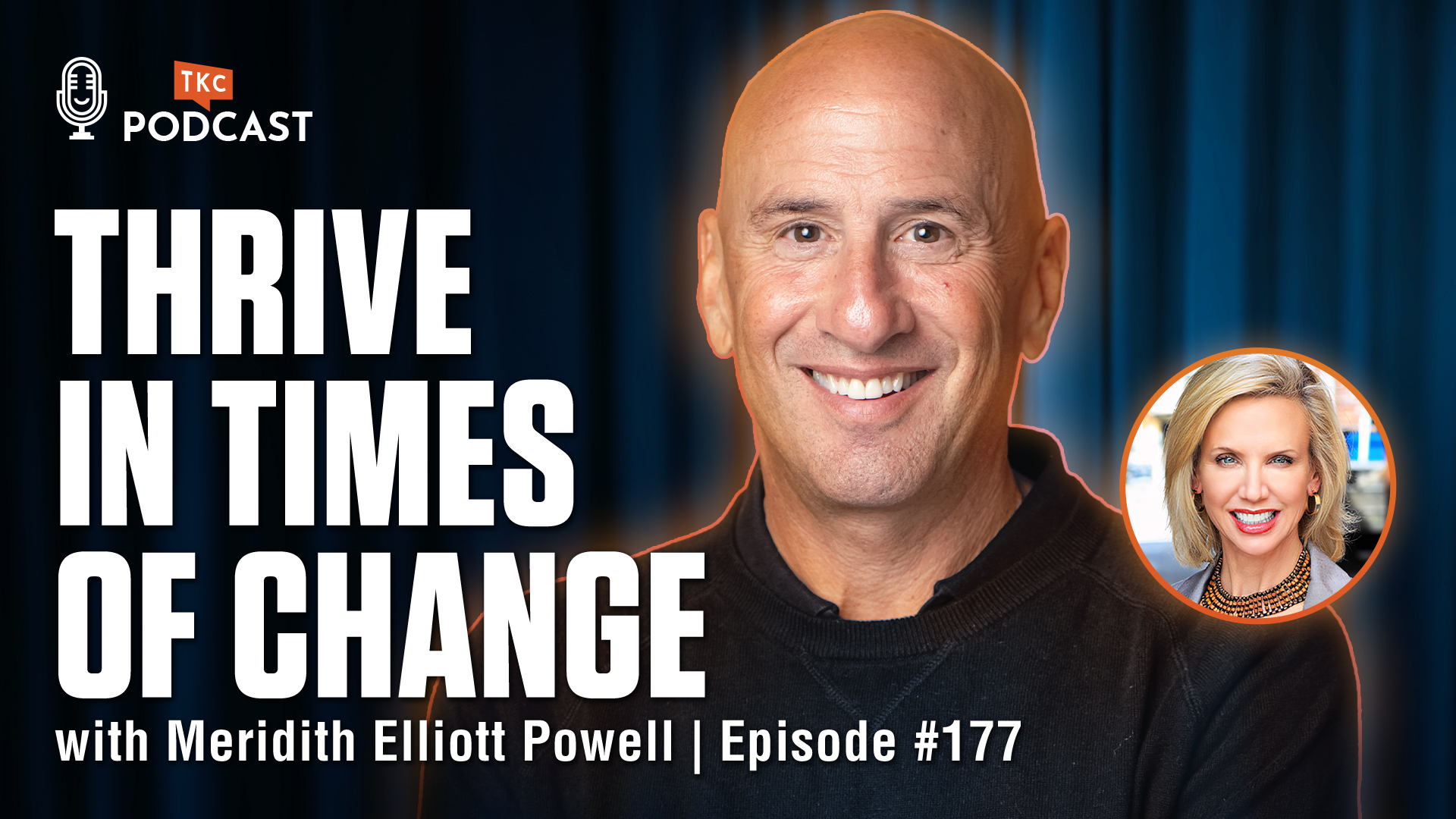
June 25, 2026Leadership strategies for uncertain times with Meridith Elliott Powell
Meridith Elliott Powell shares practical leadership strategies for turning uncertainty into competitive advantage, engaging teams, and building succession plans. (
There’s a particular kind of leadership failure that doesn’t announce itself loudly. It doesn’t arrive with a crisis memo or a sudden resignation. It builds quietly, in the accumulated weight of small decisions made by people in positions of leadership who are genuinely trying to do the right thing but are operating from a place of fear. They hold tighter. They centralize decisions. They stop asking questions and start issuing directives. And the more uncertain the environment becomes, the more they convince themselves that control is exactly what the moment demands. What they’re actually doing, in most cases, is accelerating the very disengagement they’re trying to prevent.
That tension sits at the heart of my recent conversation with Meridith Elliott Powell, one of the most original and grounded voices in leadership and business growth today. Meridith has spent decades working with executives, teams, and organizations across industries, helping them understand what effective leadership actually looks like when the environment is shifting beneath their feet. Her central argument is deceptively simple: uncertainty is not a problem to be eliminated. It is the permanent condition of modern business. The leaders who thrive are not the ones who manage uncertainty away. They are the ones who learn to lead inside it, with intelligence, courage, and a clear-eyed understanding of what their teams actually need.
What struck me most about this conversation was not just the quality of the ideas but how rooted they were in genuine experience. Meridith worked her way from entry-level to the C-suite. She has coached leaders through real disruptions, not theoretical ones. Her insights into business leadership carry the weight of someone who has been inside the room when things fell apart, and who helped people find their way forward anyway. That practical grounding is what makes her thinking so compelling and so usable.
🎧 Watch and listen to the podcast episode: YouTube • Spotify • Apple Podcasts • Amazon Music
The Control Trap That Quietly Destroys Teams
One of the most important observations Meridith shared is one I’ve seen play out in organizations of every size and sector: fear causes leaders to over-control, and over-control causes employees to disengage. It’s a cycle that feeds itself, and the insidious thing about it is that it often looks like good leadership from the outside. Meetings get more structured. Decisions get escalated. Communication becomes more frequent but less substantive. The leader is visibly in motion, and yet the team is quietly checking out.
The problem with this pattern is not just that it’s exhausting for everyone involved, which it absolutely is. The deeper problem is what it communicates about the fundamental nature of leadership. When a person in a leadership role responds to uncertainty by pulling authority back to themselves, they are telling their team something important: that judgment lives only at the top, that initiative is risky, and that the safest behavior is to wait for direction rather than take ownership. People hear that message clearly, whether it’s intended or not. And once they’ve internalized it, reversing it is far harder than preventing it in the first place.
What Meridith argues, and what I’ve come to believe is one of the most consequential ideas in leadership development, is that uncertainty actually demands the opposite response from what most leaders instinctively provide. Not less trust, but more. Not tighter control, but broader ownership.
The leaders who navigate change most effectively are the ones who have invested in their teams’ capacity to think and act independently, who create cultures where people don’t just follow direction but take genuine responsibility for outcomes. This distinction matters enormously in practice. A team that is managed through a crisis will survive it, assuming the manager makes good decisions. A team that is empowered through a crisis will learn from it, adapt faster, and emerge with capabilities they didn’t have before.
The real cost of over-control isn’t the decisions that get slowed down or the ideas that never get raised. It’s the leadership talent that never develops, because the people who had the potential to lead were never given the space to do so.
Action as the Real Antidote to Fear
One of the ideas from this conversation that stayed with me longest was Meridith’s framing of action as a genuine antidote to anxiety. This is not a motivational slogan. There is real psychological logic underneath it, and understanding that logic changes how leaders respond to the paralysis that uncertainty often creates in themselves and their teams.
When leaders or team members feel overwhelmed by uncertainty, the instinct is frequently to wait: to gather more information, to wait for clarity, to hold off on making decisions until the situation becomes more legible. This impulse is understandable, and it even feels responsible in the moment. But waiting, in most circumstances, is not neutral. It deepens anxiety, because it gives the mind more time to rehearse worst-case scenarios without any corresponding experience of movement or agency. The longer a person or a team sits in a posture of waiting, the more the uncertainty starts to feel definitive rather than temporary.
What Meridith emphasizes, and what I find to be one of the most grounding principles in contemporary leadership practice, is that movement, even imperfect movement, changes the psychological equation in fundamental ways. When you take action, you generate information you didn’t have before. You discover what works and what doesn’t. You shift from being a passive observer of circumstances to an active participant in shaping them. That shift matters beyond its practical outputs because it restores a sense of agency, and agency is what allows people to sustain their energy and judgment through prolonged uncertainty.
The implication for leadership is significant. One of the most powerful things a leader can do during periods of disruption is to model this orientation toward action. Not recklessness, not activity for its own sake, but a deliberate bias toward trying things and learning from them rather than waiting for certainty that may never arrive. Leaders who demonstrate this pattern give their teams permission to do the same. And teams that operate this way build resilience in real time, rather than trying to manufacture it after the fact.
The Art of Leading Through Questions
Something that came through clearly in my conversation with Meridith Elliott Powell was her emphasis on questions as a core leadership tool. This sounds simple until you sit with what it actually requires. The instinct, particularly during periods of uncertainty, is for people in leadership roles to show up with answers. To project confidence through certainty. To communicate, through posture and language, that they have a plan, a direction, a clear sense of what comes next. There’s real pressure on leaders to perform certainty even when they don’t feel it, because ambiguity at the top can feel contagious.
But what Meridith has found, and what the evidence from high-performing organizations consistently supports, is that the most powerful thing a leader can often do is ask a genuine question rather than provide a prepared answer. Not as a rhetorical device. Not as a management technique deployed from a distance. But as an authentic expression of curiosity and a genuine signal that the other person’s perspective matters.
When a leader asks a real question, several things happen simultaneously. They signal that intelligence and insight exist throughout the organization, not just at senior levels. They invite ownership and contribution from people who might otherwise stay quiet. And they create the conditions for better collective thinking, because people do their best reasoning when they feel genuinely respected rather than evaluated.
The practical implications of this approach to leadership extend well beyond the quality of individual conversations. Teams that are regularly engaged through thoughtful questions develop a fundamentally different relationship to problems than teams that are regularly handed solutions. They become more adaptive, more creative, and more genuinely invested in the outcomes they’re working toward. This is not soft. It is one of the most direct leadership strategies available for improving retention, accelerating innovation, and building teams that perform under pressure rather than collapse under it.
I’ve seen firsthand how much it changes the dynamic in a room when a senior leader asks a question and actually listens to the answer. It’s a seemingly small act, and yet it carries an enormous signal about what kind of leadership culture exists in that organization.
Reading the True Health of Your Team
One of the more nuanced moments in our conversation came when Meridith talked about how to actually read a team’s health and level of engagement. Most leaders, when they’re trying to assess their teams, focus on output metrics. Are the numbers good? Is the work getting done on time? Is the project on track? These are not unimportant questions. But Meridith makes a point that I think deserves to be taken seriously: output metrics are lagging indicators. By the time the numbers tell you something is wrong, the underlying problem has typically been building for a long time, and it’s considerably harder to address than it would have been earlier.
The earlier signals, the ones that reveal whether a team is genuinely engaged or simply going through the motions, tend to be behavioral rather than quantitative. Are people asking questions in meetings, or are they quiet? Are team members bringing problems forward proactively, or are they hoping issues resolve themselves before anyone notices? Is there energy and initiative in the work, or a kind of polite fatigue? Does the team argue productively about ideas, or do they simply agree with whoever holds the most authority in the room?
These patterns reveal something important: the degree to which people feel their contributions matter, and the degree to which leadership is actually creating space for them to bring their full capability to their work.
What I find most useful about this framing is that it shifts the focus of leadership assessment from results to conditions. Strong leadership creates the conditions for results to happen. Weak leadership focuses on results while neglecting or undermining the conditions that make those results possible. The best teams Meridith has encountered are teams where the leader has invested deeply in trust, clarity, and genuine connection, not as cultural niceties but as strategic priorities. The results, in those environments, are not accidental. They are the predictable output of conditions that were deliberately constructed.
What AI Cannot Replace in Leadership?
The conversation took a genuinely interesting turn when we moved into artificial intelligence and what it means for teams and leadership. This is a topic I find myself thinking about constantly, because the discourse around AI tends to polarize into either uncritical enthusiasm or existential anxiety, and neither of those postures is very useful for people trying to actually lead organizations through the transition. Meridith offered a perspective that cut through the noise in a way I appreciated.
Her position is not that AI is unimportant. Quite the opposite. She sees AI as a powerful and necessary tool, and she’s direct about the fact that leaders and teams who resist it will find themselves at a genuine competitive disadvantage. AI is capable of things that humans cannot do at the same scale or speed: pattern recognition, data processing, content generation, research synthesis. These are real capabilities, and any leadership team that doesn’t take them seriously is leaving significant value on the table. The question is not whether to engage with AI. The question is what to do with it, and more importantly, what it cannot do on your behalf.
What AI cannot do is take responsibility. It can generate an answer, but it cannot be accountable for the consequences of that answer in a specific human situation. It can model scenarios with impressive sophistication, but it cannot make a judgment call that accounts for the particular people in the room, their histories with each other, their anxieties, their aspirations, and the invisible relational dynamics that determine whether a decision will actually be accepted and implemented.
AI can produce content with technical competence, but it cannot develop the kind of leadership presence that allows a person to walk into a room of anxious, uncertain people and help them feel purposeful again. Sales leaders, communications professionals, executive teams navigating transformational change: all of them need AI as a tool, and all of them still require a human being at the center of the process, exercising judgment and bearing responsibility.
The more I think about it, the more I believe that AI is clarifying something that was always true but easy to overlook: the most valuable things in leadership were never the things that could be systematized. They were always the things that required a human being to be present, courageous, and wise.
The Skills That Set Elite Leaders Apart
This leads naturally to one of the more provocative ideas in the conversation: that AI’s rise is making certain specifically human capabilities more valuable, not less. The conventional wisdom in many organizations is that technical proficiency and domain expertise are the primary differentiators between good and excellent performers. Meridith challenges this framing, and I think she’s right to do so in a way that has real implications for how organizations invest in their people.
In a world where AI can perform an increasing range of technical tasks with impressive competence, what becomes genuinely scarce is the distinctly human capacity for leadership: the ability to build trust across relationships, to navigate ambiguity with confidence rather than paralysis, to communicate a vision in language that actually moves people to act, to exercise sound judgment in situations where the right answer is genuinely unclear and the stakes are real.
These are not soft skills in any dismissive sense of the term. These are the hardest and rarest skills in any organization, the ones that take years of deliberate experience to develop and that cannot be shortcut by any technology currently available or likely to emerge in the near future.
What’s particularly striking to me is that these are also the skills most consistently underdeveloped in organizations. Companies invest heavily in technical training, process improvement, and compliance frameworks. They invest far less in helping people develop the kind of genuine leadership capability that will actually determine their organizational performance when conditions become difficult. Meridith’s work in elite performance is focused precisely on this gap: helping individuals and organizations understand what it actually takes to develop leadership that cannot be automated, replicated, or purchased. As a leadership keynote speaker, Meridith Elliott Powell brings this argument to life with specificity and urgency that I’ve rarely encountered.
The Succession Problem Nobody Is Talking About
Perhaps the most underappreciated section of our entire conversation was the one about succession planning. Meridith has co-authored a book on this subject with Dr. Mary Kelly, and the depth of her thinking on it shows. Most organizations, to the extent they think about succession planning at all, treat it as essentially an HR exercise: a process for identifying who might step into key roles if someone unexpectedly leaves, retires, or is promoted. That framing, Meridith argues, is both too narrow and genuinely dangerous, because it misses the strategic significance of what succession planning is actually for.
The deeper purpose of meaningful succession planning is to answer a question with enormous strategic implications: Is this organization actively developing the leadership capacity it will need to function in the future? Not just maintaining current leadership capabilities, but building the bench. Creating a culture in which leadership development is ongoing at every level, where people throughout the organization are being deliberately prepared for greater responsibility, and where the organization’s performance doesn’t become fatally dependent on any single individual or small group of people.
I’ve seen the cost of neglecting this work, and it’s significant. Organizations that haven’t invested in their leadership pipeline are remarkably fragile in ways that aren’t visible until they’re suddenly obvious. When a key person exits, when a market shift demands new kinds of leadership thinking, when growth creates roles that the existing team isn’t equipped to fill, the absence of a real bench becomes a business survival question rather than a staffing inconvenience. What seemed like a personnel matter turns out to be a fundamental test of whether the organization actually invested in its own future.
What Meridith makes clear is that succession planning, done with genuine commitment, is one of the highest-return leadership investments an organization can make. It is not a project that gets initiated when someone announces they’re leaving. It is a continuous practice of developing people, creating stretch opportunities, having honest conversations about potential and readiness, and building the kind of organizational depth that creates real resilience. The companies that do this consistently tend to be the ones that don’t just survive disruption. They use it to distance themselves from competitors who were caught unprepared.
Uncertainty Is Not the Enemy
There’s a reframe embedded in Meridith’s entire body of work that I want to name explicitly, because I think it’s the most important thing to carry from this conversation. Most organizations experience uncertainty as something to be minimized, defended against, or weathered until conditions improve. The implicit assumption running through a great deal of conventional leadership practice is that uncertainty is a cost, something that makes everything harder and that good strategy and strong management should eventually reduce. Meridith inverts this assumption entirely.
Her argument, developed across her books, her podcasts, and her inspirational and motivational keynote work, is that uncertainty, handled with skill and intention, is a source of competitive advantage rather than a liability. When markets shift, when conditions change faster than old playbooks can accommodate, when the rules everyone has been playing by stop working, the organizations that have built leadership cultures of genuine adaptability don’t just maintain their position. They advance. Because while their competitors are freezing in over-control or waiting for clarity that never arrives, they are moving, experimenting, and learning faster. And in turbulent environments, the speed at which an organization learns from experience is one of the most decisive competitive advantages that exists.
This framing has real implications for how leaders understand their own role. If uncertainty is not the enemy but the terrain, then leadership is not about eliminating uncertainty or performing certainty you don’t feel. It’s about building the personal and organizational capacity to move through uncertainty with intelligence, humility, and a genuine commitment to developing the people around you. That requires a fundamentally different set of priorities: less emphasis on control and predictability, more emphasis on trust, adaptability, and the ongoing development of leadership capability at every level of the organization. Less performance of authority. More conditions where others can actually lead.
What This Moment Is Really Asking of Leaders

What I keep returning to, in the time since this conversation, is a statement Meridith made that deserves to sit with people in leadership for a long time. “People may not be able to control the situation. But they can always contribute to the solution.” That distinction between controlling and contributing feels like the essential leadership insight for this particular moment, in this particular environment, where the pace of change has outrun most organizations’ ability to manage it in the traditional sense.
The instinct to control is understandable. It comes from a genuine place: caring about outcomes, feeling responsible for people, wanting to make sure nothing goes wrong on your watch. And leadership culture has historically rewarded those who project certainty and command, who appear to have all the answers and all the authority centralized in themselves.
But the reality most leaders are operating in today is that certainty is scarce, the pace of change is faster than any individual can track, and control is largely an illusion that comes at a high cost to the people being controlled. What isn’t scarce, and what great leadership consistently creates more of, is contribution: the felt sense, on the part of every person on a team, that their thinking matters, their initiative is valued, and they are genuinely part of something they have a real stake in shaping.
Meridith Elliott Powell is one of the most clear-eyed and practical thinkers in the leadership space, and this conversation reminded me exactly why that matters. The ideas she brings to her work aren’t theoretical frameworks polished for conference stages. They are strategies forged in genuine experience, offered with a directness that actually changes how people lead, not just how they think.
Whether the conversation is about women leaders finding their path through organizations that weren’t designed for them, or about any leader navigating a market that won’t slow down, the core of her message remains consistent: the goal is not to manage uncertainty into submission. The goal is to build the kind of leadership, in yourself and in the people around you, that makes uncertainty the condition in which you do your best work.
That’s what success looks like in the environment most organizations are actually operating in. Not the absence of disruption, but the presence of leadership that has genuinely learned how to thrive inside it.
🎤 Explore Meridith Elliott Powell’s full keynote speaker profile and discover how she helps organizations turn uncertainty into competitive advantage.
📞 If your audience needs a message on leadership, navigating change, building stronger teams, or embracing AI without losing the human element, schedule a call here and let’s talk.
📩 Send your audience details and event theme to info@thekeynotecurators.com and I’ll let you know if she’s the right fit.
Discover More Insights





Get in TouchContact US
Fill out the form so we can best understand your needs.
A representative from The Keynote Curators will reach out to you.
Our Services
Keynote Speakers Topics
© 2026 The Keynote Curators. All Rights Reserved | Terms and Conditions
The Keynote Curators, 8275 South Eastern Avenue, Suite 200, Las Vegas, NV 89123
Local (310) 299-4595 | Toll Free (888) 585-8715 | info@thekeynotecurators.com
The Keynote Curators - Top Keynote Agency, USA.