
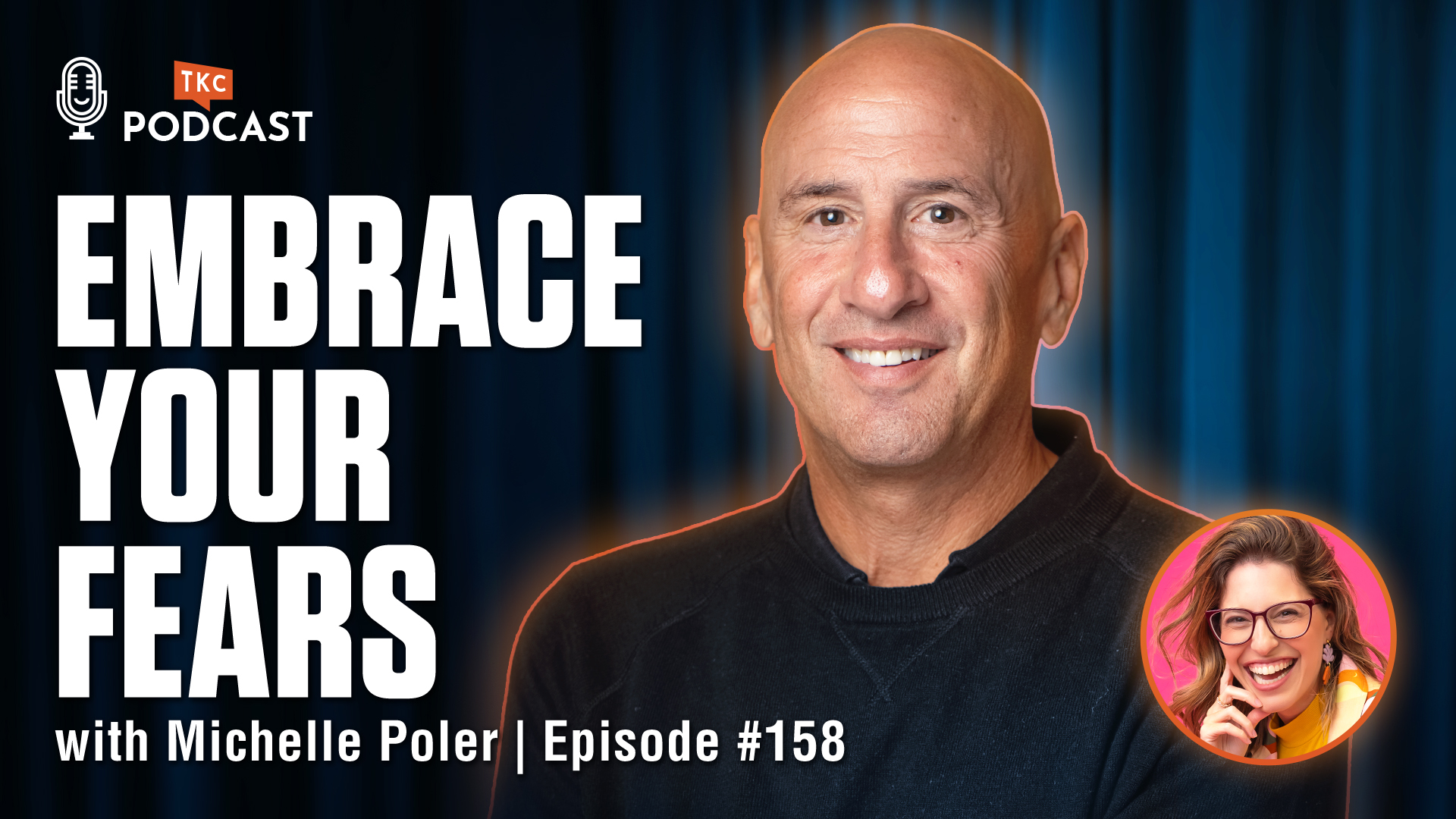
March 5, 2026Fear Is Your GPS, and Michelle Poler Shows You How to Follow It
Keynote speaker Michelle Poler shares how to navigate fear, take brave action, and build authentic brands in this episode of The Keynote Curators Podcast
What if fear wasn’t a stop sign but a signal pointing you exactly where you need to go?
That’s the reframe that sits at the center of everything Michelle Poler does — and once you hear it, it’s very hard to unsee. I sat down with Michelle, founder of Hello Fears and one of the most compelling voices working at the intersection of branding and personal growth, to talk about what actually holds people back. Not spiders. Not public speaking. The fear that operates quietly, shaping careers and decisions and relationships while nobody talks about it.
By the end of this post, you’ll understand the difference between fear and intuition, why “be brave” is the worst advice anyone can give you, and how to use a dead-simple three-column exercise to start moving again — even when you feel completely stuck.
🎧 Watch and listen to the podcast episode: YouTube • Spotify • Apple Podcasts • Amazon Music
Fear as a Keynote Speaker’s Starting Point — Why Michelle Poler Chose This Topic
There’s a reason Michelle didn’t build her platform around productivity, or hustle, or leadership. She built it around fear — because fear is the thing underneath all of it. Every bad decision, every missed opportunity, every time someone stays in a job they hate or a relationship that’s run its course — there’s almost always a fear at the root.
Michelle’s entry point into this conversation was deeply personal. She created the 100 Days Without Fear project while completing her master’s degree in Branding at the School of Visual Arts in New York City. One hundred fears, one hundred days, documented and shared publicly. What started as a thesis project became a global movement. Hello Fears has now reached over 70 million people worldwide, which tells you something about how universal this conversation really is.
What Michelle makes clear — and what I find genuinely useful every time I hear her say it — is that fear isn’t a personality flaw. It’s information. The question is whether you know how to read it.
The Fear Nobody Admits to Having
Most people, when asked about their fears, go to the obvious ones. Heights. Spiders. Flying. These are real fears, but they’re not the ones quietly steering your life. The fears that actually shape your decisions are harder to name because they’re tied to identity and belonging.
Michelle talks about this with a clarity that stops people mid-sentence. The fear of not belonging. The fear of not being enough. The fear of what people will think if you try something and fail publicly. These are the fears that make someone stay silent in a meeting when they have something valuable to say. These are the fears that keep a founder from pitching their best idea, or a leader from having the honest conversation their team actually needs.
“We are not afraid of spiders or heights as much as we are afraid of not belonging, not being enough, and not being loved,” Michelle says. And when you hear that out loud, you realize how much of your own behavior it explains.
This is part of what makes her work as a motivational keynote speaker land so hard. She’s not talking about abstract courage. She’s talking about the specific social fears that live inside professional environments — the ones that make organizations less innovative, less honest, and ultimately less effective.
The Fearless / Brave / Fearful Map That Changes Everything
One of the most actionable tools Michelle shares is a three-column exercise that I’ve seen resonate with everyone from senior executives to recent graduates. You draw three columns: Fearful, Brave, and Fearless. Then you populate them honestly.
Fearful is where you put the things you want to do but haven’t started. The business idea. The difficult conversation. The creative project that feels too exposed to share. Brave is where you put the things you’ve attempted — where you showed up despite the discomfort. Fearless is where you put the things that no longer carry any charge. The presentations that used to terrify you. The client calls that felt impossible until they didn’t.
The insight here is in what moves between columns over time. Something that sits in Fearful today can, with deliberate action, become Brave — and eventually become Fearless. The map makes that progression visible. It also shows you what you’ve already overcome, which matters more than most people realize. We’re wired to discount our own growth because we only feel the distance between where we are and where we want to be, not the distance we’ve already traveled.
Michelle’s work in innovation and change is built around exactly this kind of structured reflection — tools that turn vague anxiety into something you can actually look at, evaluate, and act on.
Bravery Starts with an Honest Question
Here’s the thing about bravery that nobody in the personal development space wants to say: not every fear is worth pushing through. Some fears are pointing you toward something genuine. Others are just the background noise of social conditioning — you want it because it looks good, not because it’s actually yours.
Before you take any brave action, Michelle says you need to ask one honest question: Do I actually want this, or does it just look good?
This distinction matters enormously, especially in professional contexts. So much of what people grind themselves down to achieve is driven by external validation — the title, the recognition, the version of success that photographs well. When you chase that kind of goal through fear, you end up exhausted and still unsatisfied because you were never actually after the thing itself. You were after the feeling of being seen.
As a TED speaker who has shared stages with some of the most influential thinkers in the world, Michelle brings a level of self-awareness to this topic that goes well beyond motivation. She’s not telling you to feel the fear and do it anyway. She’s telling you to understand the fear first — because that understanding is what makes the action meaningful.
The Difference Between Fear and Intuition (And Why It Matters)
One of the most nuanced parts of Michelle’s framework is her approach to the fear-versus-intuition problem. This comes up constantly, especially with high-achieving people who’ve learned to trust their gut. The trouble is, if your gut has been marinating in anxiety for twenty years, it’s hard to know whether you’re picking up on a real signal or just running worst-case scenarios on a loop.
Michelle’s distinction is straightforward but important: intuition tends to be quiet and clear. Fear tends to be loud and catastrophizing. When you imagine all the things that could go wrong and feel a kind of paralysis, that’s almost always fear. When you get a clean, low-volume sense that something isn’t right — not spiraling, just noticing — that’s closer to intuition.
The practical exercise she recommends is one I’ve started using myself. When you’re facing a decision and you feel that familiar dread, don’t just list everything that could go wrong. List five things that could go right. Force your brain to generate the upside with the same energy it naturally gives to the downside. This isn’t toxic positivity. It’s cognitive retraining — teaching yourself to see opportunity with the same clarity you’ve always reserved for danger.
This kind of reframe is exactly what strong communication and strategy work demands. The leaders and teams who perform best under uncertainty aren’t fearless — they’re just better at processing fear without letting it make decisions for them.
Brave Brands Are Built the Same Way Brave People Are Built
At some point in our conversation, Michelle made a turn I wasn’t expecting — from personal fear to brand fear — and it was one of the most clarifying things I’ve heard on the subject of what makes a brand actually work.
Most brands are afraid. They’re afraid to take a clear position, to say something that not everyone will agree with, to be specific enough that some people feel excluded. So they smooth everything out. They use language that means nothing. They design identities that could belong to anyone. And then they wonder why nobody feels anything about them.
Michelle connects this directly to her work in entrepreneurship and brand strategy. The same courage it takes to step into the Brave column on your personal map is the courage it takes to build a brand that stands for something specific and lives it consistently. Before she became a full-time speaker and author, Michelle worked as an Art Director for brands like Hershey’s, Wendy’s, AT&T, and Revlon — so this isn’t abstract philosophy. She’s seen from the inside what it looks like when a brand operates from clarity versus fear.
“Brave brands don’t just list their values on a slide — people feel those values the second they walk into the room,” she says. That line has stayed with me. It’s a useful test for any organization: if you replaced your values slide with the actual experience of being inside your company, would anyone notice the difference?
Creating Community That Actually Feels Like Community
This same principle extends to events, which is something I think about constantly in the work I do. Michelle talks about the gap between organizations that say community is one of their values and organizations that actually build environments where people feel like they belong.
The difference is almost never budget. It’s almost never production quality. It’s intentionality at the level of detail. When you walk into a room where community is a real value — not a stated one — you feel it before anyone says a word. The way people are greeted. The way the space is configured. The way conversation is facilitated. These are design choices, and they either reflect your values or they expose the gap between what you say and what you actually prioritize.
For anyone working in corporate culture or event design, this is the conversation worth having before the venue is booked or the agenda is finalized. What do you want people to feel? And what specific choices — not general intentions — are going to create that feeling?
Michelle’s work as a bestselling author extends this thinking into her books, Hello, Fears: Crush Your Comfort Zone and Become Who You’re Meant to Be and The Hello, Fears Challenge: A 100-Day Journal for Self-Discovery, both of which have been translated into seven languages and distributed across four continents. The books work because they’re built around action, not inspiration — the same way her keynotes work.
Tiny Brave Actions Are the Only Actions That Compound
One of the most honest things Michelle says is that there are no shortcuts here. Courage isn’t a switch you flip. It’s a practice you build, incrementally, through what she calls tiny brave actions. Not leaps. Not dramatic gestures. Small, consistent choices to do the thing that’s slightly outside your comfort zone — made deliberately, and made often.
This matters for how you frame growth inside organizations. When leaders tell people to “be bold” or “take risks” without building the conditions where small brave actions are actually recognized and rewarded, they’re asking for something they haven’t created the conditions to receive. The culture has to change first — or simultaneously — or the asks are just pressure dressed up as encouragement.
As a storytelling practitioner, Michelle understands that the stories we tell about bravery also shape what we think it looks like. When bravery only shows up in dramatic moments — the big pivot, the public speech, the career change — people stop recognizing the bravery in their daily decisions. And those daily decisions are where character actually gets built.

What Keeps Keynote Speaking Evolving
I always ask speakers how their work has changed over time, and Michelle’s answer was more honest than most. The topics audiences need have shifted. The conversations around belonging and authenticity and fear have become more urgent, not less — and she’s seen that urgency reflected in the rooms she speaks to. Whether it’s a Fortune 500 team navigating a major transition or a group of young professionals figuring out who they want to become, the core question is always the same: what would I do if I wasn’t afraid of getting it wrong?
Her work has been featured on The TODAY Show, in Forbes, on CBS, CNN, Buzzfeed, Mashable, and the Huffington Post. She’s spoken at Google, Netflix, Microsoft, Meta, ESPN, P&G, and The Global Leadership Summit — the kind of range that tells you her message cuts across industries because the underlying human experience she’s speaking to is universal.
That universality is exactly why fear as a topic works on any stage, for any audience. It’s the one thing every person in the room has in common — and it’s the one thing nobody came prepared to talk about honestly.
You can explore her full background and speaker profile, along with more business keynote speakers across every major topic, at The Keynote Curators.
🎤 Check out Michelle Poler’s full keynote speaker profile and see if she’s the right fit for your stage
📩 Want to bring Michelle to your next event? Schedule a 15-minute conversation and let’s talk about your audience and what you need — or email me directly at info@thekeynotecurators.com and tell me your theme
Discover More Insights





Get in TouchContact US
Fill out the form so we can best understand your needs.
A representative from The Keynote Curators will reach out to you.
Our Services
Keynote Speakers Topics
© 2026 The Keynote Curators. All Rights Reserved | Terms and Conditions
The Keynote Curators, 8275 South Eastern Avenue, Suite 200, Las Vegas, NV 89123
Local (310) 299-4595 | Toll Free (888) 585-8715 | info@thekeynotecurators.com
The Keynote Curators - Top Keynote Agency, USA.