
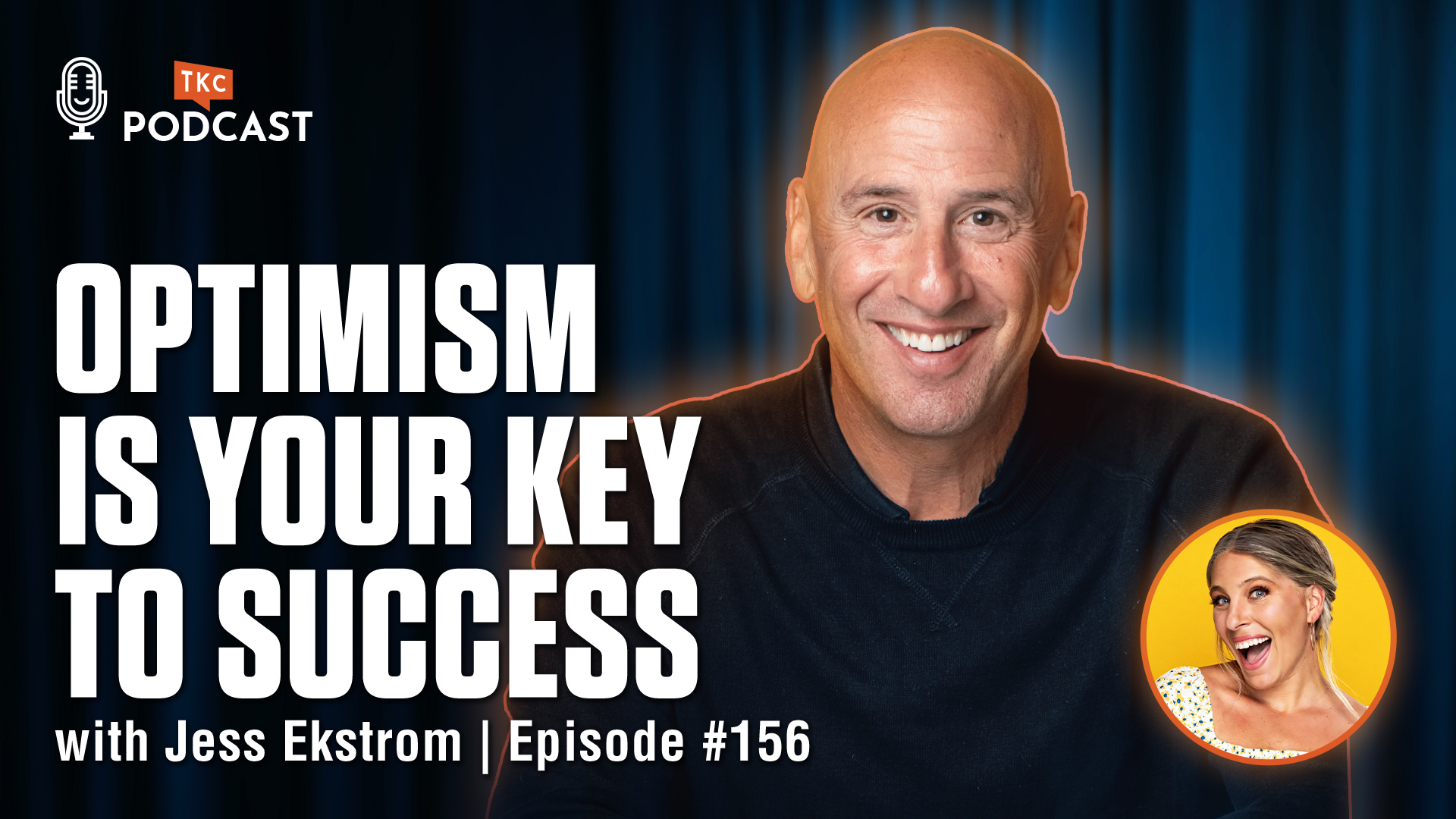
February 19, 2026Optimism as a Strategy to Turn Setbacks into Triumphs, with Jess Ekstrom
Keynote speaker Jess Ekstrom reframes optimism as a strategy for resilience, success, and making it without burning out.
What if the burnout you’re fighting isn’t a sign that something’s wrong with you — but a sign that you’ve been chasing the right goals the wrong way? That’s the reframe optimism keynote speaker Jess Ekstrom brings to every stage she walks onto, and it’s the kind of thinking that stops audiences mid-breath.
Most conversations about resilience and positivity treat struggle as something to overcome and leave behind as quickly as possible. Jess does the opposite. She sits in it, mines it, and turns it into the raw material for something worth building.
If you’ve ever asked yourself how to maintain optimism and keep going without losing yourself in the process, this conversation was made for you.
🎤 Watch and listen to the podcast episode: YouTube • Spotify • Apple Podcasts • Amazon Music
Optimism Is Not What Most People Think It Is
The word optimism gets flattened. It gets turned into a bumper sticker, a motivational poster, a directive to smile through things that genuinely hurt. And then people burn out trying to sustain a performance of positivity they never actually feel — and blame themselves for it.
Jess built her entire philosophy around rejecting that version of optimism. Her framework is rooted in three words she lives by: inspiration from frustration. The idea is not to paper over difficulty with manufactured cheerfulness. It’s to sit with the frustration long enough to understand what it’s telling you, and then use that signal as fuel to solve a real problem.
This is how Headbands of Hope was born. In 2012, Jess took a $300 grant and launched a company that donates headbands to kids going through illness. The frustration she felt when she encountered that gap — children in hospitals without something as small and dignity-affirming as a headband — became the exact energy that drove her to act. That company has since donated millions of headbands across the world, become the official headband provider for the NBA and WNBA, and landed in every Kohl’s location nationwide. None of that happened because Jess felt relentlessly positive. It happened because she felt frustrated enough to move.
That distinction matters enormously for anyone who leads people, builds teams, or stands in front of an audience trying to spark change. Inspirational and motivational content that bypasses the hard stuff doesn’t stick. What sticks is the honest account of what it actually felt like — and what you did with it.
The Messy Middle Nobody Posts About
There’s a version of success that looks clean in retrospect. The hardship was temporary, the pivot was smart, and the outcome validated the struggle. That version gets shared constantly, and it creates a distorted picture of what building something actually looks like.
Jess has lived a complicated version of that story. She’s navigated fraud. She’s been through court dates. She’s experienced the particular weight of failing in ways that involve other people’s trust and other people’s money — including a family loan she lost before finding her footing again. And rather than keeping those chapters out of her public narrative, she chose optimism, and now leads with them.
The reason is strategic as much as it is personal. Audiences are done with highlight reels. They have access to too many polished success stories, too many curated journeys that conveniently skip the part where everything was genuinely falling apart. When a speaker shows up and tells the truth about the messy middle — not to perform vulnerability, but because the truth is actually more useful than the cleaned-up version — something shifts in the room. People lean in. They recognize themselves. And the message lands somewhere real.
This is what great storytelling on a keynote stage actually does. It doesn’t reassure people that struggle is temporary. It demonstrates, through lived experience, that struggle is workable — that you can move through it without losing what matters most.
What “Making It” Actually Means
Jess’s new book, Making It Without Losing It, asks a question that sounds deceptively simple: what does making it mean to you, and who is it actually for?
That question cuts through a lot of noise. So much ambition is inherited — absorbed from culture, from parents, from industry benchmarks that have nothing to do with what you actually want your life to feel like. And the cost of chasing someone else’s version of success is high. Not just in terms of burnout, but in terms of the quiet erosion of clarity about why you started in the first place.
Jess structures this around a few questions she returns to regularly: What am I chasing? Who is it for? What is enough — for me and my team, right now? These aren’t abstract philosophical questions. They’re operational ones. They change how you make decisions, how you structure your days, how you evaluate whether a given opportunity is worth the energy it requires.
For anyone working in personal development or leading organizations through growth and change, this framework is immediately applicable. The tension between ambition and contentment is one of the most common and least-discussed challenges in high-performing environments. Jess names it plainly and gives people language to work with it — which is exactly what professional development content should do.
Optimism is About Reframing Problems as Proof You’re in the Game
One of the most practically useful ideas in this conversation is a mindset shift Jess describes around the constant friction of building something. The emails that don’t stop. The hard conversations that don’t resolve cleanly. The problems that compound before they clear. Most people experience this as evidence that something is wrong — that they’re behind, or failing, or not cut out for this.
Jess flips it. If you’re getting the hard emails, the difficult calls, the problems that require real judgment — you’re in the game. That friction isn’t proof of failure. It’s proof of participation at a level that matters. The people who never get those calls aren’t being spared. They’re just playing at a lower level.
This optimism reframe doesn’t eliminate the difficulty. But it changes the meaning you assign to it. And meaning, it turns out, is what determines whether you keep going. It’s the difference between experiencing a hard stretch as something that’s happening to you and experiencing it as something you’re actively moving through. That shift — from passive to active, from victim to player — is at the core of what Jess means when she talks about resilience as a practice rather than a trait.
This is also where her sports metaphors become genuinely clarifying. Playing to win and playing not to lose look identical from the outside but feel entirely different from the inside — and they produce different results over time. Playing not to lose is defensive, risk-averse, and exhausting. Playing to win requires accepting that loss is possible and choosing to compete anyway. That acceptance is what optimism, in Jess’s framework, actually looks like.
The 1% More Principle and Why Small Phrases Change Everything
One of the ideas that surfaces in this conversation about optimism, and tends to stay with people long after they hear it, is what Jess calls the 1% more principle. The premise is straightforward: you don’t have to transform everything at once. You just have to do one percent more than you did before. One percent more patience in a hard conversation. One percent more honesty in a difficult meeting. One percent more presence with the people in front of you.
What makes this powerful in a live event context is its durability. Big dramatic keynote moments can be inspiring in the room and largely forgotten two weeks later. But a small phrase — a simple, repeatable idea that someone can apply to a specific situation on a Tuesday morning three months from now — that’s where real behavior change lives.
This is one of the reasons Jess consistently gets brought back. Her content doesn’t just perform well in the moment. It leaves behind something portable and usable. And in a world where event ROI is increasingly scrutinized, the success of a speaker is measured less by the applause they receive and more by the change they catalyze after they’ve left the building.
For women leaders especially, this kind of thinking resonates deeply. There’s often enormous pressure to transform completely, to reinvent, to make dramatic pivots. Jess offers a quieter alternative: consistent, directional movement, one percent at a time, over a long period. That’s not a lesser version of ambition. That’s the version that actually sustains.
Why In-Person Events Still Matter in an AI World
There’s a question underneath a lot of event planning conversations right now: Does any of this still matter? In a world where content is infinite, where AI can generate on-demand and connections can happen asynchronously, what does a live event actually offer that a recording can’t?
Jess’s answer is simple and difficult to argue with: human presence changes people in ways that recorded content doesn’t. There’s something that happens when you’re in a room with two thousand other people all hearing the same thing at the same time. The collective experience is part of the content. The laughter, the silence, the moment when someone says something that makes an entire room exhale — those are not things that translate to a replay.
This matters for event professionals thinking about innovation in how they design experiences. The argument for in-person events isn’t nostalgia. It’s neuroscience. Shared emotional experience creates memory in a way that solo consumption doesn’t. When a speaker gives an audience a phrase, a reframe, or a story that they experienced together — in that room, on that day — it becomes part of a shared language. And shared language is one of the most powerful tools for corporate culture change.
Jess has built her speaking career around understanding this. Her work with Mic Drop Workshop — the company she founded in 2018 to help more women find their voice as public speakers and authors — is grounded in the same belief: that when more people tell their real stories, in real rooms, to real audiences, things change. Not abstractly. Actually.
What Event Professionals Should Look for in a Speaker Like Jess
If you’re programming content around optimism, resilience, or Women’s History Month, the temptation is to look for the most credentialed, most decorated voice in the space. Jess has those credentials — Forbes Top Rated Speaker, featured on the TODAY Show and Good Morning America, recognized by Arianna Huffington as one of 99 Female Disruptors, tapped by LinkedIn Learning and TED Education to host courses on public speaking. But credentials are, as a previous conversation on this podcast noted, the price of admission.
What makes Jess genuinely valuable as a optimism keynote speaker is the alignment between who she is and what she teaches. She doesn’t speak about entrepreneurship from a distance — she’s built two successful companies, navigated real failure, and rebuilt from it. She doesn’t speak about optimism as a concept — she lives it as a daily operating system. That alignment is what audiences feel, and it’s what makes the message land somewhere deeper than the front of the brain.
Her humor helps, too. Jess brings a lightness to hard material that makes it accessible without making it trivial. She can hold the weight of real adversity and make a room laugh in the same breath — and that’s a rare skill. It’s what thought leadership at its best looks like: ideas delivered with enough warmth and wit that people actually want to sit with them.
For event professionals programming a mainstage, a leadership summit, or a culture-building session, Jess Ekstrom is the kind of speaker who makes your event better — not just the slot she fills, but the entire experience she amplifies.
📣 Watch the full interview with Jess Ekstrom on optimism, resilience, and making it without losing it.
If you’re building an agenda around optimism, resilience, or Women’s History Month content, we’d love to help you find the right voice for your room, explore speakers by topic and audience.
You can also schedule a 15-minute strategy call to talk through your specific event goals — or reach out directly at info@thekeynotecurators.com.
Discover More Insights







Get in TouchContact US
Fill out the form so we can best understand your needs.
A representative from The Keynote Curators will reach out to you.
Our Services
Keynote Speakers Topics
© 2026 The Keynote Curators. All Rights Reserved | Terms and Conditions
The Keynote Curators, 8275 South Eastern Avenue, Suite 200, Las Vegas, NV 89123
Local (310) 299-4595 | Toll Free (888) 585-8715 | info@thekeynotecurators.com
The Keynote Curators - Top Keynote Agency, USA.