
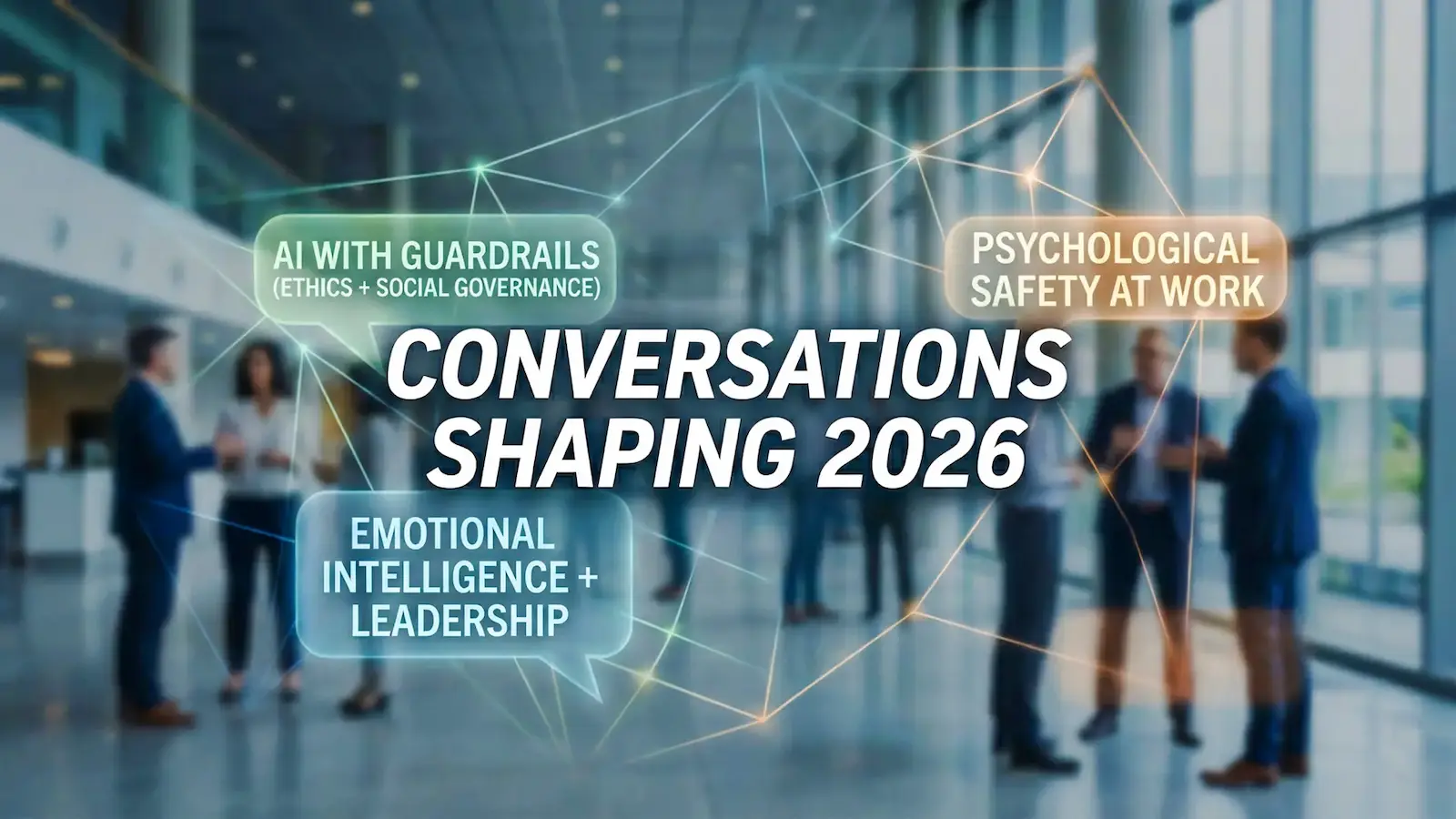
January 6, 2026The Top 3 Keynote Speaker Trends That Will Define Your Events in 2026
2026 event planning starts now: discover the keynote speakers and themes that transform audiences through AI ethics, psychological safety, and leadership.
Why Your 2026 Event Strategy Starts Before January
January doesn’t start the year. It just names it. The real work of planning 2026 happens much earlier—during those late-night agenda reviews, speakers hold negotiations, and budget reconciliations. More importantly, it surfaces during the quiet moments when you’re wrestling with the question that matters most: What does this audience need to feel, think, and do differently when they leave?
If you’re mapping your 2026 event calendar right now, you’re not alone. Event planners and meeting professionals across industries are asking the same question, and the answer isn’t found in chasing the latest buzzword. Instead, it’s about identifying the conversations that keep appearing in real briefs with real stakes—the themes that consistently move audiences from passive listening to active transformation.
I’ve been tracking three specific conversations that aren’t just interesting on paper; they’re proving actionable in practice. These aren’t predictions about what might trend in 2026. These are filters you can use right now to separate meaningful content from noise, and to identify the keynote speakers who can genuinely shift how your audience thinks and operates.
AI Implementation Beyond the Hype: Ethics and Accountability Take Center Stage

The conversation around artificial intelligence has evolved dramatically. We’re no longer asking if AI is coming—it’s already here. Consequently, the more pressing question for 2026 events is: What are we responsible for now that it’s integrated into our daily operations?
Many organizations are adopting AI tools at a pace that outstrips their policy development. They’re implementing technology faster than they’re building the cultural frameworks to support it. This creates a dangerous gap where teams have powerful tools but lack the trust structures, ethical guidelines, and accountability measures to use them responsibly.
This is where the right speaker makes all the difference. You need voices that can translate AI complexity into practical frameworks your audience can implement immediately—not next quarter, but the next morning.
Ramy Nassar, an AI keynote speaker, excels at demystifying artificial intelligence for leaders who need to move beyond “we should use AI” conversations. Ramy helps teams understand how to actually think with AI rather than simply deploying it. His approach doesn’t ask leaders to outsource their judgment, values, or accountability to algorithms. Instead, he provides a practical framework for integrating AI as a collaborator while maintaining human oversight on the decisions that matter most.
What makes Ramy particularly effective for 2026 audiences is his ability to strip away the mythology that often surrounds AI discussions. He translates technical complexity into decisions that business leadership teams can understand and execute. Furthermore, his content addresses the governance gaps that many organizations are just beginning to recognize—those spaces between tool adoption and responsible use that can create significant risk if left unaddressed.
On the other hand, Sarah Baldeo, an AI keynote speaker, approaches the artificial intelligence conversation through a completely different lens: the human nervous system. While many speakers focus on the technology itself, Sarah centers her work on the cognitive and emotional challenges of operating inside constant technological change.
Her message resonates particularly well with audiences experiencing cognitive overload and decision fatigue. Sarah frames “future-proofing” not as a matter of adopting the latest tools, but as developing mental agility—a brain skillset that allows professionals to adapt without burning out. For 2026 events where your audience is already overwhelmed by the pace of transformation, Sarah’s work provides practical strategies for staying mentally resilient while navigating continuous technological evolution.
The real challenge isn’t learning AI anymore. It’s maintaining the mental bandwidth to make good decisions about AI while managing everything else on your plate. That’s the conversation Sarah addresses, and it’s becoming increasingly critical as we move through 2026.
Creating Workplaces Where Truth-Telling Becomes Possible

Many organizations label their challenges as “engagement problems” when they’re actually dealing with something much more fundamental: truth-telling problems. Teams don’t need another motivational pep talk in 2026. They need conditions where people can raise the real issue before it becomes an expensive problem.
Psychological safety has moved from an academic concept to a business imperative, yet most cultures still treat authentic connection as something that happens accidentally rather than by design. This creates workplaces where people are physically together but emotionally disconnected—where they show up but don’t speak up, collaborate on projects but don’t trust each other with the truth.
Shasta Nelson, a psychological safety keynote speaker, brings much-needed structure and language to workplace connection. She doesn’t discuss belonging as a vague slogan or feel-good concept. Instead, Shasta breaks down the specific behaviors that create trust, the relational habits that reduce isolation, and the reason healthy workplace friendships aren’t organizational fluff—they’re infrastructure.
Her work is particularly powerful for audiences who are burned out, disconnected, or experiencing what I call the “together but not connected” phenomenon. These are teams that sit in the same meetings, work on the same projects, and occupy the same spaces, but lack the genuine connection that makes collaboration feel natural rather than forced. Shasta provides the framework for building that connection intentionally, which is exactly what 2026 workplaces need as hybrid models become permanent and generational diversity increases.
Similarly, Adam “Smiley” Poswolsky, a psychological safety keynote speaker, offers a practical toolkit for building trust and belonging across the fault lines that divide modern workplaces. Whether your audience is navigating generational differences, hybrid work arrangements, or constant organizational change, Smiley provides actionable strategies rather than abstract ideals.
What distinguishes Smiley’s approach is his realistic view of leadership. He’s not asking leaders to be perfect or to transform themselves into someone they’re not. Rather, he’s asking them to be intentional about the culture signals they send—the small moments and decisions that determine whether people speak up or stay quiet. His content addresses the practical reality that psychological safety isn’t built through grand gestures or policy announcements. It’s built through consistent, daily behaviors that signal whether truth-telling is truly safe or merely encouraged in theory.
For 2026 events focused on improving workplace culture, both Shasta and Smiley offer frameworks that move beyond awareness into application. They help audiences understand not just why psychological safety matters, but how to create it systematically.
Emotional Intelligence: The Leadership Skill That Can’t Be Automated

The leadership moments that define your 2026 rarely announce themselves in advance. They don’t appear on your calendar as “critical leadership opportunity.” Instead, they show up in a conversation you didn’t plan for, in a tone you didn’t intend, in a decision you make too fast—or avoid too long.
Emotional intelligence has become a crucial differentiator as technical skills become more commoditized and AI handles increasingly complex tasks. The abilities that remain distinctly human—reading a room, building trust, navigating conflict, inspiring commitment—are the skills that separate adequate leaders from exceptional ones.
Suneel Gupta, an emotional intelligence keynote speaker, addresses a specific pain point that many 2026 audiences are experiencing: capable but exhausted leadership teams. His work centers on treating resilience as something you build rather than something you’re born with.
Suneel helps teams reframe failure as information rather than identity. He provides strategies for recovering faster from setbacks and creating what he calls “emotional runway”—the psychological capacity to keep going without burning out. In an environment where pressure and uncertainty are constants rather than exceptions, his message gives leaders permission to build sustainable practices rather than relying on willpower and grit alone.
His content is particularly effective for audiences who are achieving results but questioning whether they can maintain the pace. These are the high performers who are succeeding by traditional metrics but privately wondering how long they can sustain their current approach. For these leaders, Suneel’s framework offers a more sustainable path forward.
Meanwhile, Rachel DeAlto, an emotional intelligence keynote speaker, makes leadership feel accessible rather than aspirational. Her superpower is demonstrating that trust isn’t built through grand gestures or perfect performance. Trust is built through clarity, respect, and the way you make people feel in small moments—the brief check-in before a meeting, the way you respond to a concern, the consistency between your words and actions.
Rachel’s approach to communication doesn’t ask people to become someone they’re not. She focuses on relatability and practical emotional intelligence strategies that feel doable rather than overwhelming. This makes her particularly effective for leaders who’ve grown skeptical of performative vulnerability or who struggle with leadership advice that feels disconnected from their daily reality.
For 2026 events where your audience includes emerging and established leaders, Rachel provides a framework for building connections without requiring people to overshare or adopt a leadership persona that doesn’t fit. Her message is essentially: you don’t need to be perfect, but you do need to be intentional about how you show up.
Translating Themes Into Tangible Event Outcomes
Selecting a relevant theme and an engaging speaker is just the starting point. The real work of event planning involves designing experiences that create lasting behavior change rather than temporary inspiration. As you’re mapping your 2026 calendar, consider three planning moves that work across all these conversation themes.
First, pick a behavior, not just a theme. Instead of designing around abstract concepts like “innovation” or “transformation,” identify what you want people doing differently 30 days after your event. This shift from theme to behavior changes everything about how you structure the experience. For instance, rather than a session on “embracing AI,” you might design around “integrating AI into weekly decision-making processes.” The specificity makes the content immediately actionable and the outcomes measurable.
Second, design for the after, not the applause. Standing ovations feel good in the moment, but they don’t guarantee lasting impact. The smallest follow-through mechanism dramatically increases the likelihood that your audience will actually implement what they learned. This might be a simple implementation worksheet, a 30-day challenge, a peer accountability structure, or a strategy session built into the schedule two weeks post-event. The key is making the transition from learning to application as frictionless as possible.
Third, measure what you’re actually buying. Most event surveys ask “Did you like it?” when the more revealing question is “Did it shift decisions, language, or action?” This doesn’t mean abandoning satisfaction metrics entirely, but it does mean supplementing them with evidence of behavior change. Track whether your leadership team starts using new frameworks in meetings. Notice whether the language around a key initiative shifts. Monitor whether the conversations you wanted to spark are actually happening in the weeks following your event.
These planning moves work regardless of which theme you prioritize because they focus on outcomes rather than outputs. They transform your event from a moment of inspiration into a catalyst for sustained change.
Selecting Speakers Who Match Your Audience’s Actual Needs
The speaker selection process for 2026 events requires moving beyond credentials and demo reels. The most impressive speaker isn’t necessarily the right speaker for your specific audience’s needs. Consider what your audience is actually experiencing right now, not what you think they should be experiencing.
Are they overwhelmed by the pace of technological change? They might resonate more with Sarah Baldeo’s work on mental agility than with a purely technical AI presentation. Are they capable but exhausted? Suneel Gupta’s framework on sustainable resilience might land better than another session on productivity optimization. Are they disconnected despite constant collaboration? Shasta Nelson or Smiley Poswolsky could provide the trust-building framework they need.
The best speakers for 2026 are those who can meet audiences where they are and guide them to where they need to be. This requires honest assessment of your audience’s current state, including the challenges they’re not saying out loud. It means having difficult conversations during the planning process about what’s really happening in your organization rather than what you wish were happening.
Additionally, consider how each speaker’s content connects to your organization’s specific priorities. A general session on emotional intelligence might be interesting, but a session on emotional intelligence in the context of your current change initiative becomes immediately relevant. The more precisely you can connect speaker content to your audience’s lived experience, the more likely the content is to stick and create lasting behavior change.
Building Events That Create Competitive Advantage
Your 2026 events shouldn’t just inform—they should create competitive advantage. In an environment where everyone has access to similar information and tools, the organizations that thrive are those that can implement faster, adapt more effectively, and maintain employee engagement through constant change.
Strategic speaker selection plays a crucial role in building this advantage. When you choose speakers who address your actual challenges rather than generic industry trends, you’re investing in capability-building rather than just content delivery. You’re creating the conditions for your team to develop skills that matter: thinking critically about AI implementation, building psychologically safe teams, leading with emotional intelligence, navigating uncertainty with resilience.
These capabilities compound over time. A team that learns to have truth-telling conversations becomes better at solving problems before they escalate. Leaders who develop emotional intelligence build stronger relationships with their teams, which improves retention and elite performance. Organizations that implement AI with clear ethical frameworks avoid the costly mistakes that come from moving too fast without adequate governance.
Your 2026 events can drive this competitive advantage, but only if you design them intentionally. This means being willing to tackle uncomfortable topics, selecting speakers who challenge rather than just affirm, and building in the mechanisms that turn insight into action. It means measuring impact differently and being honest about whether your events are actually moving the needle on the outcomes that matter most to your organization.
Practical Next Steps for Your 2026 Event Planning
As you finalize your 2026 calendar, start with clarity about what success looks like for each event. Don’t settle for vague goals like “inspire the team” or “align on strategy.” Get specific about the behavior change you’re targeting, the conversations you want to spark, and the capabilities you’re trying to build.
Once you’re clear on outcomes, work backward to identify the speakers and content that can drive those results. Use the three themes I’ve outlined—AI with guardrails, psychological safety, and emotional intelligence—as starting points if they align with your priorities. However, don’t force a theme just because it’s trending. The best 2026 events are those that address your organization’s specific needs rather than following a generic industry playbook.
Consider the full arc of your event experience, from pre-event communication through post-event follow-up. What can you do before the event to prime your audience for learning? What structures can you build during the event to encourage application? What support can you provide afterward to reinforce behavior change? The speakers you select should fit within this broader design rather than existing as standalone sessions.
Finally, build relationships with speakers who can grow with your organization. The most valuable partnerships develop over time as speakers learn your business, understand your challenges, and tailor their content to your evolving needs. This is particularly relevant for 2026 as you’re likely to face challenges that haven’t fully emerged yet. Having trusted speaker partners who can adapt their content to your changing circumstances provides flexibility that standard keynote bookings don’t offer.
Your 2026 Starts Now
The planning decisions you make now will determine whether your 2026 events create lasting impact or just fill calendar slots. The difference between an event people remember and one they forget often comes down to specificity—being clear about what you’re trying to achieve and intentional about how you’re designing for that outcome.
The three conversations I’ve highlighted—AI implementation with ethical frameworks, psychological safety that enables truth-telling, and emotional intelligence for leadership—aren’t the only themes that matter for 2026. They’re simply the ones appearing most consistently in planning conversations with meeting professionals and event planners who are serious about creating measurable impact.
Your themes might be different. Your audience’s needs might require a completely different approach. The key is being honest about what those needs are and designing accordingly, rather than selecting speakers and topics based on what feels safe or sounds impressive.
2026 event planning isn’t about predicting the future. It’s about understanding your audience deeply enough to know what they need to thrive, then creating the experiences that help them get there. The speakers, themes, and structures you choose all serve that ultimate goal. Make them count.
Let’s Design Your 2026 Events Together
Planning impactful events requires more than just booking speakers—it demands strategic thinking about your audience’s needs and the behavior changes you’re trying to create. If you’re mapping your 2026 calendar and want a thought partner who understands the event landscape, let’s compare notes.
Contact us with your audience profile and the specific behavior you want to shift, and I’ll send back speaker recommendations that align with your goals—including what to avoid based on what I’m seeing work right now.
Want to stay ahead of event trends? Subscribe to our newsletter to receive insights on emerging themes, speaker recommendations, and event planning strategies delivered directly to your inbox.
Ready to explore speakers who can transform your 2026 events? Browse our curated roster of keynote speakers who specialize in teamwork, customer experience, and other critical business topics.
Discover More Insights




Get in TouchContact US
Fill out the form so we can best understand your needs.
A representative from The Keynote Curators will reach out to you.