
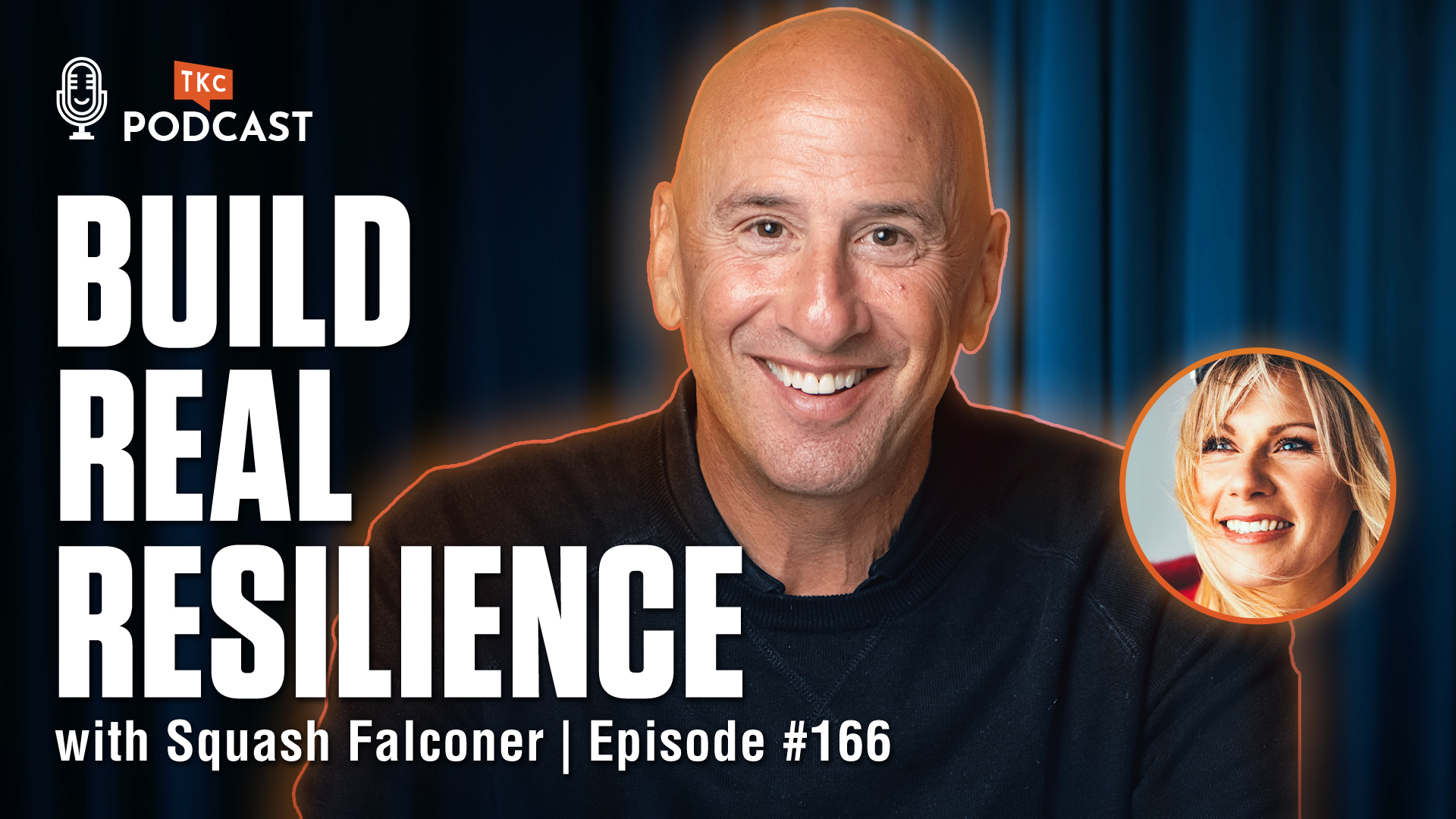
April 30, 2026The Adventurer’s Guide to Resilience with Squash Falconer
Resilience keynote speaker Squash Falconer shares how self-trust, smart decisions, and redefining failure build elite performance.
Resilience isn’t something you perform. It isn’t the motivational poster version of grit, where you clench your jaw, push harder, and never look back. The real thing looks quieter, sharper, and far more honest than that. It looks like knowing when to move forward, when to slow down, when to call it, and when to trust yourself even when every voice around you is pointing the other way.
That’s what resilience keynote speaker Squash Falconer taught me in one of the most grounding conversations I’ve had in a long time. Squash is the first British woman to summit Mont Blanc and paraglide from the top, having ridden her motorbike to get there. She’s reached the summit of Everest. She holds the world record as the highest bum boarder, earned on Cho Oyu, the sixth highest peak in the world at 8,201 meters. She’s cycled 3,000 miles on an ElliptiGO bicycle and was the European Women’s ElliptiGO Champion for three years running. She’s self-shot her own expeditions for film and television and co-presented an adventure documentary through Mexico’s Baja California on a motorbike.
None of these things happened because the conditions were perfect, the resources were lined up, or the plan was airtight. They happened because Squash found resilience and built something far more durable: a judgment system that works under pressure, a relationship with failure that doesn’t shatter confidence, and a deep understanding of when to push versus when to pause.
This conversation is for leaders, event professionals, and anyone who makes decisions when the environment keeps shifting beneath them. What you’ll take away is not a checklist. It’s a different way of thinking about what resilience actually means, and why it might be the most practical skill you can develop.
🎧 Watch and listen to the podcast episode: YouTube • Spotify • Apple Podcasts • Amazon Music
Resilience Starts as a Small, Quiet Idea That You Keep Repeating
One of the most striking things Squash shared was how her biggest adventures didn’t begin with a grand vision. They began with a whisper. A small idea, almost embarrassing in its simplicity, that she kept returning to over time.
She was not someone who sat down and mapped out a five-year plan to summit Everest. The ambition grew gradually, almost organically, fed by curiosity and a willingness to say yes to the next small step. Three dreams eventually converged into one defining adventure: the motorbike, the summit, the paraglide. But each piece arrived on its own timeline, earned by showing up consistently and letting the idea take root.
This matters enormously for how we think about building resilience. Most of us expect the motivation to show up fully formed, as if we should already know what we want and already feel ready for it. But Squash’s experience suggests something different. The clarity comes from doing, not from planning. The conviction develops through small acts of commitment repeated until they accumulate into something that can carry real weight.
For teams and organizations, resilience is a liberating idea. You don’t need perfect conditions or a complete strategy before you begin. You need a direction, a willingness to take the next step, and enough patience to let the momentum build naturally. The most resilient people are not those with the best roadmaps. They’re the ones who kept moving even when the road wasn’t visible.
What Squash modeled is that resilience at its foundation is really about relational consistency, the relationship you maintain with an idea, with a goal, with yourself, over time. You return to it. You don’t abandon it when it gets inconvenient. You let it shape you even before you feel ready to shape it.
Trusting Yourself Is a Resilience Skill, Not a Personality Trait
When Squash decided to attempt Mont Blanc, to ride there on her motorbike and paraglide from the summit, the response from people around her was not uniformly supportive. People had opinions. They had doubts. Some of those doubts were practical; others were projections of their own fears dressed up as concern.
She made a decision that becomes central to everything else she talks about: she chose to treat other people’s doubts as opinions, not instructions.
This sounds simple. It is not simple. Most of us have been conditioned to interpret skepticism from people we respect as information we should act on. When someone experienced says it can’t be done, or that it’s too risky, or that the timing isn’t right, we absorb that as evidence. And sometimes it is. But Squash draws a critical distinction between informed counsel and doubt that belongs to someone else’s limitations.
The resilience skill she developed, which is a skill, is the ability to evaluate input without internalizing it automatically. She listened. She considered. She made her own call. And she did that repeatedly across every major expedition, which means the trust she built in her own judgment wasn’t luck. It was trained.
For anyone working in high-stakes environments, this is one of the most transferable things Squash offers. Not blind confidence, but earned self-trust. The kind that comes from experience, reflection, and the repeated practice of making decisions and watching what happens. That feedback loop is how you build a reliable inner compass, and without it, resilience becomes fragile, dependent on external validation that won’t always be there when you need it.
Squash’s journey into resilience as a lived practice, not a concept, begins here. With the choice to believe in yourself.
Building from Nothing Is Where Resourcefulness and Resilience Intersect
One of the things I find most compelling about Squash’s story is what she didn’t have when she started. She didn’t have a sponsor list. She didn’t have a production budget. She didn’t have a team assembled and ready. She had an idea, a level of nerve that most people would find uncomfortable, and a willingness to create something from whatever was available.
She pulled together sponsors through persistence and relationship-building. She sourced gear creatively. She put together a film crew by asking the right questions to the right people, often before she had any obvious credibility to back the ask. She self-shot many of her expeditions, learning on the go, because waiting for the resources to be perfect would have meant not going at all.
This is the part of elite performance that gets underrepresented in the success narratives we tend to tell. We see the summit photo. We don’t see the fifty phone calls, the rejected pitches, the equipment borrowed from someone else’s kit, or the improvisation that happened on Day 3 when the original plan stopped working.
Squash’s resourcefulness is not a talent she was born with. It is a response to constraint. And constraint, it turns out, is one of the most powerful teachers of resilience available to us. When you cannot rely on the resources being there, you develop the capacity to work without them. That capacity compounds. It makes you harder to stop, because your performance is not contingent on ideal conditions.
For leaders building teams, this resilience insight is worth sitting with. The people most capable of sustaining performance through uncertainty are often those who have been forced to improvise before. Experience in constraint builds a kind of mental flexibility that abundance rarely produces. Squash didn’t struggle to find a way despite limited resources. She became exceptional partly because of them.
The Power of Pausing Is One of the Most Underrated Resilience Tools
There’s a moment in almost every high-stakes endeavor where the question stops being about capability and starts being about judgment. Can you do this? Probably. But should you? Right now? In these conditions, with this information, given what’s at stake?
Squash is emphatic about this. The ability to pause, to recalibrate, and in some cases to turn back is not a weakness. It is one of the most sophisticated expressions of resilience available to a human being under pressure. The ego wants to keep going. The culture around high performance often validates the people who push through. But the mountain, as Squash describes it, does not reward bravado. It rewards judgment.
She has turned back from the summits. She has changed plans mid-expedition when conditions shifted in ways that made the original route untenable. And she is clear that those decisions, ones that might look like failures from the outside, are often the most important decisions she has ever made. They are the decisions that meant she came home. That she was able to find resilience and try again multiple times.
The concept of the strategic pause applies far beyond mountaineering. It applies to every professional context where pressure pushes people toward momentum for its own sake. Keeping going is often the path of least resistance because stopping requires you to explain yourself, to absorb the discomfort of an incomplete outcome, and to make peace with the possibility that others will interpret the pause as retreat.
Squash reframes this entirely. Pausing is not retreating. It is gathering. It is the act of protecting your resources, both physical and cognitive, so that the next decision you make is better than the one you would have made if you’d kept moving on empty. The capacity to pause under pressure is part of what makes Squash Falconer such a compelling speaker for organizations navigating rapid change.
Failure as Useful Information Is How Resilience Gets Smarter Over Time
Squash has not submitted everything she has attempted. She has reached the high camps and been turned back by the weather. She has revised her goals mid-climb because the mountain changed its mind before she did. And she talks about these experiences not with regret but with something closer to gratitude, not in a performative way, but in the specific, practical sense that each failure taught her something she could not have learned any other way.
This is a fundamentally different relationship with failure than the one most people carry. For many of us, failure is an ending. It’s the proof that we weren’t good enough, that the goal was too ambitious, or that something in our character let us down. Squash describes it as information. Raw data about the conditions, her own capacity, the limits of the plan, and what needed to change for the next attempt.
“A missed summit isn’t a failure if you learned where the edge is,” she explains. And that distinction reshapes everything. Because once failure becomes information, you stop protecting yourself from it. You stop playing it safe to avoid it. You start engaging more fully with hard things because you know that even the worst outcomes will leave you with something you didn’t have before.
The practical value of this for teams is significant. Organizations that punish failure produce people who hide risk, underreport problems, and avoid the kinds of attempts that would actually move things forward. Organizations that treat failure as information produce people who take smart risks, communicate honestly, and recover faster because they’ve already built the habit of extracting learning from disappointment.
Squash’s approach to resilience and attitude is not relentless optimism. It’s something more durable: a commitment to staying curious about what went wrong, and staying open to what that means for what comes next.
Defining Success Before You Start Protects You From Ego-Driven Decisions
One of the most tactical pieces of advice Squash offers is deceptively simple: define what success looks like before you begin. Not after. Not once you’re already deep in the attempt and your identity is wrapped up in the outcome. Before.
Because once you’re on the mountain, once you’ve announced the goal, once the team is depending on you, the ego begins to redefine success in real time. It starts inflating the target, narrowing what counts, and making it harder to call something good enough or to recognize when the right move is to stop. The ego doesn’t want data. It wants vindication.
Squash addresses this by setting her definition of success deliberately and explicitly before the climb begins. If the definition is reaching the summit, she writes that down. If it’s learning something specific, or contributing to the team, or completing the journey safely, she names that too. And when conditions shift, when the summit becomes unreachable, or the original plan falls apart, she can return to that original definition and ask whether it’s still achievable by a different route.
This resilience practice maps directly onto organizational decision-making. How many projects drift in scope because no one defined what done actually looked like at the start? How many teams keep pushing past the point of diminishing returns because stopping feels like failing, even when the original objective has already been met? Squash’s discipline here is one of the clearest examples of what it means to lead yourself well under pressure, which is the foundation of every other leadership skill.
Success in Squash’s framework is not a fixed destination. It’s a moving target you intentionally set, revisit honestly, and protect from the interference of pride.
Human Connection Is a Performance Variable, Not a Soft Extra
When Squash describes her time on Everest, one of the things she returns to again and again is the people. Not just the teammates who shared the climb, but the strangers who showed up at the right moment, the unlikely connections made at high altitude, and the specific power of feeling seen and included when everything else is hard. That’s where resilience is built on.
She talks about meeting Alison Levine on the mountain, an encounter that clearly stayed with her. Not because of the credentials or the achievements Levine represented, but because of the quality of presence she brought to a moment that could have remained transactional. The ability to make someone feel included, valued, and genuinely recognized in a high-pressure environment is not a soft skill. It’s a performance multiplier.
Squash is emphatic that shared experience changes people. The bond that forms between individuals who have moved through difficulty together is qualitatively different from the bond formed in comfort. It carries more weight. It generates more trust. It creates the kind of loyalty that holds a team together when conditions deteriorate.
For event professionals and the leaders who bring teams together through shared experiences, this is the central argument for investing in human connection as part of performance strategy. It’s not about making people feel good in a vague sense. It’s about activating something in them that doesn’t come online through process or structure, the part of human performance that only emerges through belonging, recognition, and genuine shared stakes.
Communication in Squash’s world is not just about transmitting information. It’s about creating the conditions in which people feel safe enough to give and receive what a high-pressure environment actually demands of them.
Emotional Fuel: Why Love and Resilience Carry You When Strength Runs Out
There’s a moment in extreme physical or professional challenge when the conventional sources of motivation stop being enough. Discipline gets you far. Training gets you further. But at a certain altitude, metaphorical or literal, the question becomes what you’re actually doing this for, and whether the answer you have is strong enough to carry the weight.
For Squash, the answer involves love in a very direct and unsentimental sense. Family. Belief from the people closest to her. The specific emotional weight of knowing that someone is holding space for her return, and that the attempt means something beyond personal achievement. She is not sentimental about this. She is practical. When strength runs out, when the training has been fully spent and the conditions are still hard, something beyond physical capacity has to take over. For Squash, that something has a face and a name.
This is worth examining for anyone thinking about change and the resilience required to sustain it. We often talk about intrinsic versus extrinsic motivation as if the healthiest version is purely internal, self-sufficient, and independent of external input. But Squash’s experience suggests a more nuanced picture. The people who love you, who are waiting for you, who believe in you before the outcome is clear, these are not crutches. They are legitimate sources of energy that deserve to be named and relied upon.
Building resilience doesn’t mean becoming a self-contained unit that needs nothing from anyone else. It means knowing exactly what fuels you at every layer, physical, cognitive, emotional, and making sure those sources are tended to before the hard part begins.
The Resilience Framework That Works When the Map Runs Out
Decision-making in unfamiliar terrain, whether it’s a mountain face or a reorganization, comes down to one core question: what do you do when the plan stops working, and the information is incomplete?
Squash has a resilience framework for this, refined through years of making consequential decisions in places where getting it wrong had permanent consequences. It is not a formula. It is a set of questions she asks herself in sequence, designed to cut through the noise and return her to what she actually knows, what the conditions are actually telling her, and what the defined success metric from the beginning of the journey actually requires.
The first layer is what she can observe. Not interpret, not project, but actually observe. What is the weather doing? What is the team’s energy level? What does the route look like from where she is standing? Observation without interpretation is harder than it sounds because the mind rushes to fill gaps with assumptions. Squash trains herself on resilience to linger in the observable before moving to the analytical.
The second layer is what the information means for the defined goal. Not for pride. Not for reputation. For the goal she set before she began. This is where the pre-defined success metric does its most important work, because it gives her a reference point that exists outside the distortion field of in-the-moment emotion.
The third layer is the question she asks herself about what she will think of this decision from the other side. Not in a hypothetical sense, but practically. When this is over, and I’m looking back, which call will I be able to defend? That question introduces a kind of temporal distance that is enormously useful for cutting through urgency that isn’t real.
This framework is teachable. It’s transferable. And it’s exactly the kind of tool that makes resilience something more than a character trait. It makes it a practice.

The conversation with Squash left me thinking about what we ask of people when we talk about resilience in a corporate context. We often mean endurance. We mean tolerance for discomfort. We mean the ability to keep going when conditions are hard.
But Squash reframes the whole resilience concept. Resilience, in her definition, is not about going harder or lasting longer. It’s about staying accurate under pressure. Accurate about what you can see, what you know, what you’ve defined as success, and what your body and mind are actually telling you as opposed to what the noise around you is insisting you feel.
That accuracy is a skill. It is trained. It is earned through reflection on real experience, through the discipline of defining terms before the stakes arrive, and through the practice of trusting your own judgment even when the people around you haven’t caught up yet.
If your team needs a resilience boost and is navigating uncertainty, leading through change, or making decisions in conditions that keep shifting, Squash Falconer has something specific and practical to offer. Not inspiration as a temporary state, but tools for staying oriented when the map runs out.
🎤 Explore Squash Falconer’s full keynote speaker profile to see how she brings these ideas to life for corporate audiences
📞 If your event needs a speaker on resilience, decision-making under pressure, and elite performance, schedule a 15-minute call here, and let’s talk!
📩 Or send me your audience and event theme, and I’ll tell you whether she’s the right fit: info@thekeynotecurators.com
Discover More Insights






Get in TouchContact US
Fill out the form so we can best understand your needs.
A representative from The Keynote Curators will reach out to you.