
April 24, 2026Events That Make People Feel Seen and Create a True Sense of Community
Learn how keynote speaker Michelle Poler designs experiences for live events around core values to create real community and belonging
What if the reason your event feels forgettable has nothing to do with your budget, your venue, or your speaker lineup? What if it comes down to something much simpler and much harder to fake: whether your attendees actually feel like they belong there?
That is the question events keynote speaker Michelle Poler puts at the center of everything she builds. As both a professional keynote speaker and an independent event creator who welcomes 300 people at a time into her own live experiences, she has thought deeply about what separates events that people talk about for years from events that people forget before they reach the parking lot. Her answer is not a production trick or a novelty activation. It is a discipline: start with your core value, then design every single element of the experience around making that value undeniably real.
In this conversation, Michelle draws on her work as a branding and marketing strategist and as a founder to show how meeting professionals can stop defaulting to industry convention and start building events that actually mean something. What she shares is practical, specific, and immediately transferable to any event format, any industry, and any audience size.
🎬 Watch and listen to the full interview about events here
Events and the Core Value Question Most Organizers Skip
The starting point for everything Michelle does is a question that sounds obvious but rarely gets answered honestly: what is your most important core value, and is it actually showing up in your event?
Most organizations have values. They appear in brand guidelines, on website homepages, and in the opening slides of leadership presentations. But when it comes to event design, those values tend to disappear. The agenda looks like every other agenda. The room layout follows the same template. The experience delivers the same sequence of keynote, panel, lunch, and networking that attendees have encountered at dozens of other events before yours.
Michelle’s point is that owning a value is different from listing it. If your value is fun, she asks, are you actually owning fun, or are you just doing what every other conference does and calling it fun? The gap between stating a value and designing around it is where most events lose their chance to be memorable.
This is not a small distinction. When attendees walk into an event and feel nothing that distinguishes it from the last one they attended, the message they receive is that the brand behind the event does not actually believe in what it says it stands for. The event becomes evidence against the brand rather than proof of it.
For Michelle, the discipline of value-led event design begins with an honest audit. Take your stated value and trace it through every touchpoint: registration, arrival, the first five minutes inside the room, the way sessions are structured, the way people are encouraged to interact, the way the space itself is decorated and arranged. If the value is not legible at each of those moments, it is not really the value the event is built around. It is just a word on a slide.
That audit can be uncomfortable, but it is also the most generative thing a meeting professional can do. It turns abstract brand language into a concrete design brief. It gives every decision a filter. And it almost always surfaces opportunities that no one had noticed before.
Why Community Became the Organizing Principle for Michelle’s Events
When Michelle applies this process to her own live events, the value she keeps arriving at is community. Not education, not inspiration, not entertainment, though those things are present too. Community is the core, and everything else serves it.
“What is your most important, my most core value? And for me is community,” she explains. From that answer, every other design decision follows: “How do I make the people in there feel part of a community, feel part of something. So everything I do, the way I create the agenda, the decoration, what we say, everything is around, how do we make people feel like they belong?”
That framing, how do we make people feel like they belong, is worth sitting with. It is a different question than how do we deliver content, or how do we fill the schedule, or how do we satisfy our sponsors. It centers the emotional experience of the attendee rather than the logistical requirements of the organizer. And it changes the kinds of solutions that become visible.
When belonging is the brief, the standard conference format starts to look like a series of missed opportunities. People sit in rows facing a stage, absorbing content passively, interacting with their neighbors only during designated breaks. The event produces information transfer but not connection. It delivers programming but not community.
Michelle’s approach inverts this. She designs for connection as the primary outcome, with everything else as the supporting structure. The content is there, the sessions are there, but they exist within a deliberate architecture of belonging.
This shift in orientation is something any event professional can apply regardless of scale. You do not need 300 attendees or a large production budget to ask whether your event is designed for belonging. You need clarity about your value and the willingness to let that value override convention.
The Wall That Changes the Energy Before a Word Is Spoken
One of the most striking details Michelle shares is what her attendees encounter the moment they walk through the door. Before they find their seat, before they grab a coffee, before they check the agenda: they see their own face.
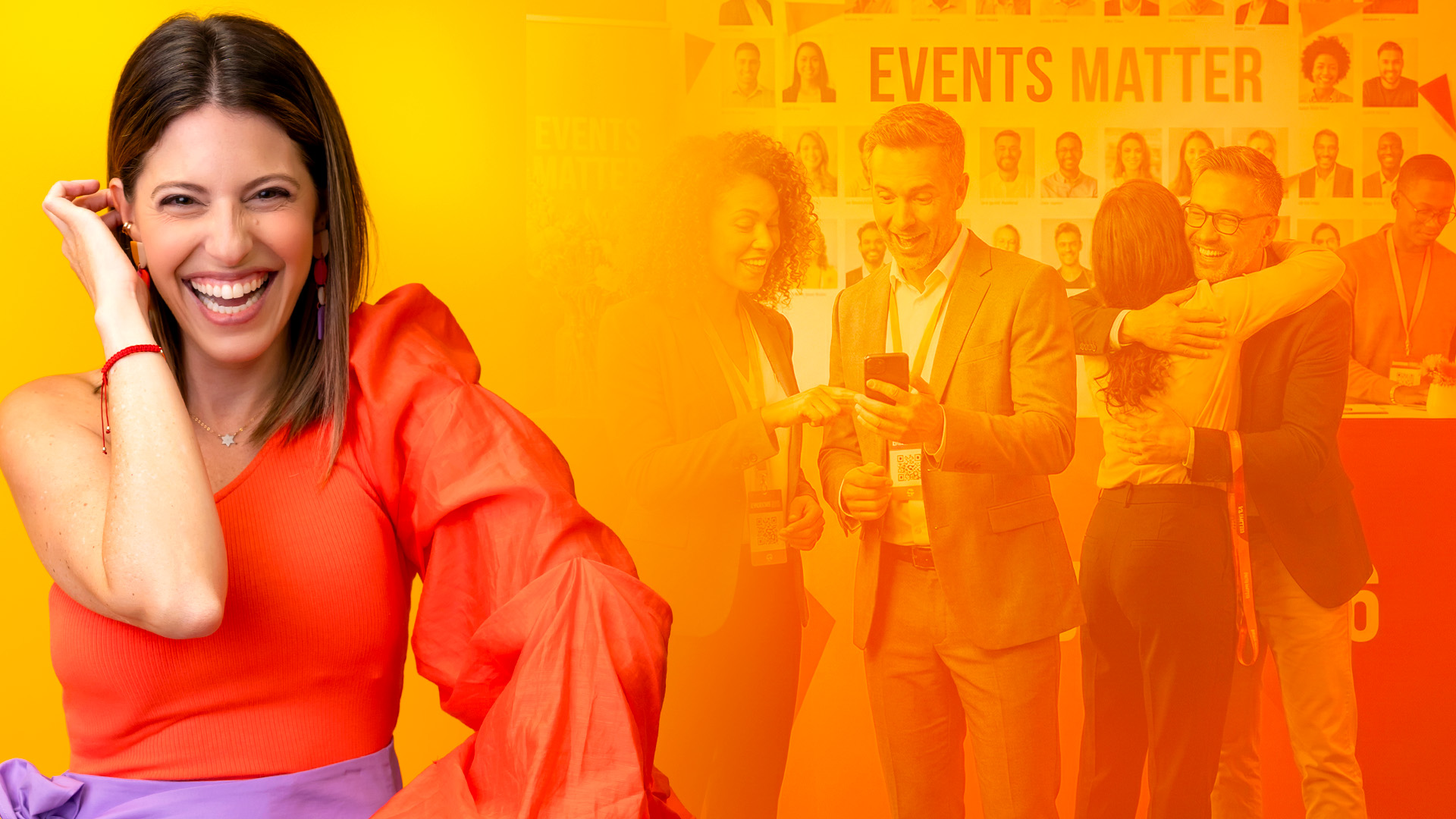
Michelle creates a large wall displaying photos of every attendee along with their Instagram handle. It is the first thing people see when they arrive, and the effect it produces is immediate and powerful. You walk into a room and you are already part of it. You are not a guest arriving at someone else’s event. You are a named, visible, recognized member of this community.
The psychological mechanism at work here is straightforward but often underestimated. Belonging is not just a feeling that develops over time through shared experience. It can be triggered by small, deliberate signals that communicate: you were expected, you were included, you matter here. The wall does exactly that in the first seconds of the attendee experience, before a single session has started.
This is the kind of creative design thinking that distinguishes events built around a value from events built around a template. It is not expensive. It is not technically complex. It is the result of asking one question repeatedly: how do we make people feel like they belong?
The answer to that question does not always require a big idea. Sometimes it requires a wall, a name, and a face.
How a QR Code on a Badge Becomes a Community-Building Tool
Alongside the arrival wall, Michelle uses a small but surprisingly effective tactic at the badge level. Each attendee’s badge includes a QR code that, when scanned by another attendee, immediately triggers a social media follow.
The friction in early-event networking is real. People arrive not knowing each other, unsure how to start conversations, often defaulting to checking their phones rather than approaching strangers. The standard solution is a structured icebreaker, which works for some people and produces visible discomfort in others.
Michelle’s QR badge approach is different because it lowers the entry cost of connection to almost zero. You do not need to introduce yourself, exchange business cards, or remember to look someone up later. One scan and the connection is made. The digital relationship exists before the conversation has even started, which often makes the conversation easier to begin.
This reflects a broader principle in her approach to communication and event design: remove the barriers that make connection harder than it needs to be. People want to connect. They come to events in part because they are looking for community. The organizer’s job is to make that as easy as possible, not to leave it entirely to chance.
The badge tactic also extends the event’s community-building effect beyond the room itself. When attendees follow each other on social media during the event, the connections they form do not end when the event does. The community continues online, which reinforces the value Michelle is trying to create and expands its reach over time.
Replacing Sponsor Screens with Attendee Voices
One of the most revealing decisions Michelle has made in her event design involves the screens. In a typical conference, screens display sponsor logos, branded content, or housekeeping announcements between sessions. They are real estate sold to partners and used to fulfill commercial obligations.
Michelle made a different choice. She asked her attendees to submit original quotes in advance, content they had created themselves, ideas they owned. Those quotes, attributed by name to the attendees who wrote them, became what appeared on the screens throughout the event.
The result is that every time someone looks up at a screen, they see a member of their own community being recognized and celebrated. They see peers as sources of wisdom rather than brands as sources of authority. The screens become part of the belonging experience rather than an interruption to it.
This decision is also a statement about priorities. It communicates, without anyone having to say it, that the community is the most important thing in the room. Not the sponsors, not the organizer, not the production value. The people who showed up.
For media and brand professionals thinking about how corporate culture shows up in live experiences, this is a useful provocation. What does your use of screens say about what you value? Who gets visibility in your event, and who is treated as the audience rather than the protagonist?
Letting the Community Become the Speakers
The same logic extends to how Michelle handles breakout sessions. Rather than sourcing outside speakers to lead breakouts, she turns to the community itself. She invites attendees to propose topics, to volunteer to lead sessions, to teach what they know to the people around them.
The effect of this goes beyond programming efficiency. When your attendees are the speakers, the relationship between the event and the community shifts fundamentally. Attendees are no longer passive recipients of content curated by an organizer. They are active contributors to an experience that belongs to all of them.
“Instead of going to find outside speakers, we ask the community, do you wanna be a speaker? Do you wanna be on stage? What do you wanna teach other people? And it’s all about that bringing people together ’cause that’s our value,” Michelle explains.
This approach also surfaces expertise that would otherwise remain invisible. Every room full of professionals contains people with deep, specific knowledge that the person sitting next to them could genuinely use. Most events never access that knowledge because the format does not create space for it. By opening the stage to the community, Michelle makes the event smarter and more useful than it could be with any outside lineup.
For meeting professionals working in innovation or change contexts, this is also a model for how to build psychological safety at scale. When people are invited to contribute rather than just consume, they develop a sense of ownership over the experience. They have more at stake. They are more engaged, more generous with each other, and more likely to build the kinds of relationships that make community real.
What This Means for Meeting Professionals Designing Events in 2026
The principles behind Michelle’s event design are not specific to her brand, her audience, or her format. They are transferable to any kind of live experience, corporate or consumer, large or intimate, in-person or hybrid.
The first principle is clarity. You cannot design around a value you have not clearly identified. And identifying it means more than choosing a word. It means understanding what that value looks, sounds, and feels like in practice, from the moment someone registers to the moment they leave.
The second principle is honesty. Most organizations, when they audit their events against their stated values, will find gaps. That is not a failure. It is information. The gap is the design opportunity.
The third principle is specificity. Belonging is not created by a general feeling of warmth. It is created by specific, deliberate design decisions: a wall with faces, a badge with a QR code, screens with attendee quotes, breakouts led by the community itself. These are not big ideas. They are small, precise ones that accumulate into something that feels unmistakably real.
As a bestselling author and TED speaker, Michelle has spent years thinking about what it takes for people to move from comfort into growth, from fear into action, from invisible to unforgettable. The same thinking she applies to personal transformation she applies to event design. The question is always the same: what would it take for this person to feel like they truly belong here?
The Compounding Effect of Value-Led Events
There is a compounding effect that happens when events are consistently designed around a genuine core value. Attendees do not just remember the event. They remember how it made them feel, and they associate that feeling with your brand.
In a landscape where business events increasingly compete for attention and attendance, the events that win are not necessarily the biggest or the most expensive. They are the ones that leave people feeling like they were seen, included, and genuinely part of something.
That is what Michelle is building with her own events, and it is what she challenges meeting professionals to build with theirs. The tactics she uses are replicable. The wall, the badges, the screens, the community-led breakouts, none of these require a large budget or a specialized production team. They require a clear value and the willingness to design every detail around it.
The storytelling dimension of this is also worth noting. When events are designed around a value and are executed well, attendees leave with a story to tell. They do not describe the sessions they attended or the speakers they heard. They describe the moment they walked in and saw their own face on the wall. They describe scanning a badge and instantly connecting with someone new. They describe hearing a peer share an idea on stage that changed how they thought about their work.
Those are the stories that travel. Those are the stories that fill your next events. And they are all the result of one honest question asked at the beginning of the design process: what is our core value, and how do we make it undeniably real?
Michelle Poler is available as a keynote speaker for events where the goal is to move people from fear into action, from comfort into growth, and from one more to one of a kind. Her work as a motivational speaker and brand strategist makes her equally compelling on stages focused on personal development, organizational culture, and creative leadership.
📆 Ready to bring Michelle Poler to your next events or design an experience your audience will never forget? Schedule a time with us, and let’s build something worth remembering.
🎧 Watch the full interview about events and community here
🎤 Hire keynote speaker Michelle Poler for your next conference
📩 Contact us: info@thekeynotecurators.com
Discover More Insights


Get in TouchContact US
Fill out the form so we can best understand your needs.
A representative from The Keynote Curators will reach out to you.