
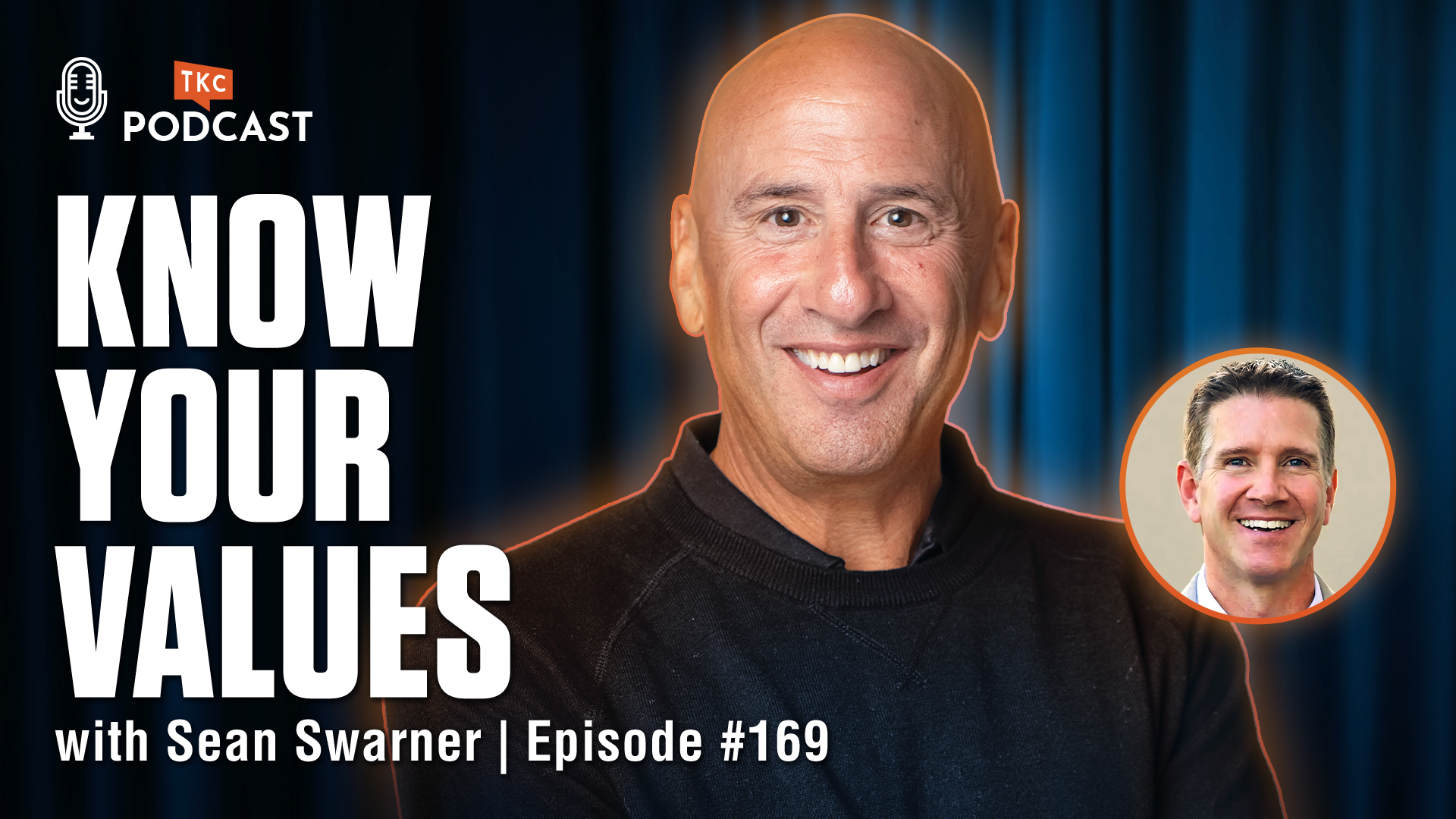
May 21, 2026Resilience and Core Values That Drive Extraordinary Results, with Sean Swarner
Resilience speaker Sean Swarner shares how core values, visualization, and one bold step can help you overcome any obstacle.
Most people assume that resilience is about willpower, grit, or simply refusing to quit. But what I’ve come to understand, especially after sitting down with Sean Swarner, a global empowerment speaker and the first cancer survivor to summit Mount Everest, is that true resilience runs much deeper than any of that. It starts with knowing who you are, what you believe, and why you’re climbing in the first place.
This conversation changed how I think about perseverance, success, and the kind of leadership that actually moves people. If you’re a professional, a leader, a team builder, or someone facing a season of real adversity, what Sean shared here applies directly to you. We covered how to take that first step when everything feels overwhelming, why most people chase goals that leave them empty, how to define the core values that will genuinely sustain you, and why no one, not even the person who climbed Everest with one lung, makes it to the top alone.
🎧 Watch and listen to the podcast episode: YouTube • Spotify • Apple Podcasts • Amazon Music
Resilience Begins Before the Mountain
There’s a temptation to think that resilience is something you discover in the middle of a crisis. That it shows up when the ground falls away and you have no choice but to find your footing. But Sean Swarner’s story dismantles that idea entirely. Long before he stood at the summit of Everest, he had already faced something most people could not fathom: a diagnosis of Hodgkin’s disease at thirteen, followed by a second cancer diagnosis at eighteen, one so rare and aggressive that doctors gave him three months to live. He was not supposed to be standing anywhere.
What pulled him through was not luck or some genetic immunity to suffering. It was a particular way of engaging with difficulty, one that he has since turned into a framework for helping others build resilience of their own. Resilience, as Sean describes it, is not a trait you either have or don’t. It’s a practice. It’s a set of decisions you make before the hardest moment arrives, and a set of values you hold onto when you arrive there anyway.
The distinction matters enormously when you’re thinking about resilience as a leadership skill rather than just a survival instinct. Leaders who only develop resilience in response to crisis are always playing catch-up. The ones who build it in advance, who examine their values, their vision, and their purpose during the calm stretches, those are the people who move differently when things get hard. Resilience built in quiet moments is the kind that holds under real pressure.
Sean’s path from a hospital bed to the Seven Summits and the Explorer’s Grand Slam is not just a remarkable biography. It’s a repeatable model for how ordinary people can build extraordinary capacity for endurance, as long as they’re willing to start with the right questions.
Why Overwhelm Is a Problem of Perspective, Not Capacity
One of the first things Sean talked about was how people defeat themselves before they even start. Most people don’t fail at the summit. They fail at the base, because they’re staring at the whole mountain. This is where resilience collapses before it ever gets tested.
This is one of the most practically useful ideas in the entire conversation. When we look at the full scope of a challenge, whether it’s a career pivot, a health struggle, a major organizational change, or a personal goal that feels impossibly large, we instinctively try to process it all at once. And the brain, confronted with that much information and uncertainty, does the only rational thing it can do: it shuts down. Overwhelm isn’t a sign of weakness. It’s a predictable physiological response to an overloaded frame.
Sean’s answer to this is deceptively simple. Take one step. Not the next ten, not the whole route, just the one step that’s directly in front of you. This isn’t motivational shorthand. It’s a neurological strategy. The moment you move your attention from the totality of the problem to the immediacy of one action, you short-circuit the paralysis loop. You generate momentum. And momentum, more than talent or preparation, is what keeps most people going. Resilience lives in that momentum, not in grand gestures.
In practice, this means learning to deliberately reframe the scale of what you’re facing. If you’re building a company, you’re not building a company today. You’re making one call, writing one paragraph, or having one conversation. If you’re rebuilding a team’s culture, you’re not transforming an organization this week. You’re modeling the behavior you want to see in a single meeting. The mountain gets climbed one foot placement at a time, and the people who understand that are the ones who eventually look back from the top.
Developing this kind of focused perspective is also one of the central skills within mental health and performance psychology. The ability to tolerate uncertainty while continuing to act is not natural for most of us. It has to be practiced, and it starts with the simple discipline of choosing your next step instead of surveying the entire trail.

How Visualization Shapes Resilience and Outcome
Sean spent real time talking about visualization, and not in the vague, aspirational way it sometimes gets framed in popular self-help. What he described is something closer to a discipline, a deliberate mental rehearsal that connects your internal experience to your external behavior. For Sean, it was also a core piece of how he built the resilience that kept him alive.
The science behind this is well established. Athletes, surgeons, musicians, and military personnel have all used visualization techniques to improve execution under pressure. When you vividly imagine completing an action, your brain activates many of the same neural pathways it would use if you were physically performing that action. You are, in a meaningful sense, practicing without moving.
For Sean, visualization was part of how he survived. He imagined himself recovering. He imagined himself standing on summits. He created such a detailed internal picture of where he was going that his body had a blueprint to follow. This is not magical thinking. It’s the kind of directed mental focus that creates alignment between what you want and how you prepare. Resilience without a clear vision of where you’re going is just endurance. Vision gives it direction.
What makes this particularly relevant for leadership and team performance is that visualization works not just individually but organizationally. When leaders create vivid, specific pictures of what success looks like, when they describe the future state in concrete detail rather than vague aspiration, they give their teams something to move toward. Clarity of vision reduces ambiguity. It replaces question marks with coordinates.
The application here is practical. Before a high-stakes presentation, before a difficult negotiation, before a major initiative launch, the question isn’t just “are we prepared?” It’s “can I see it happening?” If the answer is no, that’s useful information. It means the preparation hasn’t yet translated into confidence. Visualization is the bridge between planning and execution, and Sean made it clear that for him, it was never optional.
Values Over Grit: What Actually Fuels Resilience
This might be the most important idea in the entire conversation. We live in a culture that celebrates grit. We’re told that the people who succeed are the ones who push hardest, who refuse to stop, who grind through everything. And while persistence matters, Sean made a compelling case that grit divorced from values is not sustainable. It’s just exhaustion with better PR. And it’s not what resilience actually looks like at its core.
What actually keeps people going when everything is hard is not pure willpower. It’s a deep, clear sense of what they stand for and why they’re doing what they’re doing. Values are the fuel. Grit is just the engine. Without the right fuel, even the most powerful engine eventually stalls. Resilience that isn’t grounded in values tends to break precisely when the stakes are highest.
Sean’s approach to values is not abstract. He talks about defining them explicitly, writing them down, testing them against your actual decisions, and revisiting them regularly. This is the kind of work that feels uncomfortable for a lot of high-performers, because it requires honesty. It requires asking whether the thing you’re chasing is actually yours, or whether you’ve adopted it from someone else’s definition of success.
This connects directly to the broader framework of thought leadership development. The leaders and thinkers who have the longest careers and the deepest impact are almost always people who can articulate clearly what they believe and why. They’re not just smart. They’re grounded. And that groundedness is a form of resilience in itself. It comes from having done the uncomfortable work of naming your values and then actually living by them.
For teams, this has a direct organizational application. Teams that share explicit values don’t just perform better under pressure. They make faster decisions in ambiguous situations, because they have an internal compass rather than waiting for instructions. Clarity of values is one of the most underrated performance assets in any organization, and one of the most reliable foundations for collective resilience.
Why Success Without Meaning Leaves You Empty
Sean introduced the concept of false summits, and it hit hard. In mountaineering, a false summit is a point that looks like the top from below but reveals more mountain once you arrive. Climbers who don’t account for this can be psychologically devastated when they reach what they thought was the peak and find there’s still a long way to go. It’s also a near-perfect metaphor for what happens when resilience gets applied to goals that were never truly yours.
This is one of the most common experiences among high-achievers that rarely gets talked about honestly. You get the promotion, close the deal, hit the revenue number, or achieve the milestone, and instead of satisfaction, there’s a strange hollowness. You pushed through. You showed resilience. And you arrived at a place that means nothing to you.
The reason, according to Sean, is that many of the goals we chase were never truly ours. They were borrowed, adopted from cultural expectations, peer comparison, or the internalized voices of people we wanted to impress. When you summit someone else’s mountain, you don’t feel like a conqueror. You feel like a tenant.
This is a deeply important insight for business growth strategy and career development. Sustainable growth, both personal and organizational, has to be rooted in goals that are genuinely aligned with values. The hustle-and-metrics approach to success produces results that look impressive on dashboards but often leave the people achieving them feeling disconnected and burned out. Resilience applied to the wrong goals doesn’t build you. It depletes you.
The alternative Sean described is ego-free achievement: doing the work because it matters, because it aligns with who you are, not because it signals status or satisfies comparison. This reframe doesn’t make the work easier. But it makes the arrival mean something. And that meaning is what sustains effort over the long arc rather than just sprinting to the next visible point on the horizon.
Defining Your Core Values: A Practical Framework
Sean walks people through a specific process for identifying their core values, and it’s worth unpacking in some detail because it’s not what most people expect. It’s not a list of admirable words you select from a menu. It’s an excavation. And it’s the foundation on which genuine, lasting resilience gets built.
He starts with a question: what would you refuse to compromise, even under significant pressure? Not what sounds good, not what looks good on a leadership profile, but what you would actually protect when it cost you something to do so. That’s where your real values live. Not in your aspirations, but in your behavior under pressure.
From there, the process involves looking backward at the decisions you’ve made in your life, particularly the hard ones, the ones where you took a stand even when it would have been easier not to, or where you stayed in something because it felt right even when it was difficult. Patterns emerge. Those patterns tell you something true about who you are and about where your resilience naturally comes from.
This is where mindfulness becomes a practical tool rather than a wellness buzzword. The ability to observe your own reactions, to notice what energizes you and what depletes you, to pay attention to the moments when you feel most like yourself, those are all data points. Values clarification is ultimately a practice of radical self-honesty, and mindfulness is the training ground for developing that capacity.
Once you have clarity on your values, they become an operational tool. They inform how you set goals, how you make decisions, how you build your team, and how you respond to adversity. More than any strategy document or mission statement, your values are the real architecture of your choices, and the most reliable source of resilience you can build.
The ASCEND Framework: Turning Resilience Into Action
Sean references a framework he calls ASCEND, and it functions as a practical bridge between the mindset principles he talks about and the day-to-day mechanics of moving forward. It’s a structure designed to help people translate purpose into momentum rather than letting inspiration remain abstract. It’s also how resilience gets operationalized rather than just admired.
The framework addresses something that a lot of motivational content misses: the gap between being inspired and actually changing behavior. You can have a profound realization about your values and your purpose, and still walk out of the room and fall back into your default patterns. That gap is where most personal and professional development fails, not in the understanding phase but in the implementation phase. Resilience without structure often evaporates before it produces anything real.
Sean’s ASCEND approach treats action as a skill to be developed, not just a decision to be made. It incorporates the kind of iterative, step-by-step progress that he described earlier in the conversation, applied to the larger arc of a goal or project. The framework emphasizes accountability, specific action steps, and a recognition that forward movement doesn’t have to be dramatic or massive. It just has to be consistent.
For business leadership specifically, this is a critical lesson. Leaders often mistake visibility for progress. They want the big gesture, the bold announcement, the sweeping pivot. What actually moves organizations is quieter: consistent, values-aligned action accumulated over time. The resilience of a team is often reflected not in how they handle the biggest crises but in how consistently they show up for the smaller ones. The ASCEND framework gives that accumulation a structure to operate within.
Applied to team contexts, the framework also creates common language. When everyone on a team is using the same vocabulary around action steps, accountability, and iterative progress, alignment happens faster and gaps become visible sooner. It turns individual resilience and momentum into collective movement.
No One Climbs Alone: Community as a Resilience Strategy
Sean was direct about this: he did not climb Everest alone. He had a team. He had support. He had people who believed in the goal even when the conditions were terrible and the summit felt impossibly far. And he was clear that this wasn’t just logistics, it was fundamental to his resilience and his ability to keep going.
We’ve built a cultural mythology around the lone achiever, the solitary genius, the self-made success story. And it’s almost always incomplete. Behind every extraordinary achievement is a web of relationships that made it possible: mentors, peers, sponsors, support systems, and communities of people who share the belief that the thing being attempted is worth doing. Resilience without community is fragile. With it, it becomes something structural.
This is not a soft observation. It’s a strategy point. The most resilient teams are not the ones made up of the toughest individuals. They’re the ones with the strongest relational trust. When people know that someone has their back, they take more calculated risks, they recover from setbacks faster, and they sustain effort over longer periods. Psychological safety, as research consistently shows, is one of the most powerful predictors of team performance.
For Sean, this principle extends beyond personal support into something larger. His work with The Cancer Climber Association is built on the idea that one person’s survival and transformation can create the conditions for others to believe in their own. Helping one person climb their mountain is not a small act. It’s a multiplier. It plants a belief in someone that then travels further than you can track.
The communication dimension of this is important too. Building the kind of community that sustains resilience requires honest, courageous conversation. It requires leaders who ask for help when they need it, who acknowledge difficulty without dramatizing it, and who create environments where people feel safe being honest about where they’re struggling. Sean models this in the way he tells his own story, never minimizing the fear or the pain, but always framing it within a larger arc of purpose and possibility.
The Defining Moments When Everything Goes Wrong
One of the most grounded parts of the conversation was when Sean talked about what happens when things go genuinely wrong, not the motivational version where obstacles are just opportunities in disguise, but the real version where the situation is serious and the way forward is not obvious. This is where resilience either shows up or it doesn’t.
His point was that your response in those moments is almost entirely determined by the preparation you’ve done before them. The values you’ve named, the visualizations you’ve practiced, the community you’ve built, the framework you’ve internalized, all of that becomes what you reach for when the ground disappears. Resilience in a crisis is the sum of all the smaller choices you made in the calm.
This is why the work he describes is not just inspirational. It’s structural. You are essentially building the architecture of your response to future adversity, right now, in the quiet periods. The person who has done that work moves differently in a crisis. They don’t freeze at the scale of the problem because they’ve already practiced navigating scale. They don’t abandon their values under pressure because they’ve already tested them in smaller moments. They reach for their community because they’ve invested in it before they needed it.
“You don’t rise to the level of your goals,” Sean reminded me, “you fall to the level of your systems.” That idea is one of the most clarifying things I heard in this entire conversation. It reframes resilience not as something heroic or exceptional but as something designed. Something built. Something anyone can create if they’re willing to do the intentional work before the hard moments arrive.
This is the final piece, and perhaps the most important one. Resilience is not what happens to you. It’s what you build. It’s the result of knowing who you are, acting on that knowledge repeatedly, and surrounding yourself with people who are committed to the same climb. Sean Swarner has done all of that, in circumstances most of us will never face. But the principles he carries from those circumstances are ones any of us can apply, starting with one honest step today.

If your audience is facing adversity, rebuilding after setbacks, or trying to reconnect success with something that actually means something, Sean is one of the most powerful voices delivering that message on stages today.
🎤 Book Sean Swarner as a keynote speaker for your next event
Schedule a 15-minute call and tell me about your audience and event theme
Reach me directly at info@thekeynotecurators.com and I’ll let you know if he’s the right fit for your stage
Discover More Insights



Get in TouchContact US
Fill out the form so we can best understand your needs.
A representative from The Keynote Curators will reach out to you.