
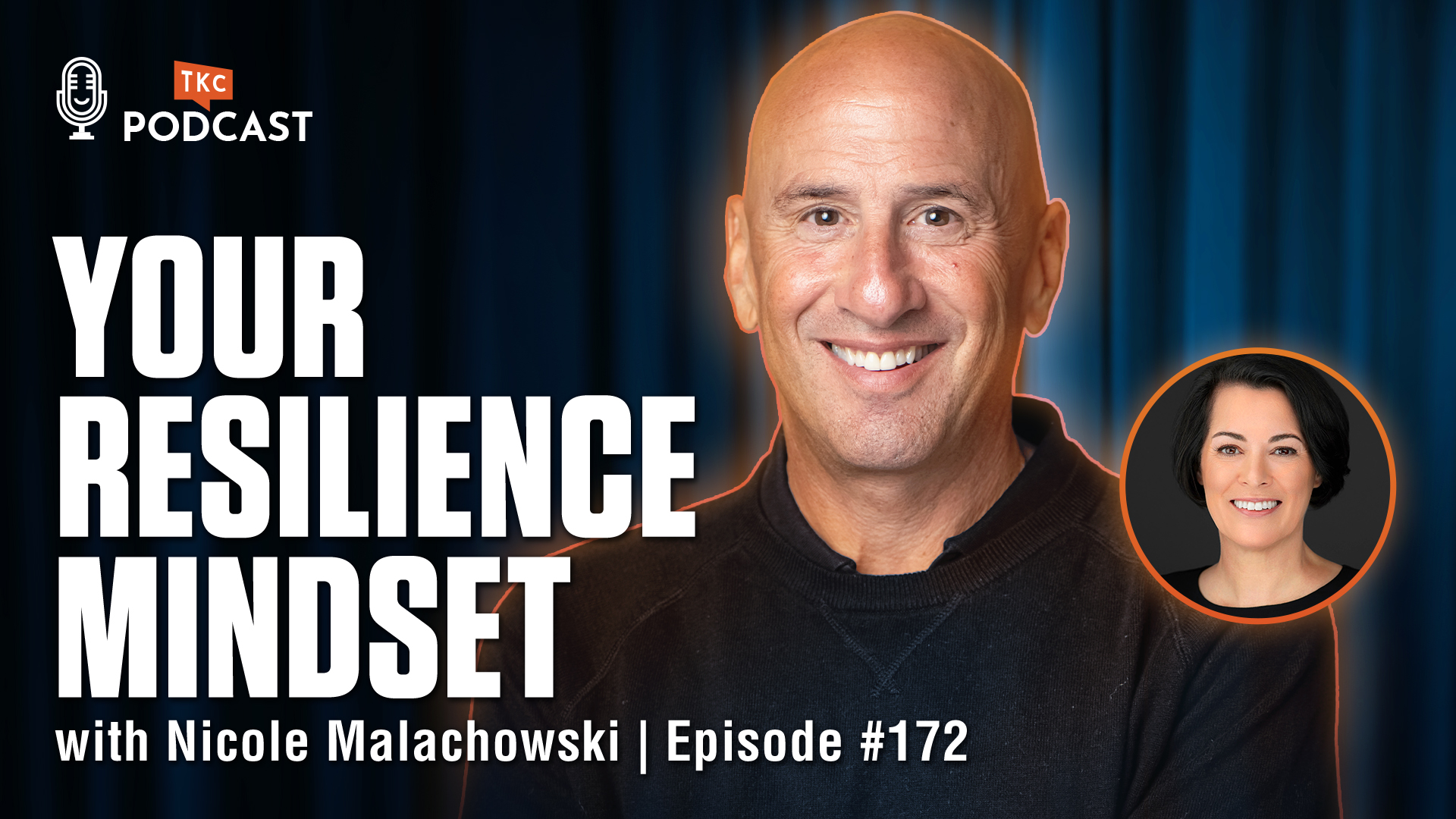
June 8, 2026Resilience Is Not Survival: Choosing an Unscripted Life, with Nicole Malachowski
Discover how resilience means thriving through uncertainty with leadership lessons from a fighter pilot who rewrote her life when the script ended.
There’s a moment in most people’s lives when they realize the script they wrote for themselves no longer applies. This isn’t a gentle transition. It arrives without warning, often disguised as failure, illness, rejection, or simply a turn in the road where the map no longer matches the terrain. In that moment, most of us want to know the same thing: how do we survive what’s happening? But that question gets the stakes wrong. The real question is different. It’s not how we survive. It’s how we become the kind of person who doesn’t just endure hardship but transforms through it.
I’ve been thinking about resilience lately—not the sanitized, corporate version that gets printed on motivational posters, but the real thing. The kind that doesn’t look like unwavering determination. The kind that sometimes looks like letting go. The kind that requires vulnerability, self-doubt, and the willingness to admit that your original plan was only ever a starting point. These are the insights I carried away from a conversation with Nicole Malachowski, the first woman pilot to fly on the U.S. Air Force Thunderbirds Air Demonstration Squadron and a White House Fellow whose 21-year Air Force career ended the way most careers don’t—not with a retirement ceremony, but with a neurological illness that left her unable to walk or speak for almost nine months. She didn’t just survive that chapter. She became resurgent through it. And what struck me most about our conversation was how her understanding of resilience challenges nearly everything we think we know about it.
What she taught me is this: resilience isn’t about toughness. It’s about flexibility. It isn’t about following the path ahead—it’s about having the wisdom to change course when the original destination no longer exists. And perhaps most importantly, it’s not a solitary endeavor. It’s built on the strength of how we show up with others, how we admit what we don’t know, and how we transform our vulnerability into the foundation of exceptional teams. For anyone navigating uncertainty, leading through change, or trying to understand what it actually takes to build the kind of teams that perform at the highest level, her story becomes a masterclass in what resilience truly means.
🎧 Watch and listen to the podcast episode: YouTube • Spotify • Apple Podcasts • Amazon Music
The Courage to Choose the Unscripted Path
Most high achievers have something in common: they have a plan. They’ve visualized their future, identified the milestones, and executed methodically toward a known destination. We celebrate this kind of clarity. We call it vision. We teach it in business schools. But what happens when the greatest opportunity of your life arrives outside the plan? What happens when the thing that will define your career isn’t on the script you already wrote?
This is where Nicole’s story becomes instructive. The path to becoming a Thunderbird pilot wasn’t something she actively pursued. It found her because she had built a reputation for excellence in a different domain. She was succeeding as a fighter pilot, logging combat hours, earning respect from her peers, and building a meaningful career. The Thunderbirds opportunity arrived not because she applied for it—she initially talked herself out of even trying—but because her work had demonstrated something worth noticing. What struck me about this is how it inverts our normal thinking about career progression. We’re taught to chase specific positions. We’re trained to identify the role we want and then architect our way toward it. But Nicole’s experience suggests something different: excellence in your current role creates optionality. The unscripted opportunities arrive precisely because you’ve mastered the script you were already following.
This distinction matters because it changes how you approach work fundamentally. Instead of climbing toward a specific title or role, the real work becomes mastering your craft at each stage. You become so good at what you’re doing right now that extraordinary opportunities have no choice but to find you. That’s not complacency. That’s not settling. That’s actually the most ambitious thing you can do, because it means you’re not betting your career on a single vision of the future. You’re building your capabilities so broadly, and your reputation so solidly, that the future becomes something you shape rather than something you chase.
What makes this approach to leadership particularly powerful in modern organizations is that it embraces the reality most of us live: nobody actually knows what the future holds. Economic shifts, technological disruption, industry changes—these arrive unannounced. The organizations that thrive aren’t necessarily those with the clearest five-year plan. They’re the ones where talented people have become so excellent at what they do that when the future shifts, they can shift with it. They can see opportunities that others miss because they’re not rigidly attached to a predetermined path.
Nicole’s willingness to let the Thunderbirds opportunity find her, rather than chasing it directly, teaches something deeper about personal development. It suggests that the best path forward often isn’t the one you planned. It’s the one you create through consistent excellence in your current role. The lesson I’ve carried away from this is that nobody wants to lead a scripted life—her personal mantra. And the way to live an unscripted life isn’t through recklessness or blind faith. It’s through becoming so capable, so reliable, and so excellent that you can respond to opportunity whenever it arrives, even when it’s not on your original agenda.
Self-Doubt Is the Silent Killer of Great Opportunities
Here’s what rarely gets discussed in conversations about achievement: the most talented people often hold themselves back not because they lack ability, but because they’re trapped in a particular story about who they are. They’ve internalized a narrative—sometimes one others wrote, sometimes one they wrote about themselves—and that narrative becomes their cage.
When the Thunderbirds’ opportunity approached Nicole, she did what many talented people do. She talked herself out of it. Not because she lacked the skills. She had proven she could fly anything the Air Force threw at her. Not because she lacked experience. She had already flown combat missions, trained other pilots, and earned respect from her peers. The obstacle was entirely internal. It was self-doubt wearing a practical costume. The voice saying: Who do you think you are? There must be someone more qualified. This isn’t meant for someone like you.
What saved her from that particular trap was a mentor—someone in her corner who saw something in her that she couldn’t yet see in herself. This person didn’t tell her she was good enough. They didn’t offer abstract encouragement. Instead, they held up a mirror to her own achievement and essentially said: look at what you’ve already done. Look at your track record. Now explain to me why you shouldn’t apply. The mentor didn’t fight the doubt. They made the doubt itself the problem. And that’s a crucial distinction. The best mentorship doesn’t bulldoze self-doubt. It makes self-doubt justify itself against the evidence.
What struck me about this particular moment in Nicole’s story is how universally applicable it is. This pattern repeats endlessly in organizations. Women underestimating their qualifications. Talented people from non-traditional backgrounds are talking themselves out of stretching. Mid-career professionals are doubting whether they’re “ready” for the next level. In every case, the obstacle isn’t capability. It’s narrative. It’s a story about who gets to be on that stage, who gets to fly that plane, who gets to sit at that table. And until someone helps them break that story, they’ll talk themselves out of greatness.
The responsibility here extends beyond the individual struggling with self-doubt. It extends to anyone in a position of leadership. Because if self-doubt is the silent killer of great opportunities, then creating environments where people confront their doubt rather than hide it becomes essential. It means building cultures where asking “Am I qualified?” is met with evidence-based feedback rather than false confidence. It means mentors like Nicole’s, who push back gently but firmly against the diminishing stories people tell themselves.
What I’ve seen working is this: the best leaders actively recruit great people out of their self-imposed limitations. They don’t wait for people to raise their hands. They recognize capability and then make a compelling case for why that capable person should stretch. They don’t let imposter syndrome win because they understand something fundamental: imposter syndrome is just self-doubt wearing a psychological label. And self-doubt, when left unexamined, costs organizations their best talent. It costs teams the diverse perspectives and capabilities they need to solve hard problems. It costs businesses their competitive advantage.
What We Learn From Breaking Glass—and Why Being First Isn’t the Point
There’s a particular burden that comes with being first. Everyone notices. Everyone has opinions. Everyone wants you to represent not just yourself but an entire category of people. And that burden can distort why you actually wanted the opportunity in the first place. You can start flying for Thunderbirds—or doing whatever remarkable thing you wanted to do—but you end up flying for the narrative. You’re no longer pursuing excellence. You’re performing representation.
This is where Nicole’s perspective becomes genuinely clarifying. She became the first woman Thunderbird pilot. That’s historically significant. That’s important. But what she keeps returning to in our conversation is something else entirely. Being first was a byproduct, not the goal. The goal was to fly the mission, to master the craft, to be part of an elite team performing at the highest level. The significance of being first arrived because she was pursuing excellence, not because she was pursuing history.
This distinction dissolves a lot of confusion about progress, representation, and women leaders. We live in organizations obsessed with diversity metrics and representation. And those things matter. But they matter as outcomes, not as objectives. When a woman or a person of color gets elevated primarily because the organization needs to check a representation box, something fundamental gets corrupted. The person becomes a quota rather than a contributor. Their identity becomes their job rather than their context. And that’s actually worse for everyone involved.
What Nicole demonstrates is something subtly different: when you focus entirely on excellence in your craft, when you show up every day determined to be better than you were yesterday, when you measure yourself against the standard rather than against your category—the breakthrough happens anyway. The glass ceiling breaks not because you’re trying to break it but because excellence is fundamentally transformative. It changes what’s possible. It changes what others believe is possible.
I think this has enormous implications for how organizations approach diversity, equity, and inclusion. The most effective diversity initiatives I’ve observed aren’t the ones built around representation metrics or hiring quotas. They’re the ones built around removing barriers to excellence. They’re about making sure that talent can flow to capability regardless of background. They’re about mentorship, like Nicole’s mentor provided. They’re about creating cultures where people don’t have to minimize themselves to fit in. And when you do those things—when you actually create space for excellence—representation follows naturally. The glass ceiling breaks not as a conscious social engineering project but as a logical consequence of getting the best people into the positions where excellence matters most.
There’s something even deeper here about resilience. Nicole faced barriers that plenty of others in her position didn’t face. Flying fighter jets isn’t historically a female-dominated profession. The military isn’t known for celebrating diversity. But she didn’t let those external obstacles become internal narratives. She didn’t approach the Thunderbirds opportunity thinking: I need to break barriers. She approached it thinking: I need to fly this plane exceptionally well. That reframing—from external revolution to internal mastery—is what actually built the resilience to survive the isolation of being first. Because if your identity is tied to your category, you become fragile. But if your identity is tied to your craft, you become unshakeable.
Loosen Your Grip: The Counterintuitive Path to Control
One of the most important lessons Nicole offered came embedded in a flying metaphor, but its implications stretch far beyond the cockpit. When you’re flying in formation during turbulence, the instinctive response is to grip tighter. You clench the controls. You tense every muscle. You try to muscle your way through the shaking. And it doesn’t work. It makes everything worse. The tighter you grip, the more likely you are to make a mistake. The more likely you are to lose the formation. The more likely you are to crash.
What the elite pilots learn—what separates the exceptional from the merely good—is counterintuitive: you loosen your grip. You relax your hands on the controls. You trust your training. You let the aircraft do what it’s designed to do. And here’s what’s remarkable about this: loosening your grip isn’t about losing control. It’s about regaining it. When you grip tightly, you’re fighting the physics of the situation. When you loosen your grip, you’re working with it. You’re cooperating with reality instead of battling it. And that cooperation is precisely what allows you to maintain formation and fly through the turbulence successfully.
I sat with this resilience metaphor for a long time because it applies so directly to how most of us approach difficulty in business leadership and life. When circumstances get chaotic—when projects go sideways, when market conditions shift, when organizations face unprecedented challenges—the instinct is to grip tighter. Leaders often respond to uncertainty by increasing control. They make more decisions. They require more approvals. They demand more information before moving forward. They try to manage their way through the turbulence. And in doing so, they often paralyze their organizations. They make it impossible for people to move quickly. They create bottlenecks where nimbleness is required.
What Nicole’s flying experience teaches is that the path through turbulence isn’t harder control—it’s better trust. Not naive trust. Not the absence of accountability. But trust is built on preparation, training, clear processes, and confidence in the people around you. When a leader can loosen their grip because they’ve built systems that work without constant oversight, that’s when organizations become resilient. That’s when teamwork actually works. That’s when people can respond to circumstances with the speed and creativity that turbulent environments demand.
There’s a particular application of this that hit me while listening to Nicole discuss it: the tighter you grip, the fewer options you preserve. When you’re clenching, you can’t adjust. You can’t pivot. You can’t respond to new information. But when you loosen your grip—when you’re holding things lightly enough that you can change course—you preserve your optionality. You stay flexible. And flexibility is the definition of resilience. Not rigidity. Not pushing harder. Not willing yourself through adversity. But maintaining the flexibility to adjust, adapt, and move in new directions as circumstances require.
For leaders specifically, this reframing is essential. Leadership isn’t about being so competent that you can force outcomes. It’s about being secure enough in your competence that you can trust others and adjust your approach when needed. It’s about controlling the controllables and releasing everything else. And the controllables, it turns out, are almost always about your own preparation, your own clarity, and your own clarity of purpose. They’re almost never about commanding every detail of what your team does.

When Life Doesn’t Follow the Script You Wrote
Nicole had a 21-year career in the military planned out. She had achieved things most people only dream of. She had flown combat missions, trained the next generation of pilots, commanded a squadron, and become a symbol of what’s possible for women in high-performance environments. She had earned the rank of Colonel. She had a meaningful identity built over two decades. And then a tick-borne illness arrived—Powassan virus, a neurological disease that essentially shut down her body. For nearly nine months, she couldn’t walk. She couldn’t speak. She lost the physical and cognitive capabilities that had defined her entire adult life. The script didn’t just get rewritten. It was shredded.
What strikes me about how Nicole talks about this chapter is that she doesn’t minimize it. She doesn’t perform gratitude for the lessons. She doesn’t pretend it was all part of some greater plan. She acknowledges it as what it was: devastating. Unfair. Life-altering in ways that nobody chooses. The day of her medical retirement was the day she hit bottom. Not metaphorically. Actually. She describes the experience of losing everything that had structured her identity as something she had to survive in the most basic sense.
But she also describes something that’s usually absent from the way we talk about adversity in business and leadership. She describes the moment when the falling stopped. When she reached bottom and realized that the only direction available was up. Not in a what doesn’t kill you makes you stronger kind of way. But in a more literal way: she had hit the absolute floor of what was possible, and from that position, she could begin rebuilding. Not back to what she was—because that wasn’t available anymore. But forward into something new.
This is where her mantra—”yield to overcome”—becomes relevant. She had to yield to the reality that her Air Force career was over. She had to yield to the fact that her body wouldn’t do what she demanded of it. She had to yield to the idea that the identity she’d built over 21 years no longer applied. And in that yielding, something shifted. She stopped trying to fix what was broken and started asking: What’s actually available to me now? Not what I want. Not what I had before. What’s actually available?
Yield to Overcome: The Mindset Shift That Changes Everything
The metaphor of yielding seems counterintuitive in contexts like resilience and strength. We’ve been trained to think that overcoming means forcing. That strength means refusing to bend. That resilience means gritting your teeth and pushing through. But what Nicole discovered, and what she teaches, is something different. Yielding isn’t defeat. Yielding is actually the most powerful response to circumstances you can’t control.
Think about the physics of yielding. A tree that’s rigid breaks in the wind. A tree that yields—that bends with the wind—survives the storm. A fighter pilot who grips tightly during turbulence crashes. A fighter pilot who yields to the forces of the aircraft survives and maintains formation. A person fighting their illness, fighting their circumstances, fighting the reality that their life has fundamentally changed—that person becomes brittle. But a person who yields to what’s actually true, who accepts the current circumstances and asks what can I do now instead of what I can’t do anymore—that person becomes adaptable.
In organizational contexts, I’ve seen this same principle operate. The companies that survive disruption aren’t the ones that grip tighter to their existing business models. They’re the ones that yield. They acknowledge that the world has changed. They accept that the old way isn’t working anymore. And from that acceptance, they ask what’s actually viable now. The leaders who build resilient teams aren’t the ones who try to force people to perform under unsustainable conditions. They’re the ones who yield to human limits and ask: given that people are humans, not machines, what structure would actually allow people to do their best work? The people who build resilient lives aren’t the ones who fight against their circumstances forever. They’re the ones who yield, adjust, and build something new from what’s actually available.
What I find most striking about Nicole’s understanding of yielding is that it’s not passive. She didn’t yield to her illness and then do nothing. She accepted the reality that she could no longer be a fighter pilot, and then became obsessed with recovery and reinvention. She yielded to the fact that she could no longer do the work she’d been doing, and then she became an advocate for other veterans, an adviser to the White House, a speaker and thought leader helping people understand what it actually takes to build resilient lives and organizations. The yielding was the moment she stopped wasting energy on what couldn’t be and started directing all her focus on what could be.
This applies directly to how we approach change and professional development. So many people and organizations spend enormous energy resisting change—wishing circumstances were different, hoping conditions would return to what they were, fighting against the new reality. That energy is wasted. It’s like gripping the controls tighter during turbulence. It makes the situation worse. But when you can yield—when you can actually accept that circumstances have changed and then ask what’s possible within those new circumstances—that’s when you unlock your actual options.
Vulnerability Is Where Elite Teams Are Built
Here’s something that almost never gets said in conversations about high-performance teams: the ones that perform at the absolute highest levels aren’t the ones where nobody ever fails. They’re the ones where people openly acknowledge failure, weakness, and uncertainty. And they don’t do this because they’re particularly emotionally mature. They do it because they’ve discovered that it’s operationally essential.
Nicole describes the debrief—the post-mission meeting where pilots review what happened, what worked, what didn’t, and what they’ll do differently next time—as the most important part of any mission. Not the flight itself. The debrief. Because that’s where learning actually happens. And learning, in high-performance contexts, is the only thing that separates the teams that improve from the teams that stagnate. The key to the debrief working, though, is vulnerability. Pilots have to be willing to say: I made a mistake. I missed something. I didn’t understand this properly. I was afraid. And their teammates have to be willing to hear those things without judgment.
What Nicole learned as a fighter pilot applies directly to business leadership and teamwork. Most employee engagement problems in organizations don’t stem from people not caring about their work. They stem from people being unwilling to be honest about what they don’t understand, what they’re struggling with, or where they need help. And they’re unwilling because vulnerability has been punished. It’s been interpreted as weakness. It’s been used against people. So people hide. They pretend. They perform competence even when they’re drowning. And teams that are full of people performing competence are teams that can’t actually improve.
The insight I took from Nicole’s description of fighter pilot culture is that vulnerability, properly understood, is a competitive advantage. When people can admit what they don’t know, teams can access the collective intelligence of the entire group rather than being limited by the knowledge of whoever’s in charge. When people can admit what’s not working, teams can adjust quickly rather than persisting with broken strategies. When people can admit they’re overwhelmed or struggling, teams can distribute work more effectively rather than having people quietly fail. The vulnerability isn’t the problem. The performance of invulnerability is.
But here’s the critical insight that often gets missed: this only works if vulnerability is reciprocal and structural. Individual vulnerability without psychological safety is just humiliation. People will only be honest about their struggles if they believe that honesty won’t be used against them. They’ll only admit mistakes if they’ve seen that admitting mistakes leads to learning, not punishment. And they’ll only bring their whole selves to work if the culture has explicitly created space for that. That’s a leadership responsibility. It’s not something that happens naturally. It requires leaders who are willing to go first—who are willing to be vulnerable about their own struggles, their own learning edges, their own uncertainties. It requires explicitly rewarding the kind of honest debrief that Nicole describes. And it requires patience as people learn to trust that this new culture is actually real.
The Debrief: How We Turn Experience Into Wisdom
Most organizations treat experience as though it speaks for itself. You do something, you learn from it, and you move on. But Nicole’s emphasis on the debrief suggests something different. Experience isn’t automatic wisdom. It’s potential wisdom. And the debrief—the intentional reflection on what actually happened—is what converts experience into learning.
Think about how most of us work. We complete a project. We move to the next one. Maybe there’s a quick retrospective meeting, but often that’s something we push through between calendar items on a crowded day. We don’t actually spend serious time asking: what did we learn? What would we do differently? Where did we assume something that turned out to be wrong? What did we do well that we should double down on? We move too fast for that. We have too much on our plate. And as a result, we repeat the same mistakes. We miss obvious improvements. We keep operating from outdated assumptions because we never actually crystallized the lessons from our experience.
Nicole’s approach to the debrief in fighter pilot culture is different. It’s not optional. It’s not rushed. It’s the primary mechanism for improving performance. And what she describes is teams that, mission after mission, become more effective. Not because they’re trying harder. But because they’re learning faster. They’re extracting wisdom from experience rather than just accumulating stories.
The application to modern business leadership and professional development is straightforward. Organizations that build cultures of serious reflection—that allocate time to understand what’s actually happening, not just what’s happening on the schedule—are organizations that improve continuously. They make better decisions. They adapt faster. They don’t repeat costly mistakes. But that requires treating the debrief as seriously as the mission itself. It requires protecting time for reflection in calendars that always feel full. It requires psychological safety so people will be honest about what went wrong. And it requires discipline to actually implement the lessons rather than moving on to the next thing.
What struck me most about Nicole’s emphasis on the debrief is that it’s fundamentally about respect for experience. When you take time to actually understand what happened and why, you’re honoring the effort that went into the mission. You’re saying that this experience matters enough to extract its lessons. You’re refusing to let hard work simply disappear into the past. That’s how teams and organizations actually change and improve. Not through proclamations about new values or visions, but through the disciplined practice of reflecting on what’s actually happening and making small adjustments based on that reflection.
Human Connection in an Age That Forgot Why It Matters
There’s a particular kind of irony in the current moment. We have more communication tools than ever before. We can reach someone on the other side of the world instantaneously. We can share information, coordinate work, and stay connected across any distance. And yet, we’re simultaneously more isolated and disconnected than we’ve been in generations. The tools that were supposed to bring us closer have often had the opposite effect. They’ve made it easier to hide. Easier to perform rather than connect. Easier to exchange information without actually touching another human being.
Nicole spoke about this directly—the importance of human connection in an age when technology keeps pushing us toward interaction that’s more efficient but less real. She talked about how the most powerful moments in her military career weren’t in the cockpit. They were in the debrief room. Not because of the information being exchanged, though that mattered. But because of the human presence. The actual bodies in the room. The eye contact. The ability to see someone’s face change when they understood something new. The chance to experience another person’s struggle and response. That kind of connection is irreducible. You can’t fully replicate it over Zoom. You can’t engineer it into a well-written email. It requires proximity. It requires time. It requires vulnerability.
And here’s what really struck me: Nicole talked about this in the context of the future of work. Not as a Luddite arguing against remote work or technology. But as someone who understands that certain kinds of learning, certain kinds of team building, and certain kinds of human development simply require actual human presence. You can train a fighter pilot over video conferencing to a point. But you can’t train them to maintain formation during turbulence that way. You can’t build the kind of trust that allows a team to function under extreme stress through video calls. You can’t create the psychological safety that enables vulnerability through Slack messages.
This has profound implications for how organizations think about employee engagement and culture. The swing toward fully remote work or hybrid arrangements isn’t inherently wrong. But it does require being intentional about which kinds of work actually benefit from remote flexibility and which kinds require human presence. It requires protecting time and space for the kinds of interactions that actually build culture—not the big all-hands meetings, but the small debriefs where people are honest about struggles and learning. It requires recognizing that some of the most important work in organizations isn’t the stuff that looks productive on a spreadsheet. It’s the human connection that allows people to trust each other enough to be vulnerable. It’s the presence that allows people to learn from each other rather than just exchange information.
The deeper point Nicole is making is about what humans actually need to thrive. We need to know we’re part of something. We need to feel seen by other people. We need to experience being understood. We need to witness other people’s humanity and have our own humanity witnessed in return. Technology is remarkable at many things, but it’s terrible at that. And when organizations optimized entirely for efficiency, when they treat human presence as something to minimize, when they turn connection into something that happens through screens—they’re sacrificing something essential. They’re building organizations where people can execute tasks but struggle to find meaning. Where productivity happens but purpose gets lost. Where we’re all connected to everything except the people sitting next to us.

I’ve carried away from our conversation the sense that resilience is less a destination and more a practice. It’s the practice of staying curious about your circumstances rather than becoming bitter about them. It’s the practice of being honest about your struggles rather than performing strength. It’s the practice of loosen your grip when everything in you wants to clench. It’s the practice of turning experience into wisdom through reflection. It’s the practice of showing up as a whole human being with other whole human beings, even when—especially when—that requires vulnerability. Nobody wants to lead a scripted life. The unscripted life, it turns out, is where resilience actually develops. It’s where we learn who we actually are beneath the identity we built. It’s where we discover that we’re more capable of change, more resilient in the face of difficulty, and more powerful in our humanity than we knew.
This is what leaders across every field need to understand about resilience. It’s not an individual trait that some people have and others don’t. It’s a collective capability that organizations build through the way they support vulnerability, reward honest reflection, create space for human connection, and help people yield to reality rather than fight against it. It’s what happens when we stop trying to force our predetermined scripts and start asking what’s actually possible. The script will always break. The plan will always meet circumstances that weren’t anticipated. And in those moments, the organizations and individuals who thrive are the ones who’ve learned to dance with uncertainty rather than battle it. That’s not a weakness. That’s the strength of resilience itself.
📚 Discover more about women leaders and the impact of diverse perspectives in business
💡 Browse keynote speakers and thought leaders on resilience, leadership, and organizational change
🤝 Learn how to build high-performing teams through vulnerability and authentic connection
🏢 Explore leadership speakers and resources for transforming how your organization approaches change
Discover More Insights





Get in TouchContact US
Fill out the form so we can best understand your needs.
A representative from The Keynote Curators will reach out to you.