
September 21, 2026Values in Business: Why Living Them Matters More Than Posting About Them
Are your values just posted on the wall? Keynote speaker McKain explains why living your values, not displaying them, is what keeps customers loyal.
Almost every company says it cares about its customers. You can find the promise on the website, on the lobby wall, and in the onboarding deck. Yet I keep running into a quiet truth. The words are easy. The behavior is hard. That gap is what my conversation with Scott McKain kept circling back to, and it is why I keep thinking about values and what it takes to actually live them.
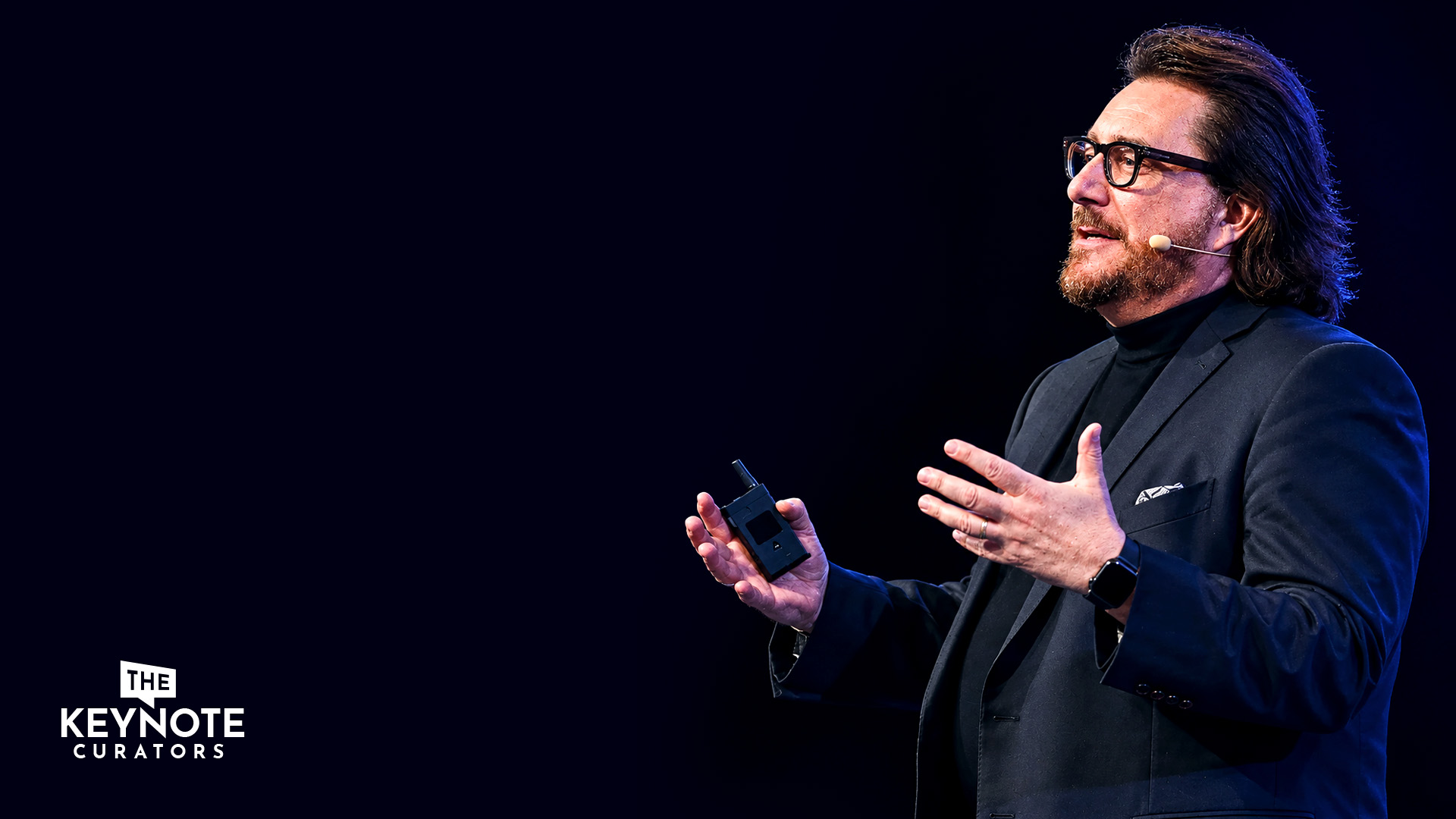
Scott is a Hall of Fame speaker, a bestselling author of ICONIC, and a distinction expert who has worked with organizations like Cisco, BMW, and Bank of America. When I asked him about the ideas in business that never change, he did not hand me a list of new trends. He said the values behind great customer experience are timeless. What changes is whether anyone follows through. That answer sounds simple, but I don’t think it is. It asks every leader a hard question: do the values on the wall match the values in the building?
🎥 Watch and listen to the full interview with Scott McKain
Why Values Are Easy to Write and Hard to Live
Writing a values statement takes an afternoon. Someone books a conference room, a team picks words like integrity, service, and respect, and a designer turns the list into a poster. I have sat in rooms like that. The energy is real, and people mean it. But the poster is the easy part. The hard part starts the next morning, when a customer calls with a problem and the systems, the schedules, and the incentives all pull in a different direction than the poster does.
What I appreciated about Scott is that he does not attack the idea of stated commitments. He simply asks what happens after they are stated. In his view, nearly every business has some version of the same sign. We are here to take care of our customers. The purpose of business is to attract and retain customers. Nobody argues with that. And yet, he told me, he sees companies doing things every week that contradict it. The sign is not the problem. The behavior is.
The more I think about it, the more I believe this is one of the central leadership challenges of our time. Values are cheap to declare and expensive to honor. Declaring them costs nothing. Honoring them costs money, time, attention, and sometimes short-term profit. That is why so many organizations quietly stop at the declaration. It feels like progress, and it looks good in a brochure. But customers and employees do not judge an organization by what it says. They judge it by what happens when it is inconvenient to be consistent.
This is where the real work of leadership begins. A leader’s job is not to write the values. A leader’s job is to protect them when the quarter gets tight and when a cheaper shortcut shows up. Shortcuts almost always look reasonable. That is exactly what makes them dangerous.
The Thirty Minute Hold That Says Everything
Scott told me about a call he made to his insurance company that same day. He was on hold for thirty minutes. While he waited, a recording kept repeating how important his call was. He laughed as he told it, because anyone who has been there knows the feeling. But behind the laugh there is a serious point. “If my call was that important, you wouldn’t put a customer on hold for half an hour listening to awful music and this constant reminder.”
What struck me most is how cleanly this small story exposes a contradiction. The recording says one thing. The wait says another. And the customer believes the wait, every time. Words can claim importance, but time is the currency that proves it. When you make someone spend half an hour of their day listening to a loop, you have told them exactly where they rank, no matter what the recording says.
Scott treats this as a values problem rather than a service problem, and I think that distinction matters more than it first appears. If you label it a service problem, you hire more agents, buy better software, or shorten the queue. Those fixes help, but they treat the symptom. If you label it a values problem, you ask a harder question: what did we decide mattered when we built this system? Someone chose the phone tree. Someone chose the staffing level. Someone approved the recording. Each choice reflected what the organization truly cared about, which is not always what it said it cared about.
Scott also joked that, now that AI has arrived, many of us find ourselves yelling at our phones, “Representative, representative!” It gets a laugh in every presentation, and I think it lands because the experience is so shared. It also points to something bigger. Technology can make a company faster, but it cannot make a company care. If the values underneath are weak, automation only delivers the weakness at scale. A poor experience handled by a machine is still a poor experience, just repeated a million times a day. The heart of great customer experience has never been the tool. It has always been the intention behind the tool.
Timeless Values in a Turbulent World
When I asked Scott about the through lines that never change, I half expected a set of predictions. Instead he gave me something closer to reassurance. The core values of a healthy business, he said, are timeless. They transcend the turbulence of today. Technology moves, markets swing, and customer habits shift, but the basic promise underneath stays put.
I find that comforting and uncomfortable at the same time. It is comforting because leaders do not have to reinvent their principles every time a new tool arrives. It is uncomfortable because it removes the excuse. If the values are timeless, then a failure to live them cannot be blamed on the times. It can only be blamed on us.
The principles themselves are not complicated. Keeping a customer is worth more than finding a new one. People want to feel respected. Nobody needs a consultant to explain either idea. Yet these simple values are often the first to erode when a company gets busy, gets big, or gets nervous about its numbers. Complexity is not the enemy here. Forgetting is.
That is why this conversation belongs in any serious discussion of business. Strategy gets the attention. Tactics get the budget. But the values decide whether a strategy is carried out with care or with indifference. Scott put the real challenge in one place: the execution and the implementation. He wants customers to be able to say, “Man, they live their values.” That phrase stayed with me. Customers never say it about a statement. They only say it about an experience.
What Southwest Airlines Teaches Us About Values
Scott offered an example that I keep coming back to. He used to say in his speeches that he had flown to the event, and they told jokes on the plane, and everyone had a great time. Then he made a point I loved. No one ever stood up and asked whether he had flown American. Everybody knew he had flown Southwest. The brand was so distinctive that the story named the airline without ever naming it.
That is what living your values looks like from the outside. Southwest did not just claim to be fun and friendly. Passengers experienced the jokes. Bags flew free. There was a clear reason to choose them and a clear reason not to choose anyone else. The values were visible in behavior, and that visibility became the brand itself.
So when Scott says he worries about Southwest, I take it seriously. His worry is not that the airline lacks smart people or good numbers. His worry is that somewhere along the way, “we get so business-like, so corporate, we count the numbers, and we eliminate the very things that keep customers coming back.” I have seen this pattern in many industries. A company does something unusual, and customers love it. Then the spreadsheet arrives. Every quirk that cannot be measured starts to look like waste, so it gets trimmed.
The trouble is that the unusual thing was never waste. It was the reason people chose the company. When a business removes the behaviors that made it distinctive, it is not cutting cost. It is cutting the link between its values and its customers. Over time, the brand becomes standard, and standard is easy to replace. Real business growth often depends on the things that look inefficient on paper. I would not presume to tell any one airline what to do. But the lesson holds for every leader. Before you cut something, ask whether customers chose you because of it.
Why Success Is Such a Poor Teacher
Scott passed along a line from his friend Joe Calloway that I have not been able to shake. “Success means you know what used to work.” Read it slowly. It does not say success tells you what works. It says success tells you what used to work. That small shift in tense is where a lot of companies get into trouble.
Success creates confidence, and confidence creates habit. A company hits a good run, and the habits that produced it start to feel like laws of nature. Leaders stop asking questions because the answers seem obvious. Meanwhile, customers change, competitors learn, and the thing that earned the good run may have quietly changed without anyone noticing. The company keeps running on memory. I think that is one of the most dangerous positions a business can be in, because everything still looks fine from the inside.
It is tempting to believe that strong values protect us from this drift. I don’t think they do, at least not automatically. Values can go stale, too, if we stop asking how they show up today. A company can keep the same words on the wall for thirty years while the behavior slowly moves away from them. Scott named two forces behind this. One is the tradition in our industry, the belief that this is simply how things are done. The other is the myopic view that leadership can develop, where the horizon shrinks to the next report.
The question Scott wants leaders to ask is what is going to work for us today and tomorrow, not what used to work. I like that framing because it does not ask a company to abandon its values. It asks the company to express those values in a way that fits the present. That is the essence of innovation at its best. It is not novelty for its own sake. It is faithfulness to a purpose, carried out with fresh methods.
Values Without Execution Are Just Decoration
There is a line I keep repeating to myself after this conversation. Values without execution are just decoration. I have walked into lobbies where the values are printed in large, elegant letters, and I have watched the way people were treated within ten minutes of walking in. The decoration and the behavior did not agree. And guess which one I believed.
Employees see this gap before customers do. They know which values leaders defend and which ones they only display. If a company says it respects people but schedules its team into exhaustion, the team learns that the poster is for visitors. If a company says it puts customers first but rewards only speed, the team learns that speed is the real value. People are remarkably good at reading what an organization truly rewards. They do not need a memo. They just watch what happens to the person who does the right thing at a cost.
This is the kind of idea that belongs in thought leadership, because it changes how we look at ordinary things. A hold recording is not just a hold recording. A cut perk is not just a cost saving. Each is a small message about what the organization believes. Even in sales, where the pressure to close can be intense, trust is built or broken by whether the values a company describes at the start of the relationship survive to the end of it.
Organizations that want to close this gap often turn to values keynote speaker Scott McKain, who has spent decades speaking and consulting for some of the most recognized companies in the world. What comes through in his work, and in our conversation, is that he is not interested in slogans. He is interested in what a customer can feel on an ordinary day. That is a far more demanding standard than a well-written statement, and I think it is the right one.
How Leadership Decides Which Values Customers Feel
Scott did not blame customers for being fickle or markets for being harsh. He pointed at internal causes: tradition and a narrow view of what leadership is for. I appreciated that honesty. It is much easier to blame the environment than to examine our own decisions. But the customer’s experience is the sum of thousands of decisions made inside the company, and each one is a choice.
That is why business leadership and values cannot be separated. Leaders decide what gets measured, what gets funded, and what gets celebrated. If a call center is measured only on how quickly it ends calls, it will end calls quickly, even when the customer needs more time. If it is measured on whether the customer felt respected, it will behave differently. The metric becomes a quiet statement of values, and it usually speaks louder than the poster.
I think this is also why Scott’s work in ICONIC touches customer experience, innovation, and employee culture all at once. Those three are not separate projects. They are three views of the same question. Are we distinctive because of how we treat people, or are we just similar to everyone else with a nicer logo? Employees who work inside a culture that lives its promises tend to pass that experience along to customers. Employees who work inside a gap tend to pass that along, too.
There is one more thing I would add. Customers feel a company’s principles through behavior, but they feel them most strongly in the small moments when nobody is watching. The unrecorded call. The refund that could have been refused. The follow-up nobody required. Those moments are where a company shows who it is when it is not performing. Leaders who understand that stop chasing big gestures and start paying attention to the quiet ones.
A Simple Way to Test Whether Your Values Are Real
After the interview, I kept looking for a practical way to apply Scott’s thinking, and I landed on a few simple tests. The first is the hold test. Call your own company as a customer and see how long you wait, how you are spoken to, and how the recording makes you feel. If the experience contradicts your stated values, you have found a place to start. It costs nothing, and it is more honest than a survey.
The second is the quiet cut test. Before any organization trims a cost, it should ask whether customers chose it because of the thing being trimmed. Southwest is the example Scott used, but the question applies to any business. Some things look small on a spreadsheet and enormous in a customer’s memory. The third is the random Tuesday test. Ask what a customer would experience on an ordinary day, with no special event and no senior leader watching. If the answer lines up with your values, you are probably doing well. If it does not, you have a gap that no poster can close.
This is not only an organizational question. It is a professional development question for each of us. Every professional has a version of the hold recording, a place where what we say and what we do drift apart. Maybe it is how we answer email from a junior colleague. Maybe it is how we treat a client who cannot help us. When I look honestly, I find my own examples. The values I say I hold and the ones I show are not always the same, and the gap is worth noticing.
People sometimes assume that the most inspirational and motivational ideas have to be dramatic. I have come to think the opposite. The most motivating idea in this conversation is quiet and practical: make your behavior match your words. It does not need a new program or a new budget. It needs attention, honesty, and the courage to fix what is uncomfortable to look at.

A Random Tuesday Call Tells the Truth
I started this reflection with a thirty-minute hold, and I will end with it. Scott’s story is funny, but its lesson is not small. The companies that keep their customers are not the ones with the best-written values page. They are the ones where a customer can feel it on a random Tuesday call. That kind of proof cannot be faked with a poster, a slogan, or a well-timed campaign.
If I had to name the lesson that stayed with me, it would be this. Values are not what you write. They are what you repeat under pressure. They show up in the phone system, the staffing plan, the way a cost gets cut, and the way a complaint gets answered. Southwest reminds us that distinctive behavior can build a brand people love, and that removing it can quietly dissolve the reason people came. Joe Calloway reminds us that yesterday’s success is not tomorrow’s strategy. Together, they point to the same challenge for any leader.
So the question I would leave you with is the one Scott leaves with his audiences. Are you living your values, or just posting them somewhere visible? Your customers already know the answer. They knew it the moment the recording told them how important they were. The only open question is whether you will listen to what their experience is telling you, and whether you will change what needs changing, starting with the next call.
🎤 Explore the full profile of Scott McKain and see how he helps organizations become distinctive.
📈 Browse more business growth voices for your next event.
🤝 Find more customer experience speakers who help teams deliver on their promises.
Discover More Insights




Get in TouchContact US
Fill out the form so we can best understand your needs.
A representative from The Keynote Curators will reach out to you.