
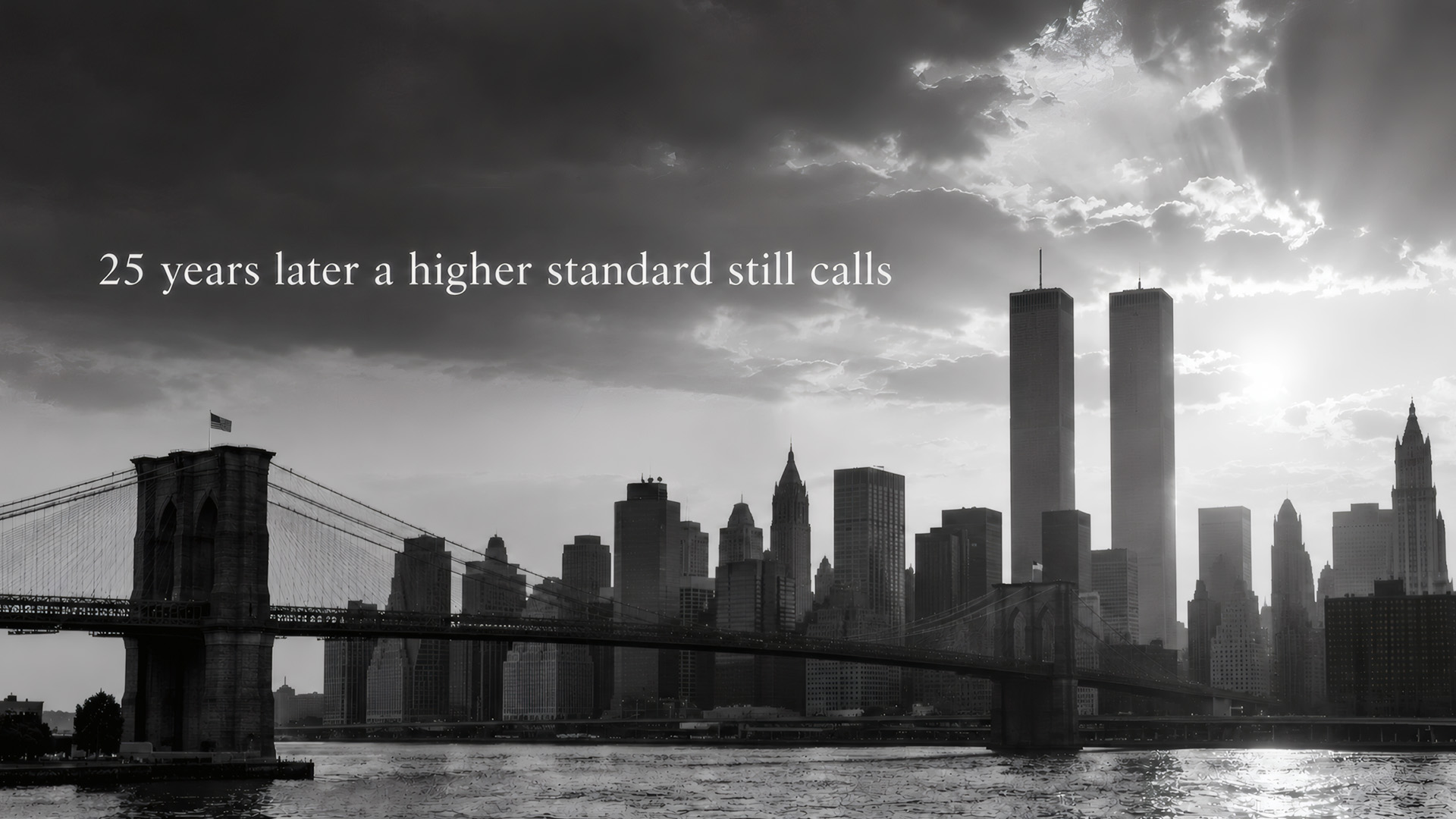
September 8, 202625th Anniversary of 9/11
Twenty-five years is a strange distance. It's long enough for 9/11 to start sounding like history to people who weren't alive for it, and close enough that many of us can still say exactly where...
Twenty-five years is a strange distance. It’s long enough for 9/11 to start sounding like history to people who weren’t alive for it, and close enough that many of us can still say exactly where we stood the moment we heard the news.
On September 11, 2001, the world changed in ways we’re still trying to understand. There’s no clean way to write about it. No clever phrase earns the weight of that day, and this isn’t an attempt to turn 9/11 into a leadership lesson. But twenty-five years later, there’s a question worth asking with care: what did that day reveal in us that we still need now?
For a moment after the event, something remarkable happened. Strangers looked out for each other. Differences mattered less. Service mattered more. A country under extraordinary pressure remembered what it means to depend on one another. Not perfectly, and not permanently. But genuinely, for a moment, we were better.
I don’t write that lightly, and I don’t mean it as sentiment. The need for common ground and steady leadership didn’t disappear once that moment passed. Neither did the need to serve something larger than our own certainty. If anything, that need feels more urgent now, twenty-five years after 9/11.
The View From Inside the Bunker
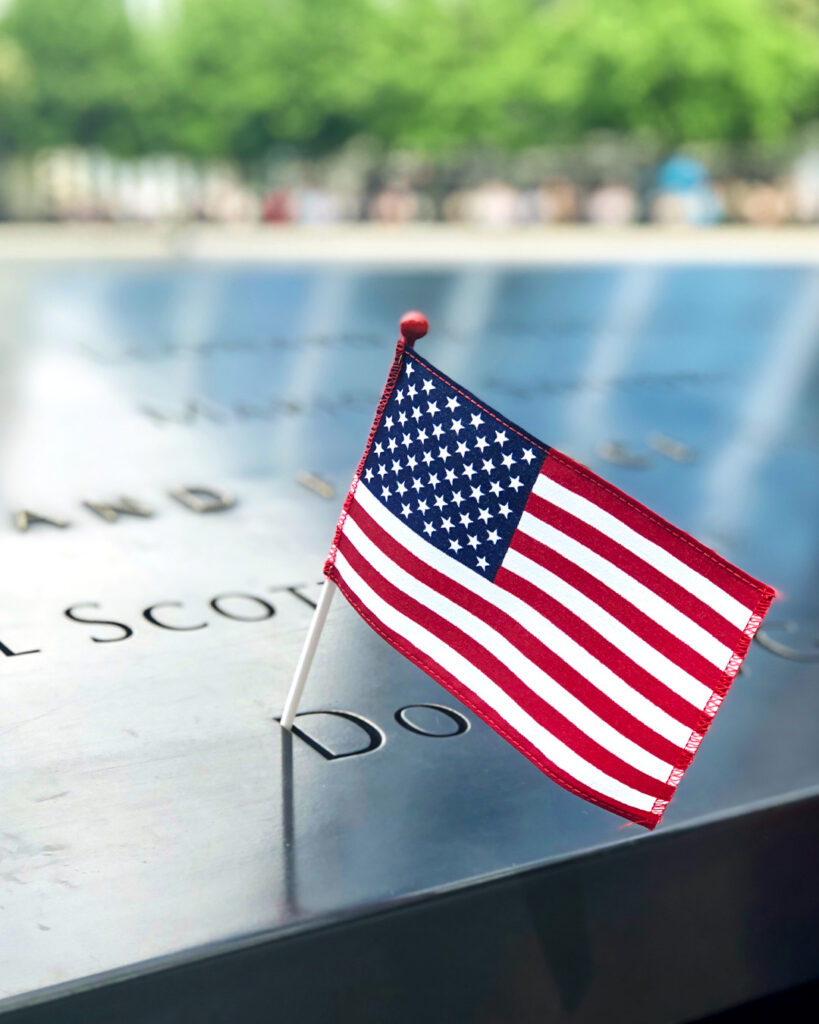
Lt. Col. Robert J. Darling watched 9/11 unfold from inside the White House bunker, which is almost impossible to picture unless you were there. What stays with me about his account isn’t only where he was. It’s how he talks about it.
He doesn’t turn crisis into theater. He doesn’t flatten 9/11 into a slogan, and he doesn’t use fear as a dramatic device or patriotism as a shortcut around the human weight of what happened that day. He remembers a morning when the information was incomplete, the pressure was unbearable, and waiting for certainty simply wasn’t an option. That’s what makes his perspective on 9/11 so useful now, a quarter century later.
What struck me most, listening to how Robert describes those hours, is how ordinary the mechanics of the decisions actually were. People still had to speak clearly. Someone still had to decide what to say next, and to whom. The stakes were enormous, but the process underneath them was still made of small, human choices. That’s easy to forget when 9/11 gets remembered mostly through its images. The planes, the towers, the smoke. Underneath those images were rooms full of people trying to think straight while the ground moved.
What Crisis Actually Reveals
Here’s the part of Robert’s story that I keep coming back to. Crisis doesn’t usually create character out of nowhere. It exposes what’s already been practiced.
A leader who’s practiced ego brings ego into the room. A team that’s practiced blame will blame faster once things go wrong. A culture that’s practiced silos will protect itself in pieces instead of pulling together. None of that shows up for the first time during the crisis. It was there already, quietly, waiting for pressure to reveal it.
But the opposite is also true, and this is the half of the equation that gets less attention. A leader who’s practiced steadiness has something to offer when the room starts losing oxygen. A team that’s practiced trust can move faster because it isn’t wasting precious time questioning each other’s motives. A culture that’s practiced service can make better decisions because people aren’t fighting to be the hero of the story.
That feels like one of the quieter leadership lessons sitting inside 9/11. Not every hard moment is a national crisis. But every organization eventually hits a moment when the plan fails, the room tenses, the facts are incomplete, and everyone looks around to see who is going to make the next moment better or worse. By then, it’s too late to invent your culture. You bring what you built.
I’ve seen this same pattern outside of anything close to 9/11. A product launch that breaks at the worst possible time. A layoff announced badly. A public mistake that spreads faster than the truth can catch up to it. In every case, the organization’s real character shows up in the first ten minutes, not the press release that comes a week later.
Calm Is Not Passive
There’s a kind of calm that gets mistaken for weakness. It isn’t.
Calm can be one of the most active forms of leadership there is. Not detached calm, and not coldness. Not pretending the stakes are low when they aren’t. It’s the kind of calm that keeps a room usable. That gives people enough clarity to act. The kind that says, “We don’t know everything yet, but here’s what we know, here’s what matters, and here’s the next right step.”
That’s not a line from a movie. It’s closer to what actually has to happen in rooms like the one Robert describes on 9/11, and in far smaller rooms every single day since. In tense moments, people borrow the nervous system of the leader in front of them. If the leader spins, the room spins with them. If the leader performs certainty they don’t have, people learn to hide their own uncertainty instead of raising it. If the leader stays honest and steady, the room has a real chance of staying useful.
The more I think about it, the more I believe this is the actual skill underneath most crisis leadership. Not bravery in the dramatic sense. The discipline to keep your own signal clean when everyone around you is reading it for cues. Robert’s story from 9/11 gives us a way to understand that without turning it into a theory, because he watched what happens when decisions carry real consequences, and he watched what becomes possible when people choose discipline over panic and service over self.
What a Room Borrows From Its Leader
I want to sit with that idea a little longer, because I think it explains more about ordinary workplaces than most leadership books do.
Every team has a nervous system, and it usually mirrors whoever is standing at the front of the room. This isn’t mystical. It’s observable. Watch a meeting the moment bad news lands. Watch how fast the tone in the room follows the leader’s tone, up or down. A leader who reacts to bad news by looking for someone to blame teaches the whole team to hide problems until they can’t be hidden anymore. A leader who reacts by asking, calmly, “okay, what do we actually know,” teaches the team that honesty is safe.
9/11 is an extreme version of this dynamic, but it isn’t a different dynamic. The same borrowing happens in a hospital when a patient crashes, in a cockpit during turbulence, in a startup when the funding falls through. What Robert’s story does, better than almost anything I’ve encountered, is strip the dynamic down to its clearest form. There was no room for performance on 9/11. Only for what people had actually built inside themselves before that morning began.
That’s the part I think gets lost when 9/11 becomes an anniversary rather than a lesson. We remember the images. We remember the grief, and rightly so. But we don’t always sit with the quieter truth underneath it, which is that the people who held rooms together on 9/11 weren’t improvising heroism. They were drawing on habits they’d built long before anyone was watching.
Unity Is a Discipline, Not a Memory
This might be the idea that feels most important right now. Unity is a discipline.
It’s easy to talk about unity, especially around 9/11, as if it were a feeling we misplaced somewhere. A moment we should somehow get back to, if only we tried hard enough or missed each other enough. But unity doesn’t mean everyone agrees on everything. It doesn’t mean sameness, and it doesn’t mean avoiding hard conversations because disagreement feels uncomfortable.
Unity is the decision to remember that shared responsibility still exists, even when trust is strained. It’s the ability to sit beside someone you don’t fully understand and still ask, “what does this moment require of us?” That’s less sentimental than the way 9/11 anniversaries often get talked about, and I think it’s more useful.
Because right now, the world needs leaders who can lower the temperature without lowering the standard. Leaders who can help people think clearly under pressure. Leaders who understand that service isn’t weakness, and who remind a room that common ground isn’t a slogan. It’s something we practice, especially when it would be easier not to. That’s true whether we’re talking about a company navigating a hard quarter or a country trying to remember what it owes 9/11’s survivors and the families who are still carrying that day with them.
Why This Story Still Belongs in the Room
I don’t think Robert’s story matters because it’s dramatic. Plenty of stories from 9/11 are dramatic, and drama alone doesn’t teach anyone anything. It matters because it’s clarifying.
It asks something of a room without shouting at it. It reminds people that crisis response begins long before the crisis, in the habits we build, the trust we protect, and the kind of people we become when no one is clapping.
That feels especially relevant now, when so many organizations are trying to lead through uncertainty, fractured attention, low trust, constant change, and a public square that often rewards division more than discipline. A story like Robert’s, rooted in the specific weight of 9/11, doesn’t solve any of that. But it can create a pause. It can make people look at their own pressure differently, and it can remind leaders that calm isn’t passivity, unity isn’t nostalgia, and service isn’t weakness.
That’s not remembrance alone. That’s preparation.
What Twenty-Five Years Should Teach Us About Trust
The lesson that stayed with me longest, after sitting with Robert’s account of 9/11, is how much of what mattered that day had already been decided before the day arrived. Trust doesn’t build itself in a bunker. It gets built or eroded in ordinary meetings, ordinary disagreements, ordinary moments when nobody’s watching closely and it would be easy to cut a corner.
That’s true of nations, and it’s just as true of teams. The trust a company draws on during its worst week was either deposited or spent during the hundred ordinary weeks before it. 9/11 makes that principle unmissable because the stakes were so high and the timeline so compressed. But the principle itself doesn’t need a national tragedy to be true. It’s operating quietly in every organization, all the time, whether anyone’s paying attention to it or not.
What caught my attention, thinking about this twenty-five years out from 9/11, is how tempting it is to treat trust as something that shows up automatically when it’s needed. It doesn’t. Robert’s story is a reminder that the people who function well under pressure are almost always the people who did unglamorous work on trust long before the pressure arrived.
What This Looks Like Off the Anniversary
It would be easy to read all of this and file it under “things that apply once a year, around 9/11, and then fade again.” I don’t think that’s the right way to hold it.
Most of us will never sit in a bunker. Most of us will never face a morning like the one Robert describes from 9/11. But almost everyone reading this has sat in a smaller version of that room. The meeting where the numbers come in worse than expected. The call where a client says they’re walking. The morning a key person quits without warning and everyone else is staring at each other, waiting to see how the leader reacts before deciding how alarmed to be.
What I’ve noticed, watching leaders in those ordinary moments, is that the ones who hold steady rarely do it through some special reserve of courage they were born with. They do it because they’ve already decided, long before that meeting, what kind of leader they intend to be when things go sideways. That decision, made in advance and rehearsed in small ways over time, is what 9/11 made visible on the largest possible stage. It’s also what’s available to anyone willing to build it deliberately, without needing a crisis on the scale of 9/11 to reveal it.
This is where I think the anniversary earns its place beyond remembrance. Not as a once-a-year ritual, but as an annual check-in with ourselves. Have we been practicing the version of leadership that 9/11 asked of the people inside that bunker? Or have we let the daily noise talk us out of it, one small compromise at a time, until the habits we’d need in a real crisis quietly went unbuilt?
A Question for the Room
As the 25th anniversary of 9/11 approaches, remembrance matters. So do the names. The families. The first responders, the service members, the survivors, and the ordinary people whose lives were forever changed by 9/11.
But maybe remembrance should also ask something of us. Something useful, not just something reverent. The next time pressure enters your room, whatever kind of room it is, ask yourself: what would this moment look like if service mattered more than being right?
That question doesn’t dismiss disagreement, and it doesn’t simplify a complicated situation. But it might change the next decision. It’s a small enough question to carry into an ordinary Tuesday, and a large enough question to have shaped how people behaved inside a White House bunker on 9/11.
We were better for a moment, and we can be again
Twenty-five years on, 9/11 still asks something of us, even when we’d rather just observe it and move on. The honest answer is that the unity people felt after 9/11 wasn’t a mystery. It was ordinary people choosing, for a stretch of time, to practice trust instead of suspicion, and service instead of self-interest. Robert’s story from that day is proof that the choice is available under even the worst conditions, because it was made, deliberately, inside a bunker under the White House while the country outside tried to make sense of what was happening.
I don’t think honoring 9/11 means trying to recreate the exact feeling of that week. That’s not realistic, and it isn’t really the point. The point is smaller and more usable. It’s remembering that the version of ourselves that showed up after 9/11 wasn’t invented out of nowhere. It was already inside us, and it’s still inside us now. The habits that produced it, steadiness, trust, service, are habits we can practice on an ordinary day, long before anything asks it of us. That’s the quiet lesson underneath 9/11 that I keep returning to. Not a call to relive the past, but a reminder of what we’re capable of building on purpose, starting now.
📅 Planning your next event? Let’s schedule a call and find the speaker for you
📩 Have a question? Reach out to us here
🕊️ Want more reflections like this one? Follow our weekly newsletter
🎙️ Want Robert Darling’s perspective for your own event? Learn more about booking him here
Discover More Insights


Get in TouchContact US
Fill out the form so we can best understand your needs.
A representative from The Keynote Curators will reach out to you.
Our Services
Keynote Speakers Topics
© 2026 The Keynote Curators. All Rights Reserved | Terms and Conditions
The Keynote Curators, 8275 South Eastern Avenue, Suite 200, Las Vegas, NV 89123
Local (310) 299-4595 | Toll Free (888) 585-8715 | info@thekeynotecurators.com
The Keynote Curators - Top Keynote Agency, USA.