
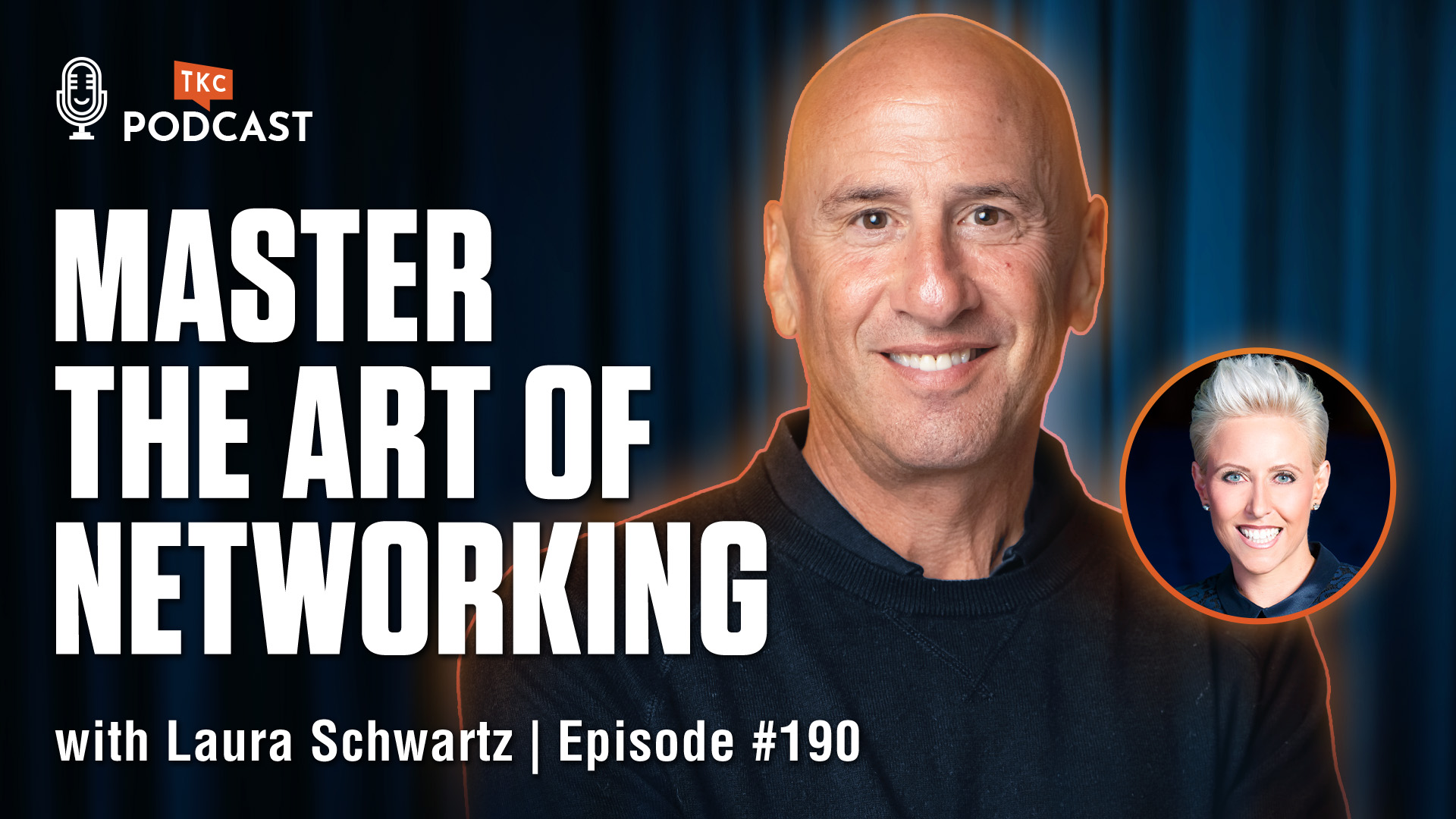
September 3, 2026Networking Redefined: Eat, Drink, and Succeed, with Laura Schwartz
Laura Schwartz reveals what real networking looks like: service, presence, and community over status and self-interest.
Most people think networking is a numbers game. Collect enough business cards, shake enough hands, and something good will eventually happen. I used to believe that too. Then I sat down with Laura Schwartz, the former White House Director of Events under President Clinton, and she said something that stuck with me long after we finished recording. Networking, she told me, isn’t about what you can get. It’s about what you can give.
That single shift in thinking changes everything about how you walk into a room. It changes who you talk to, what you say, and what you remember about the people you meet. Laura has spent decades studying this idea, first inside the White House, where she built more than a thousand events for heads of state and world leaders, and later as a keynote speaker and emcee working with brands like Microsoft, Hilton, and PepsiCo. Her approach to networking isn’t theoretical. It’s built from watching what actually makes people feel connected, and what leaves them feeling used.
What struck me most about our conversation is how simple her philosophy sounds on the surface, and how rarely people actually practice it.
🎧 Watch and listen to the podcast episode: YouTube • Spotify • Apple Podcasts • Amazon Music
Networking Starts With a Question, Not a Pitch
Laura’s entire philosophy on networking can be traced back to one question. Not “what do you do,” which is how most of us are trained to open a conversation. Her question is simpler and harder at the same time: who am I, and why am I here?
It sounds almost too basic to matter. But I’ve watched enough networking events go sideways to know that most people never actually answer that question for themselves before they walk into a room. They show up with a stack of cards and a rehearsed pitch, and they treat every conversation like a transaction waiting to happen. Laura’s version of networking asks you to do the opposite. Before you think about what you want from someone, she wants you to think about why you’re standing in front of them at all.
This is where her book, Eat, Drink, and Succeed, earns its title. The book isn’t a manual for climbing a ladder. It’s a study of how relationships actually form, usually over a meal, a drink, or a shared moment that has nothing to do with business on paper and everything to do with business in practice. You can read more about her work and her approach to networking on Laura’s speaker profile, and it’s worth doing, because the ideas hold up outside of any single event or industry.
The Power of Community: Access vs Influence
One of the most interesting distinctions Laura draws is between access and influence. Access gets you in the room. Influence is what happens once you’re there. A lot of people spend their entire careers chasing access, collecting titles and connections that look impressive on paper, without ever building the kind of trust that makes people actually want to help them.
Community, in Laura’s world, is what turns access into something real. When you build genuine relationships instead of just a contact list, you stop needing to prove your importance every time you walk into a room. People already know who you are, because you’ve shown up for them before. This is a lesson that applies far beyond events and conferences. It’s true in leadership as well. The leaders people trust most aren’t always the ones with the biggest titles. They’re the ones who’ve built a track record of showing up when it counts.
I’ve seen this same pattern play out in organizations that talk a lot about corporate culture but never quite get it right. Culture isn’t a slogan on a wall. It’s the sum of a thousand small moments where people either treat each other like resources or like human beings. Networking, done well, is one of those moments repeated over and over.
Eat, Drink, and Succeed: Redefining Networking
The title of Laura’s book sounds almost playful, but there’s a real argument underneath it. Some of the most important conversations of her career happened not in meetings, but at dinners, receptions, and the in-between moments most people rush past on their way to something else. Networking, in her experience, rarely happens during the scheduled agenda item. It happens in the hallway afterward.
This reframes what networking actually is. It isn’t a skill you deploy during a designated session at a conference. It’s a mindset you carry into every interaction, formal or not. The person seated next to you at dinner might matter more to your future than the keynote speaker on stage. That idea alone should change how seriously people take the “soft” parts of an event, the parts that don’t show up on the agenda but shape everything that happens afterward.
Laura’s proceeds from the book go entirely to nonprofits chosen by the clients who bring her in to speak, which tells you something about how she thinks about philanthropy and generosity as extensions of the same networking philosophy. Giving without expecting something immediate back isn’t naive. It’s strategic in the truest sense, because it builds the kind of reputation that outlasts any single transaction.
The Question That Changed Everything: Who Am I, Why Am I Here
Laura first had to answer that question at nineteen years old, when she arrived at the White House as the youngest female presidential appointee in history. She had no political connections. She wasn’t from a family with Washington ties. She had to figure out, fast, who she was in a building full of people who already knew exactly who they were and why they mattered.
What she learned in that pressure cooker environment is that networking under those conditions isn’t about pretending to belong. It’s about finding the value you actually bring and offering it clearly, without apology and without arrogance. That answer became the foundation for everything she built afterward, climbing from Staff Assistant to Midwest Press Secretary to Director of Television and eventually to White House Director of Events.
This is a lesson in professional development that doesn’t get talked about enough. Most career advice focuses on skills and credentials. Laura’s story suggests that clarity about your own value, and the confidence to offer it through genuine networking rather than self-promotion, matters just as much.
Leaving the White House and Facing “Who Am I” Again
Here’s the part of Laura’s story that I think about the most. After years of producing events on the world stage, after working directly with a sitting president and heads of state, she left the White House and had to ask herself the exact same question again. Who am I, and why am I here? Except this time, there was no title attached to the answer.
That moment reveals something important about identity and networking that most professionals never have to confront directly, but eventually will. The relationships you build during a high-status chapter of your career only prove their worth once the title disappears. If your networking was built entirely on your position, it evaporates the moment the position does. If it was built on genuine connection, it survives the transition and often becomes even more valuable, because now people are showing up for you rather than for your job.
This is why the difference between transactional networking and relationship-based networking isn’t a matter of style. It’s a matter of what actually lasts.
The Details a Great Host Notices
Laura’s years hosting events, from state dinners to global conferences, taught her to notice things most people walk right past. A name badge turned the wrong way. A guest standing alone near the exit. The subtle body language of someone who wants to leave a conversation but doesn’t know how. These details matter because great hosting, like great networking, is an act of attention.
This connects directly to how she thinks about customer experience. Whether you’re running a five-thousand-person conference or a small client dinner, the quality of the experience is built from these small, easily missed moments. Networking that actually works follows the same logic. You’re not managing the room. You’re paying attention to the individuals in it.
What caught my attention here is how much of this skill is really just presence. Not multitasking, not scanning the room for someone more important while you’re mid-conversation, but actually being where you are. Laura has emceed events for companies like Microsoft, Hyundai, and Verizon, and the thing that makes her effective in those rooms isn’t polish. It’s her ability to make a room full of strangers feel like they’re being genuinely seen.
Relevant and Relatable: A Two-Part Framework for Connection
Laura breaks down effective connection into two words: relevant and relatable. Relevant means the content, the message, or the conversation actually matters to the person in front of you. Relatable means they can see themselves in it. Miss either one, and the connection falls flat, no matter how much charm or polish you bring to it.
This framework applies directly to networking, because most networking conversations fail on one of these two counts. Either the person talking has nothing relevant to offer, or they’re so focused on their own credentials that nothing they say feels relatable. The people who network well instinctively balance both, offering something useful while staying human enough that the other person actually wants to keep talking.
I think this framework is one of the more underrated tools in communication generally, not just at networking events. It applies to public speaking, to leadership conversations, to how you write an email to your team. Relevant and relatable is a filter worth running everything through.
Creating an Atmosphere for Connection
One thing Laura emphasized that doesn’t get discussed often enough is how much the physical and emotional atmosphere of a room shapes whether real networking can happen at all. You can put a hundred interesting people in a space, but if the lighting is wrong, the seating forces isolation, or the energy in the room feels stiff and formal, none of that potential connection actually happens.
This is where her background in entertainment and event production becomes relevant beyond the events industry itself. Creating an atmosphere where people feel comfortable enough to be themselves is a skill, not an accident. Whether you’re a team leader trying to build teamwork across departments or a founder hosting a company retreat, the environment you create either invites networking and connection or shuts it down before it starts.
From ROI to Return on Experience
Laura introduced a phrase in our conversation that I haven’t stopped thinking about: return on experience. Most business leaders are trained to measure everything through return on investment, and there’s nothing wrong with that discipline on its own. But when you apply pure ROI thinking to networking and relationship building, you miss the point entirely, because the value of a genuine connection often doesn’t show up on a spreadsheet for months or years.
Return on experience asks a different question. Did the person walk away from this interaction, this event, this conversation, feeling better than when they arrived? Did they feel seen, valued, and genuinely engaged? That feeling is what people remember, and it’s what actually drives them to reach back out later, refer someone to you, or think of you when an opportunity comes up. This is the long game version of networking, and it’s the one Laura has built her entire career around.
For entrepreneurs, this idea matters even more, because early-stage networking often has no obvious short-term payoff. You’re planting seeds you may not see grow for years. Measuring only ROI in that stage of building a business will make you give up on relationships too early.
Handwritten Notes in an Age of AI
In a world full of automated emails and templated LinkedIn messages, Laura still believes in the handwritten note. It sounds almost old-fashioned, but that’s exactly the point. When everything else is fast and automated, a slow, deliberate gesture stands out precisely because it costs something: time and attention.
She told a story about a confetti thank-you note, a small, playful detail that turned an ordinary gesture into something memorable. That’s the essence of good networking. It’s not about grand gestures or expensive gifts. It’s about small, thoughtful details that show someone you were actually paying attention to them as a person, not as a name on a contact list.
This matters more, not less, as media and communication become increasingly automated. The people who stand out in a networking context going forward will be the ones who resist the pull toward efficiency at the expense of genuine connection.
What Larry King Taught Her About Listening
Laura shared a lesson from her time around legendary broadcaster Larry King that ties everything else together. King’s gift wasn’t that he asked brilliant questions. It was that he listened so closely to the answers that his follow-up questions felt like he’d known the person for years. That kind of listening is rare, and it’s the real engine behind effective networking.
Most people, in a networking conversation, are only half listening because they’re already planning what they’ll say next. Laura’s approach, shaped by watching King work, is to actually be present in the answer someone gives you. This ties back to her early TED style talks and her keynote work, where she often coaches audiences on the difference between hearing and listening.
Networking built on real listening doesn’t feel like networking at all. It feels like a conversation between two people who genuinely want to know each other, which is exactly what it should be. This kind of attentiveness also connects to conversations around DE&I, because listening fully to someone means recognizing and valuing a perspective that may be very different from your own.

Networking, Redefined by What You Give
The more I think about my conversation with Laura, the more I realize that networking has almost nothing to do with the skills we usually associate with it. It’s not about confidence, charisma, or a well-rehearsed elevator pitch. It’s about attention, generosity, and the willingness to show up for someone before you know what, if anything, they can do for you.
Laura’s story, from a nineteen-year-old staff assistant to White House Director of Events to a globally recognized keynote speaker, is proof that this kind of networking works over the long run, even when it doesn’t pay off immediately. The lesson that stayed with me is simple: the best networking doesn’t feel like networking at all. It feels like genuine human connection, built one conversation, one handwritten note, and one moment of real listening at a time.
🎤 Explore Laura’s keynote speaker profile and book her for your next event
📞 Schedule a time to talk about bringing Laura’s message on networking to your audience
📩 Send your audience and event theme to info@thekeynotecurators.com, and I’ll tell you if she’s the right fit
Discover More Insights





Get in TouchContact US
Fill out the form so we can best understand your needs.
A representative from The Keynote Curators will reach out to you.