
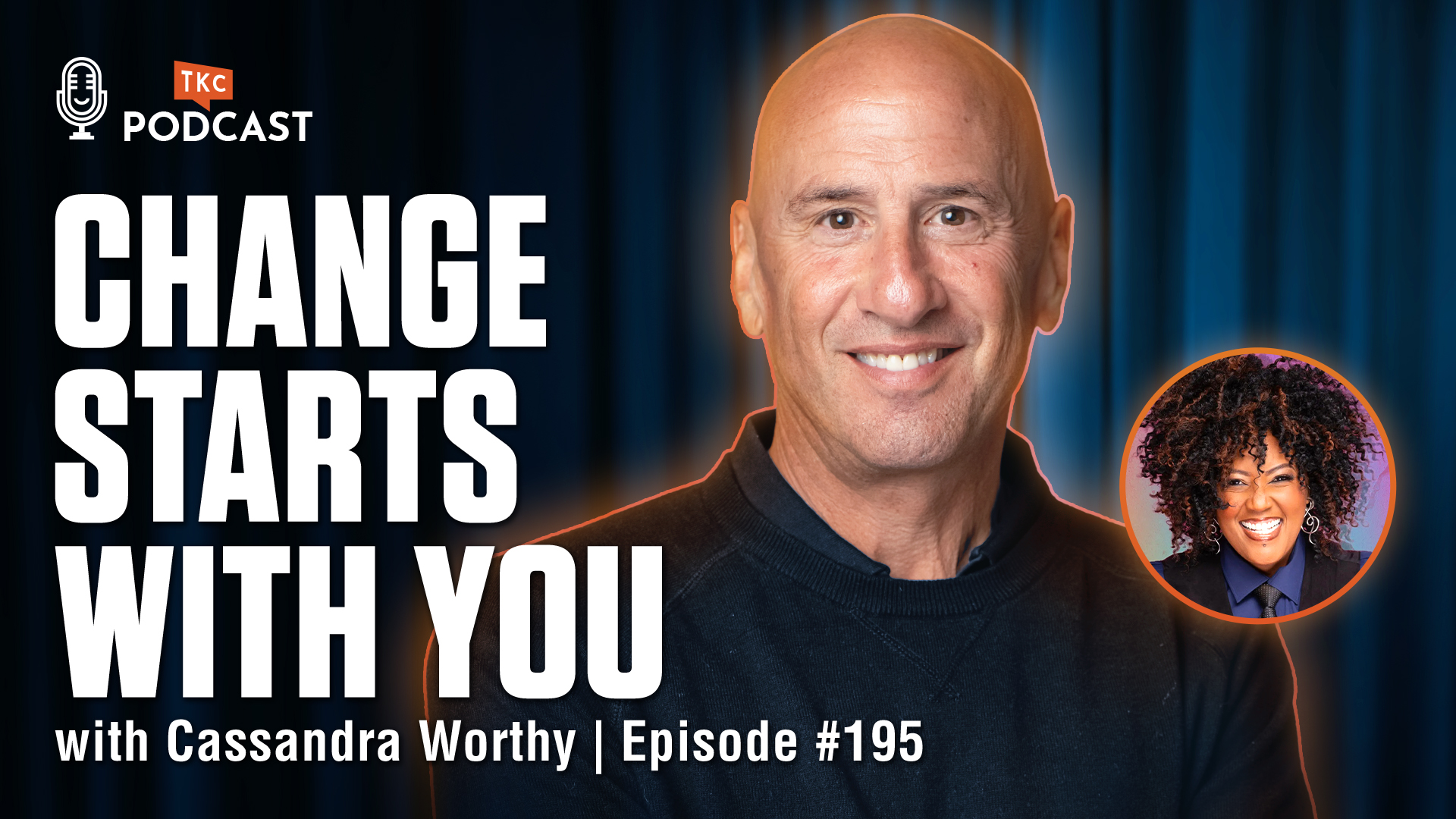
October 8, 2026Change Starts When You Embrace Your Emotions, with Cassandra Worthy
Change starts when you embrace your emotions. Cassandra Worthy shows how to read your feelings as signals and turn discomfort into forward movement.
Most advice about change starts with a plan. Build the roadmap, name the owners, set the timeline, and communicate early. I have heard that advice many times, and I have given some version of it myself. But when I sat down with change keynote speaker Cassandra Worthy, our conversation went somewhere most plans never go. It went to the stomach, the chest, and the tight jaw that show up when a leader hears that everything is about to be different.
Cassandra’s view is easy to say and hard to practice. Change is an emotional event long before it is a strategic one. If we skip the feelings, we skip the very thing that decides whether the change works. She does not mean this as a soft idea. She built a global consulting firm on it, and her client list includes some of the most demanding names in business.
What stayed with me is how practical her answer is. She does not ask leaders to suppress what they feel, and she does not ask them to cheer for every disruption. She asks them to treat the emotion as information. That one move turns a painful moment into something useful. In this article, I want to explore what that means for how we lead change, how we handle rejection, and how we help people through the grief that comes with AI and other major shifts at work.
🎧 Watch and listen to the podcast episode: YouTube • Spotify • Apple Podcasts • Amazon Music
Why change keeps colliding with emotion
Think about the last major change you lived through at work. A new boss, a reorganization, a merger, a new system, a shift in strategy. Now ask yourself what people talked about in the hallway afterward. It was rarely the project plan. It was worry, irritation, relief, fear, and sometimes quiet excitement. Those reactions are not side effects of change. They are the main event, and they shape almost everything that follows. A plan can be flawless on paper and still fail because the people who must carry it out feel unseen.
Cassandra knows this from the inside. Before she built Change Enthusiasm Global, she was an innovation leader at a Fortune 100 company and a trained chemical engineer. She worked through mergers, restructures, and market disruptions, including a multi-billion-dollar acquisition early in her career that nearly made her resign. What struck me is what she did next. She did not decide to become tougher. She decided to read her discomfort differently, as a signal that something important was happening rather than a threat to survive.
That decision became the foundation of her entire approach, and I think it works because it respects how people actually are. Most change models treat emotion as noise that gets in the way of the real work. Cassandra treats emotion as data that points toward the real work. Those are very different starting points, and they produce very different leaders. One group learns to manage people’s reactions. The other learns to listen to them.
Leave your emotions at the door still shapes corporate culture
For years, many of us worked inside an unspoken rule: leave your emotions at the door. Professionalism meant looking calm, sounding certain, and keeping feelings private. Cassandra and I talked about whether that rule has truly faded in an era of constant change. My honest read is that it has softened in language but not always in practice. Companies now say they want authentic leaders. Yet in the moments that matter, such as a reorganization announcement or a hard quarter, the old habits come back fast. People still perform confidence they do not feel.
I have seen this pattern in meetings where everyone nods and no one says what they actually think. The cost shows up later, in quiet disengagement, rumors, and talented people who leave without ever explaining why. This is where corporate culture is really built. Culture is not the values poster on the wall. It is what people feel safe enough to say when the news is uncomfortable. A culture that cannot hold emotion cannot hold an honest conversation about change either, and that makes every transformation harder than it needs to be.
What makes Cassandra’s perspective useful is that she does not swing to the opposite extreme. She is not asking leaders to cry at the town hall or turn every meeting into a therapy session. She is asking for something more disciplined. Name what is happening, learn from it, and then act. Emotion becomes an input to good judgment instead of a threat to it. When leaders understand that distinction, the old rules about change and emotion start to loosen, and people begin to bring their full selves to the work. That is the real foundation of employee engagement.
Confident vulnerability is how leaders earn trust in change
One idea I keep returning to is what Cassandra calls confident vulnerability, the ability to show your full emotional range without losing your authority. Many leaders believe they have to choose between being strong and being honest. They worry that admitting fear will make people lose faith. Cassandra’s experience points the other way. When a leader pretends to be fearless during change, people can tell. They sense the gap between what is said and what is felt, and they trust the leader less, not more.
Think about what the pretending communicates. It tells the team that fear is not allowed, which means their own fear must go underground. People then hide their questions, their doubts, and their early warnings. Those are exactly the things a leader needs to hear. I find it striking that the act meant to protect credibility is the one that quietly destroys it. Honesty about the emotional side of a hard moment gives people permission to be honest in return. That permission is where teamwork gets real, because a team cannot lead change if it is afraid to name what is happening.
The word confident matters here. This is not about oversharing or leaning on your team for comfort. It is about saying, calmly, that this is hard, that you feel it too, and that you still have a direction. I think of it as the difference between a leader who claims to have no worries and a leader who admits to a concern and explains how they are thinking about it. The second one is more believable and more useful, because it shows people how to carry difficult feelings and keep moving. That is a form of leadership that no amount of technical skill can replace.
The three steps that turn change into movement
Cassandra’s framework for change has three steps: signal, opportunity, and choice. It sounds almost too simple, and that is part of its strength. First, recognize the signal. When frustration, anxiety, or disappointment shows up, treat it as a message instead of a malfunction. Second, find the opportunity. Ask what the feeling is pointing toward, and what might be possible on the other side of it. Third, make a choice. Decide how you will respond, rather than letting the emotion decide for you.
What I like is the order. Most of us jump straight to the choice, and it is usually a reactive one. We snap at a colleague, avoid a hard conversation, or push a decision through just to escape the discomfort. The signal and opportunity steps slow things down enough to create room for judgment. In a fast-moving organization, that small pause can be the difference between a thoughtful response to change and an expensive one. It also gives personal development a clear and repeatable shape, since anyone can practice these three steps in an ordinary week.
There is also a quiet sense of agency in this model. A person cannot always control what happens to them, such as a restructure, a lost client, or a new technology that rewrites their role. But they can control how they read their reaction and what they do next. That is a modest kind of power, yet I have found it to be the kind that lasts. It turns people from passengers in a change effort into participants in it. That shift is what separates organizations that absorb disruption from those that get flattened by it.
Signal literacy and the humility of practicing what you teach
Cassandra uses the term signal literacy, and I think it deserves more attention than it gets. Literacy implies a skill that can be learned and improved. Some people read their emotions fluently. They can tell that a feeling is frustration, and that it is pointing to something they value being blocked. Others only feel a general fog of stress. Signal literacy is the practice of moving from fog to clarity. It matters because you cannot respond well to change if you cannot read what your own reaction is telling you.
What I appreciated most was how candid Cassandra was about her own struggles. She shared a personal moment where she had to practice what she teaches, and she did not present it as a tidy success story. That honesty is rare among experts, and it adds weight to the framework. A method for change that only works for people who never struggle is not much of a method. The fact that someone who teaches this for a living still has to work at it tells me the skill is real, and that nobody ever fully graduates from it. Every new situation asks you to read the signal again.
I have thought about this in my own work. It is easy to give advice about change from a safe distance. It is much harder when the discomfort is yours, when the deadline is close and the stakes feel personal. That is the true test of any framework. If it holds up in the middle of your own struggle, it is worth teaching. If it does not, it is only theory. Cassandra’s willingness to be open about that gap is part of why her message lands. It also reminds me that resilience is not a trait some people have and others lack. It is a habit built by returning, again and again, to the same simple questions.
Why you should take rejection personally
This was the part of the conversation that surprised me most. Conventional advice says not to take rejection personally. Grow thick skin, move on, and do not let it get to you. Cassandra says the opposite, and she pairs it with another piece of advice that sounds just as odd: embrace change. When I first heard that, I pushed back a little. But the more I thought about it, the more sense it made.
Here is the reasoning as I understand it. If you tell yourself rejection means nothing, you also tell yourself it has nothing to teach. You skip the sting, and you skip the information that came with it. Taking it personally means letting yourself feel the disappointment, the embarrassment, or the doubt, and then getting curious about what it reveals. Maybe it shows how much you care about the work. Maybe it points to a gap in how you presented an idea. Maybe it simply shows that you were willing to try something that could fail. Each of those is useful. Numbness is not.
This matters for business growth more than most leaders admit. Growth requires asking, pitching, proposing, and launching, and every one of those invites a no. Every change asks someone to hear a no at some point. Teams that avoid rejection avoid growth. Teams that can feel a no, learn from it, and ask again move faster over time.
It also shapes how we treat people inside our organizations. If someone’s idea is turned down, the question is not only whether the decision was right. It is also whether that person has a way to turn the disappointment into learning. A leader who helps them do that is building a habit of courage, and courage is what any serious change effort depends on.
AI grief and what people are actually losing in times of change
Few areas of change carry as much emotion right now as AI. Companies are rolling out new tools at a pace that leaves little time for reflection. The official message is usually about efficiency, productivity, and opportunity. Cassandra points to something that message leaves out. Many employees are grieving. They are not always sad about the technology itself. They are sad about what it is replacing: the way they used to work, the skills they spent years building, and the sense of who they were in their role.
I think this idea of AI grief is one of the most important observations for leaders to absorb this year. When a person has spent a decade becoming excellent at a craft, and a tool arrives that can do a version of it in seconds, the loss is not only practical. It is personal. In that moment, the change feels like a verdict on their worth. Telling that person to be excited does not help. It usually makes them feel unheard, and unheard people quietly withdraw. The more useful move is to let them name what they are losing. Is it status? Mastery? A familiar rhythm? Until that loss is acknowledged, they cannot fully turn toward what is next.
This is why Cassandra says people may need to process what they are losing before they can embrace what is coming. It sounds slow, but I believe it is faster in the end. Rushing past grief does not remove it. It just moves it out of sight, where it shows up as resistance, cynicism, and low trust in the next initiative. Leaders who make space for the loss tend to find that the same people become willing partners in the change that follows. That is a more durable path than pushing for adoption and hoping feelings will sort themselves out.
Finding what makes you uniquely you, and holding both sides of grief
One of the most hopeful parts of our conversation was about identity. If a tool can do part of what you do, what is left that is yours? Cassandra encourages people to look for what makes them uniquely them. I take that to mean the judgment, the relationships, the perspective, and the way of seeing that came from a particular life. A tool can produce an output. It cannot carry your history into the room. Seeing this clearly is a form of professional development, because it shifts the question from how to compete with the machine to where to add something no one else can.
She also described grief as having two sides, loss and celebration. I found that framing generous. We tend to think grief is only about what is gone. But the things we grieve are usually things we loved. Missing the old way of working before the change means it gave us something worth missing. So there is room to honor the past and still be curious about the future.
I think that is a healthier stance than either clinging to what was or pretending the loss does not matter. Both sides can be true at once, and holding them together is a mark of emotional maturity. It is also the core of inspirational and motivational leadership that actually sticks, because people trust a message that admits the cost.
I keep returning to how much this shifts the tone of a transformation. Instead of a campaign that asks people to cheer, it becomes a shared process that asks them to be honest first. That is a subtle difference, and it asks more of leaders. But it also creates a stronger foundation for change, since people who have been allowed to grieve and to celebrate are far more likely to commit.
Why the pace of change makes emotional agility essential
Cassandra made a point that I think is easy to miss: change itself has changed. It used to arrive in waves, with calmer stretches in between. Now it arrives continuously, and the gaps where people could catch their breath have nearly disappeared. A leader in the past might have guided one major transformation every few years. Today a leader may be managing several at once, while the tools, markets, and expectations keep moving underneath them.
In that environment, emotional agility stops being a nice extra. It becomes a core capability. If every new shift triggers the same slow cycle of shock, resistance, and eventual acceptance, an organization will always be behind. The people and teams who can read their reactions quickly, find the opportunity, and choose a response will adapt faster. That is not about being less human. It is about being more skilled at being human under pressure. I would argue this is where change leadership is heading: toward people who can stay steady inside constant motion.
This also connects to something Cassandra raised about the life of a keynote after it ends. A powerful talk can leave a room energized, and then the energy fades by Monday. She cares about making the impact of a talk on change last beyond the stage, which means giving people tools they can use in their daily work and not only a moment they remember. I agree with that. Inspiration without practice is entertainment.
The value arrives when a team returns to their desks and shares a language for what they are feeling and what to do about it. That is what real thought leadership looks like. As the best TED speakers show, a great idea can travel far, but it only shifts behavior when it comes with something people can apply. For anyone choosing a speaker, the question worth asking is simple: what will people do differently on Tuesday?

The message hiding inside the discomfort
When I think back on my conversation with Cassandra Worthy, the idea I carry forward is that discomfort is not the opposite of progress. It is often the first sign of it. Every real change asks something of us, and the ask usually arrives as a feeling before it arrives as a task. We can fight the feeling, bury it, or read it. Her work makes a persuasive case for reading it.
That is the thread running through everything we discussed. Leaders who admit their fear. People who take rejection personally and learn from it. Employees who are allowed to grieve what AI replaces. Teams who practice signal, opportunity, and choice. In each case, the emotion is not the enemy. One line from this episode has stayed with me: The emotion isn’t necessarily the problem. It might be the information.
If you are leading a team through change this year, start there. Before the roadmap, ask what people are feeling and what that feeling is trying to tell you. If your audience needs this message, Cassandra is a strong fit as a keynote speaker on change, emotional intelligence, and AI transformation. The next time change arrives, and it will, you do not need to be fearless. You only need to be willing to listen.
🎤 Explore Cassandra Worthy’s keynote speaker profile on our website.
📞 If your audience needs a message on change, emotional intelligence, AI transformation, and turning discomfort into forward movement, Cassandra delivers. Schedule a time here and let’s talk.
📩 Contact us by email to start planning your next event.
Discover More Insights





Get in TouchContact US
Fill out the form so we can best understand your needs.
A representative from The Keynote Curators will reach out to you.