
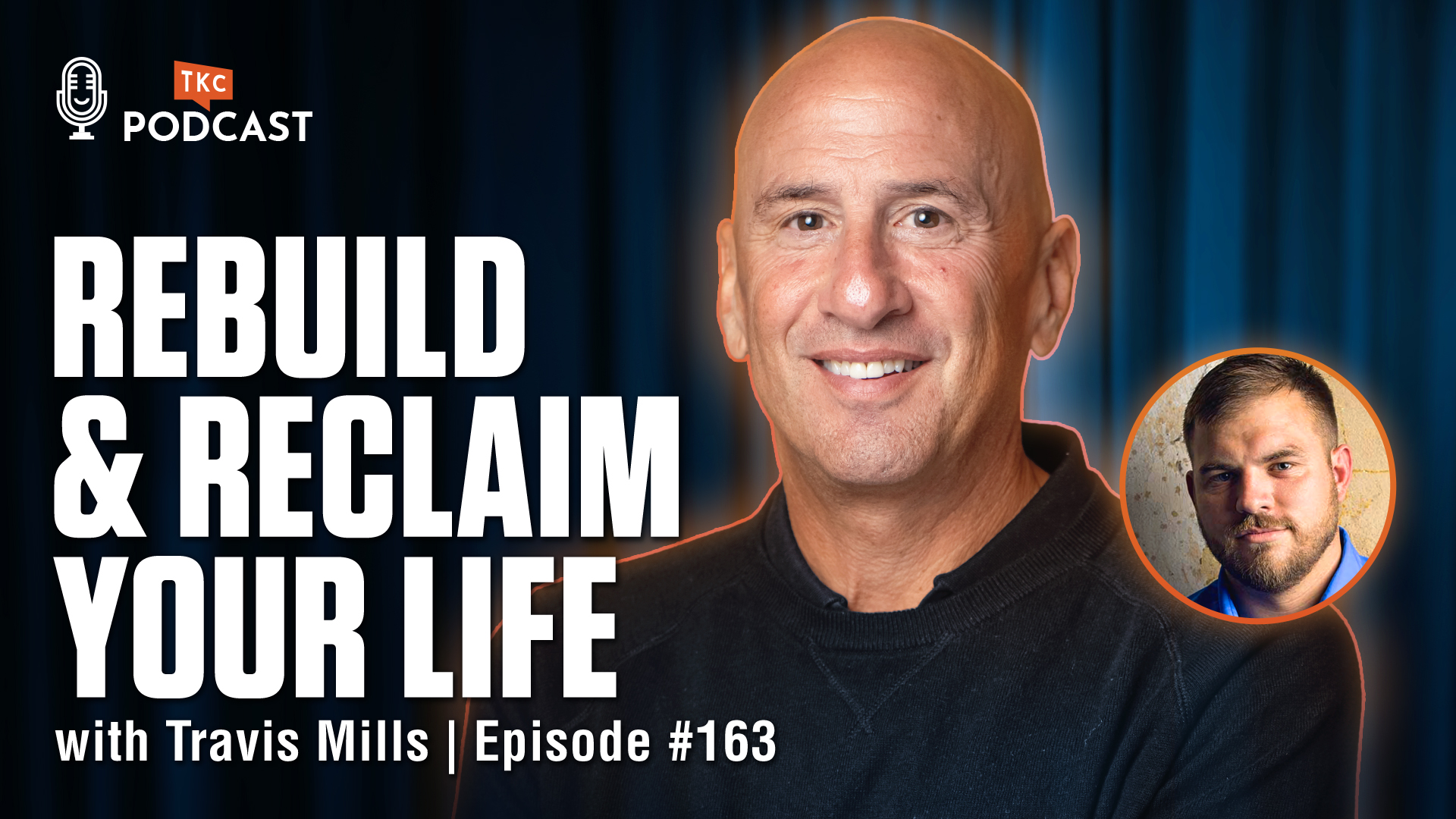
April 9, 2026Resilience Lessons to Rebuild Your Life, with Military Veteran Travis Mills
Resilience keynote speaker Travis Mills shares how he rebuilt his life after losing all four limbs, with lessons on mindset, purpose, and never quitting.
Most people think resilience is something you develop through hardship. Keynote speaker Travis Mills discovered it was something he had to rebuild from scratch, one day at a time, from a hospital bed, without arms or legs.
I sat down with retired U.S. Army Staff Sergeant Travis Mills to talk about what resilience actually looks like when life doesn’t just knock you down but removes the version of you that existed before. Travis is one of only five quadruple amputees from the wars in Iraq and Afghanistan to survive his injuries. He lost portions of both arms and both legs on April 10, 2012, when an IED detonated during his third tour of duty in Afghanistan. What followed was not a recovery story in the conventional sense. It was a complete reconstruction of identity, purpose, and will.
If you lead teams, work in high-stakes environments, or just need a reminder that forward momentum is always possible, this conversation will reach you where it counts. Travis doesn’t talk about resilience as a concept. He lives it in real time, every single day, and what he’s built from the rubble of that moment in Afghanistan is extraordinary.
🎧 Watch and listen to the podcast episode: YouTube • Spotify • Apple Podcasts • Amazon Music
Resilience Keynote Speaker Travis Mills and the Moment Everything Changed
On the day Travis was injured, he was on patrol in Afghanistan during his third deployment. He had already served two tours, survived countless operations, and made the deliberate choice to go back. That choice matters because it tells you something about who Travis is before we even get to what happened next.
When the IED detonated, Travis lost portions of both legs and both arms. He spent fourteen hours in surgery. The fact that he survived at all was, by his own account, due to the heroic actions of the men in his unit, the prayers of thousands of people, and the extraordinary work of the healthcare teams at Walter Reed Army Medical Center.
For most people, even imagining that scenario produces a kind of paralysis. But paralysis, Travis would tell you, is a choice, not an inevitability. The question he faced in that hospital bed was not whether his life was over. It was what his life would become. That’s real resilience.
That question, and the way he answered it, is at the core of everything Travis now teaches. As a resilience keynote speaker, Travis doesn’t stand in front of audiences and tell them things are going to be okay. He tells them what it actually takes to make them okay, and that’s a very different conversation.
“Never Give Up, Never Quit”: What That Motto Actually Means in Practice
Travis lives by a resilience motto that is simple enough to print on a t-shirt but demanding enough to build a life around: never give up, never quit. I asked him what that means when the circumstances are genuinely catastrophic, not just inconvenient.
His answer was grounding. He doesn’t apply that motto in the abstract. He applies it to the next specific thing in front of him. When he woke up without four limbs, he didn’t set a goal to run a marathon. He set a goal to get through that day. Then the next one. Then the physical therapy session that felt impossible. Then the one after that.
This is where so many frameworks around resilience get it wrong. They treat it as a long-range orientation, a kind of heroic attitude toward the future. Travis treats it as a moment-by-moment decision. You decide not to quit right now. Then again in five minutes. Then again tomorrow morning.
What makes this practical for audiences is that it scales. Whether you’re managing a difficult quarter, leading a team through significant change, or personally navigating something that has shaken your identity, the mechanism is the same. You don’t need to know how the whole thing ends. You need to make the next decision in the direction of forward. Travis has earned the right to say that in a way very few people have, and it lands differently when you understand what he chose that phrase against.
“I Get To” Instead of “I Have To”: The Resilience Mindset Shift
One of the most powerful things Travis shared in our conversation about his resilience journey was a reframe so simple it almost sounds like a slogan, until you sit with it long enough. He replaced the phrase I have to with I get to.
He gets to wake up. He gets to do physical therapy. He gets to see his family. He gets to build something. This is not toxic positivity. It’s not a refusal to acknowledge hardship. It’s a recognition that the alternative to doing the hard thing is far worse than the hard thing itself, and that framing shapes whether you move toward something or merely endure it.
Travis came to this resilience shift in part because of who he lost. Friends who didn’t come home from Afghanistan. People who would never get the chance to do the hard work of rebuilding. Honoring them meant refusing to waste the life he still had, even a profoundly altered version of it. That’s gratitude with weight behind it, the kind that comes from real loss, not from a journaling prompt.
For leaders and organizations, this reframe has immediate personal development applications. Teams that approach their work with a sense of obligation operate differently from teams that approach it with a sense of privilege. The shift isn’t always natural. Often it needs to be taught, modeled, and reinforced. Travis models it every day, and he’s built a career helping others internalize it.
Stop Asking Why: How Accepting a New Normal Accelerates Recovery
One of the resilience principles Travis outlines in his work is the decision to stop asking why. This might be the hardest instruction he gives, and also the most liberating.
When something catastrophic happens, asking why is instinctive. Why me? Why now? Why did this happen? Those questions feel important because they feel like they’re pointing toward meaning. But Travis observed, in his own recovery and in working with hundreds of veterans and civilians since, that the why rarely produces an answer worth waiting for. More often, it keeps you anchored to a moment you can’t change, at the expense of a future you can still shape.
This doesn’t mean you don’t process what happened. It means you eventually choose to stop making the unanswerable question the center of gravity in your life. Acceptance of a new normal is not resignation: it’s a process that helps you build resilience over time. It’s the prerequisite for movement. You can’t build a new version of your life while you’re still litigating whether the old version had to end.
For organizations going through transformation, restructuring, or loss, this principle is deeply relevant. Teams that stay stuck in why did this happen to us are teams that aren’t building toward what comes next. Leaders who can model this kind of acceptance, who can grieve what was lost while orienting toward what’s still possible, tend to bring their people through difficulty more effectively. Travis puts language to something that high-functioning leaders often do intuitively but rarely articulate.
Asking for Help Is Not Weakness: Why Support Systems Drive Resilience
Travis is direct about this. He could not have survived, let alone rebuilt his life, without other people. His wife and daughter. The men in his unit. The medical teams at Walter Reed. His family and friends. The community that formed around him. Resilience, in his telling, is never a solo achievement.
This runs counter to one of the most persistent myths in motivational culture, which is the idea that the truly strong figure it out alone. Travis is one of the most genuinely strong people I’ve ever spoken with, and he will tell you without hesitation that asking for help is not a sign of weakness. It’s a survival skill.
He also speaks candidly about patience, particularly the patience required in recovery and in the slower work of rebuilding. The impatience to be well, to be back to normal, to be past the hard part, can actually interfere with the healing process. Patience with yourself and with the process is not passive. It’s active, it’s disciplined, and it’s hard.
In corporate culture terms, this translates to something leaders hear about but often struggle to model: psychological safety. When the people at the top demonstrate that asking for help is acceptable, even admirable, it gives everyone else permission to do the same. Travis doesn’t just teach this. He is a living demonstration of it, which is why his message on empowerment and resilience lands not as theory, but as evidence.

The Travis Mills Foundation: Purpose Built From Pain
In September 2013, Travis and Kelsey founded the Travis Mills Foundation, a nonprofit that provides all-inclusive, all-expenses-paid, barrier-free retreats in Maine for post-9/11 veterans who have been injured in active duty or as a result of their service. Veterans and their families participate in adaptive activities, connect with other veteran families, and get genuine rest in Maine’s outdoors.
What I found fascinating in our conversation was how the foundation came to include families so centrally. Travis told me about a sports camp in Colorado that was doing powerful adaptive work with injured veterans but had no programming for the veterans’ families. He saw immediately what was missing. The injury doesn’t happen to one person. It happens to a family. The recovery doesn’t require one person’s healing. It requires the family’s. Building the foundation around that insight on resilience changed everything.
The Travis Mills Foundation has raised over fifty million dollars to support this mission. That number is significant not just as a fundraising achievement but as a measure of the community that has formed around Travis’s story and his commitment to military families. Travis greets every guest personally. He built the entire operation around the values he embodies in his own life: inclusion, presence, and the refusal to let anyone feel like they’re going through it alone.
This is also where his storytelling instincts are most visible. Travis understands that people give to people, not to causes. The foundation’s success is inseparable from the authenticity of its founder, and from his willingness to share the full story, including the lowest points, including the moments of doubt, because those are the moments that make the rest of it believable and, over time, build resilience.
How Travis Approaches Speaking and What Happens in the Room
I asked Travis what it’s like to speak on stage, and his answer was one of the more unexpected things he said in our conversation. He told me that speaking had become therapeutic. Standing in front of an audience and sharing his story was not just a professional obligation but something that continued to help him process and integrate his experience.
He also described the arc of an audience during one of his talks: laughter, then tears, then something that functions like a reset. Travis brings humor into what could easily be a devastating presentation. He is genuinely funny. He talks about the absurdities of everyday life with four prosthetic limbs, the strange moments of grace and frustration, and comedy that make up an ordinary day. That humor doesn’t minimize what he’s been through. It invites the audience in.
By the time the tears come, the audience is already invested. They’ve laughed with him. They’ve been surprised by him. And then when the weight of what he survived settles in the room, it lands differently because he didn’t lead with tragedy. He led with life.
This is what distinguishes Travis’s approach from many speakers that also talk about resilience. He’s not performing resilience. He’s not performing survival. He’s sharing a life, and the business lesson embedded in that approach is that authenticity is not a presentation strategy. It’s a result of actually living what you’re talking about.
Invisible Battles: Why This Resilience Message Reaches Everyone in the Room
One of the most important things Travis said in our conversation was about the universality of struggle. He’s aware that when he walks into a room, some people look at him and think their problems can’t compare, so they shut down. He works hard to close that gap.
His message on resilience isn’t that everyone’s suffering is equivalent to his. It’s that everyone has something they’re carrying, and the mechanisms for carrying it well are the same regardless of what the weight is. You accept what you can’t change. You ask for help. You replace I have to with I get to. You stop asking why and start asking what’s next.
Travis also talks about what it’s like for people who feel uncomfortable around disability, how initial discomfort tends to dissolve when someone leads with warmth and openness. He notices this regularly, and rather than finding it frustrating, he treats it as a teaching moment. The discomfort people feel around visible difference is often a projection of their own fear: that hardship might find them too, that they might not survive it. Travis shows them, through his presence and his humor and his honesty, that survival is possible. That life after catastrophe is not just livable but genuinely good.
This is why his resilience message is effective across industries and contexts, from military organizations to corporate teams to DE&I frameworks that wrestle with how to create cultures where people feel seen and supported. Travis doesn’t preach inclusion as a policy. He demonstrates what it feels like to be welcomed and to welcome others, even when the circumstances are hard.
Success Is a Team Sport, and Travis Mills Proves It Every Day
One moment in our conversation that struck me most was Travis’s reflection on what success actually means to him now. He is famous in Maine. He runs a restaurant. He runs a foundation that has changed thousands of lives. He has written a New York Times bestselling memoir and spoken to hundreds of thousands of people around the world. He is teaching his daughter about entrepreneurship at the age of 14.
And yet his definition of success, when he articulates it, is fundamentally relational. It’s about the team around him. It’s about his wife. It’s about the veterans who come to his foundation and leave changed. It’s about the people in the room when he speaks who come up to him afterward and say something in them shifted.
There is always a way forward. That’s the closing thought Travis returns to again and again, not as a platitude but as a statement he has empirically validated by getting up every morning and finding it. The way forward might look nothing like the path you were on before. The new normal might be unfamiliar and demanding and nothing you would have chosen. But it is yours, and the decision to move toward it rather than away from it is where resilience begins.
When you book Travis Mills for your event, you’re not booking a speech. You’re bringing a living proof point into the room. A man who chose life, who built something extraordinary from devastation, who shows up for the people around him every day with the same conviction that carried him through fourteen hours of surgery and out the other side. His attitude toward life is not accidental. It is chosen, daily, deliberately, and it is exactly what teams and leaders and audiences need to witness right now.
That’s what resilience looks like when it’s real.
💡 If your audience needs a message on resilience, mindset, and purpose that earns the room, Travis delivers it.
Explore resilience keynote speaker Travis Mills’s full profile here
Schedule a quick call, and let’s talk about your event
Or send your event details and audience profile directly: info@thekeynotecurators.com
Discover More Insights




Get in TouchContact US
Fill out the form so we can best understand your needs.
A representative from The Keynote Curators will reach out to you.