
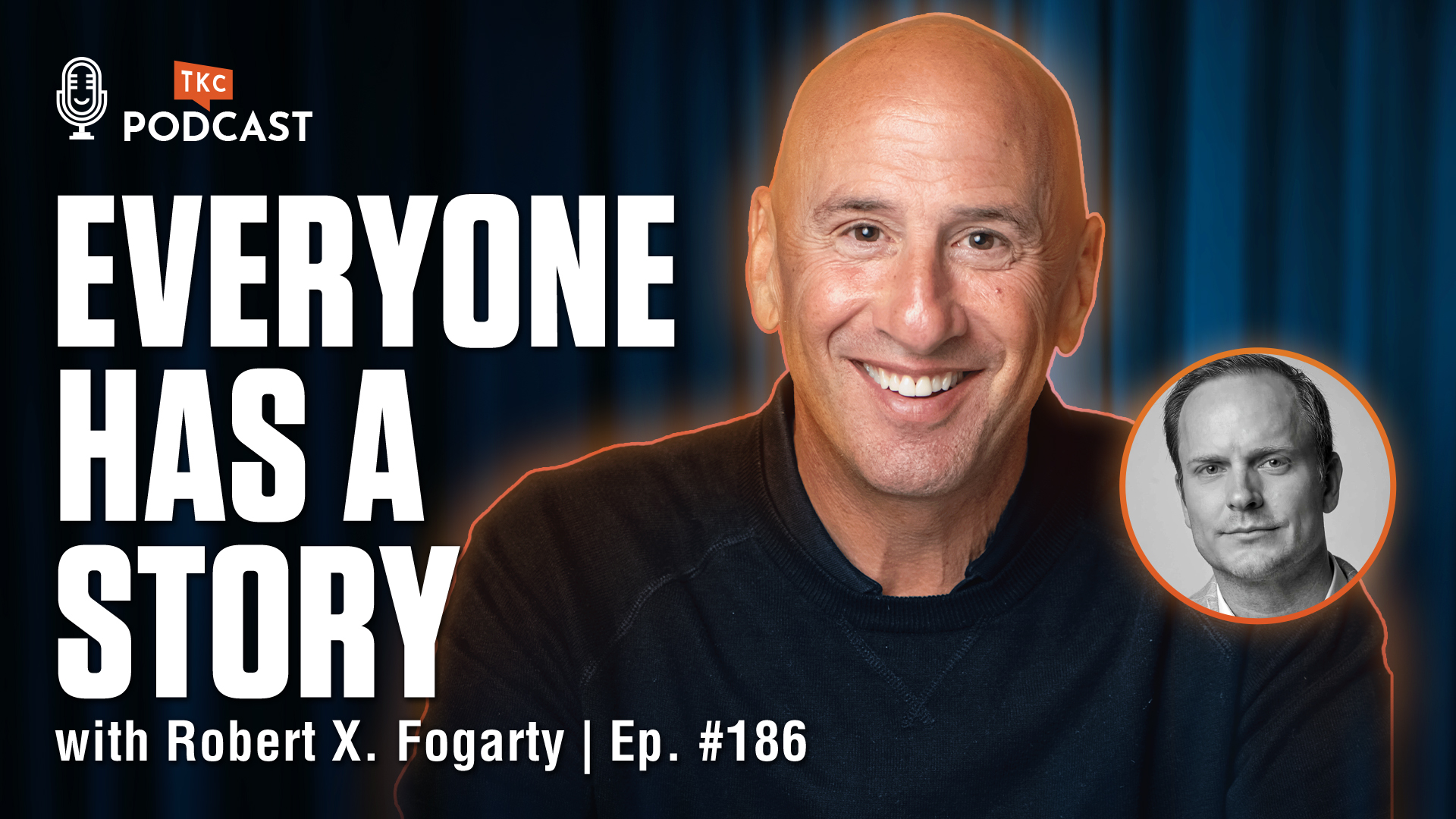
August 6, 2026Why Every Story Deserves to Be Told, with Robert X. Fogarty
Dear World founder Robert X. Fogarty shares why every story deserves to be told and how one storyteller helps people feel truly seen at events and beyond.
A thousand people can fill a ballroom and still feel like strangers to each other. That is the paradox I keep coming back to whenever I think about events, teams, and the rooms we build to bring people together. Getting a crowd through the door is the easy part. Getting them to actually see one another, to feel something real in a space designed for networking lanyards and branded lighting, is the hard part. That is exactly the tension storytelling expert Robert X. Fogarty has spent the last fifteen years working to solve, and it is why every story he helps someone tell matters more than the polish of the room it is told in.
I sat down with Robert for The Keynote Curators Podcast, and what stayed with me long after the conversation ended was not a tactic or a framework. It was a conviction. Robert believes, with a kind of quiet certainty, that every story deserves to be told, and that belief has shaped everything from the way he approaches strangers on the street to the way he designs experiences for Fortune 100 companies, national championship basketball teams, and Syrian refugees rebuilding their lives after unimaginable loss.
🎧 Watch and listen to the podcast episode: YouTube • Spotify • Apple Podcasts • Amazon Music
Why Authenticity Reaches Us Before Technique Does
One of the first things Robert said that stopped me in my tracks was his observation that audiences can feel authenticity before they can explain why they feel it. We tend to assume that people respond to production value, to lighting, to a perfectly rehearsed delivery. Robert’s experience says otherwise. People respond to truth first, and craft second. A story told with shaking hands and an honest tremor in the voice will outperform a polished monologue almost every time, because the audience is not evaluating performance. They are scanning for something real.
This is a harder lesson than it sounds, especially for leaders who have been trained their entire careers to project confidence and control. The instinct in a boardroom or on a keynote stage is to smooth every rough edge before anyone else sees it. What Robert’s work suggests is nearly the opposite. The rough edge is often the entryway. When someone tells a story that includes fear, doubt, or failure, the audience does not lose respect for them. They lean in. What struck me most about this idea is how often it contradicts standard advice about executive presence, and yet how consistently it proves true whenever I have watched it happen in a room.
What It Means to Make People Feel Seen
Robert’s organization, Dear World, has built its entire method around a deceptively simple request: reflect on your life, distill that reflection into a few words, and write those words on your skin so the message becomes inseparable from the person carrying it. It sounds almost too simple to matter. But the impact is not simple at all. When someone is asked to reflect that deeply, and then to physically carry the result of that reflection, something shifts. They stop being a name badge in a crowd and become a person with a history worth acknowledging.
I have seen this same pattern show up outside the world of events entirely. In workplaces, in classrooms, in family gatherings, the moment someone is invited to share something true about themselves, the temperature of the room changes. People stop performing and start participating. This is the deeper implication behind Robert’s method. It is not really about photography or messaging. It is about giving people permission to be known, even briefly, in a setting that usually asks them to be efficient instead of honest.
The Ordinary Moment as the Origin of Every Great Story
Robert made a point during our conversation that I have not stopped thinking about since. He said that the most powerful stories rarely come from extraordinary circumstances. They come from ordinary moments that someone finally paused long enough to notice. A missed flight. A conversation with a stranger. A single sentence a parent once said in passing. None of these moments look significant while they are happening. They only become a story once someone decides they deserve attention.
This reframes how I think about the raw material of leadership communication. Executives often believe they need a dramatic turning point to justify telling a personal story from the stage. Robert’s experience suggests the opposite is true. The smaller and more ordinary the moment, the more universally an audience can relate to it, because everyone has lived through a version of the same quiet instant. A great story does not need scale. It needs honesty and specificity, and those two ingredients are available to absolutely everyone, regardless of how dramatic their résumé happens to be.
Shared Experience as the Fastest Path to Trust
Another thread that ran through our conversation was Robert’s belief in simple shared activities as a shortcut to real connection. Instead of asking two strangers to make small talk about their job titles, he will ask them to complete a small physical task together, something with almost no stakes attached. What he has found is that trust builds faster through shared doing than through shared talking. Once two people have laughed together over something as small as writing on each other’s arm or completing an awkward creative prompt, the walls that usually separate colleagues at a networking event come down almost immediately.
This has real implications for how organizations think about employee engagement and team culture. So much of corporate connection strategy still relies on icebreaker questions that ask people to talk about themselves in the abstract. Robert’s approach suggests that doing something together, even something small and slightly uncomfortable, builds trust faster than talking ever will. The story that eventually gets shared is almost secondary to the shared experience that made people willing to be vulnerable enough to share it in the first place.
Every Person in the Room Deserves to Feel Noticed
Robert spoke about the challenge of making sure every single person at a large event feels noticed, not just the people closest to the stage or the ones who happen to be naturally extroverted. This is a genuinely difficult problem, and most events never solve it. Even the best-produced conferences can leave hundreds of attendees feeling like background noise to someone else’s main event.
What Robert’s work has taught him is that noticing someone does not require a grand gesture. It requires attention. A specific question. A moment of eye contact that lasts one beat longer than usual. The lesson that stayed with me from this part of our conversation is that scale is not the enemy of intimacy, but indifference is.
An event can host ten thousand people and still make each of them feel individually seen, as long as the people designing the experience are intentional about creating small moments of genuine attention rather than relying purely on production scale to carry the emotional weight of the room. This is where empowerment actually starts, not with a slogan on a screen, but with someone feeling like their presence registered with another human being.
Taking the Shot Before You Feel Ready
Robert’s own origin story is worth sitting with for a moment, because it reveals something important about how meaningful work actually begins. He founded Dear World in New Orleans in 2010, the same year the city’s football team won the Super Bowl, at a moment when the city itself was still rebuilding its sense of identity after Hurricane Katrina. He was a trained journalist who had never actually worked at a newspaper, television network, or internet media company. By conventional standards, he was not ready.
What I find most instructive about this is not the outcome, but the decision that preceded it. Robert did not wait until he had the perfect résumé, the perfect funding, or the perfect plan. He started asking people to reflect on their lives and write down what mattered most, and the honesty of that early work is what eventually built an organization now published in more than thirty countries with over one hundred thousand participants.
This is a pattern I have seen repeatedly among people who go on to do meaningful work. Readiness is often a myth we tell ourselves to postpone the discomfort of starting. The story of Dear World did not begin because Robert felt prepared. It began because he was willing to take the shot anyway, and the story he built from that willingness is now one that other entrepreneurs and founders can learn from directly.
Asking People to Share the Moments That Required Courage
Some of the most powerful material Dear World has collected did not come from comfortable moments. It came from asking people to describe times in their lives that required real courage. Robert has done this work with Syrian refugees, with survivors of the Boston Marathon bombing, and with children rescued from slavery. These are not easy conversations, and Robert was candid about the responsibility that comes with asking someone to revisit their most painful memories in service of a message that might only be a handful of words.
What this reveals about leadership, both in his own work and in the organizations he consults for, is that courage and story are almost never separable. The stories that move people the most are rarely the ones about victory alone. They are the ones that include the moment before victory, the moment when the outcome was still uncertain and the person had to choose to keep going anyway. When a leader is willing to include that moment of uncertainty in the story they tell their team, rather than skipping straight to the resolution, something in the audience relaxes. They recognize the shape of their own struggle inside someone else’s account of theirs.
Keeping a Memory Alive Through Art
Robert also spoke about the role that story plays in preserving memory, particularly for people and communities who have experienced significant loss. A story, once told and recorded, becomes a kind of permanent record that outlives the moment it describes. This is part of why Dear World’s charitable arm has worked so closely with communities carrying historical trauma. The act of telling a story is not only about the present audience in the room. It is about ensuring that a piece of someone’s truth survives beyond the conversation itself.
The more I think about this, the more I believe it applies well beyond the nonprofit and humanitarian work Robert is known for. Organizations that fail to capture the stories of their founding generation, their earliest employees, or their hardest years often lose something they can never fully recreate. Corporate culture is built, in large part, on the stories people tell each other about where the organization came from and what it survived to get here. When those stories are not deliberately preserved, they fade, and with them fades a piece of the organization’s identity.
The Small Ritual of a Genuine Greeting
One of the smallest details from our conversation ended up being one of the most memorable. Robert talked about how a simple, genuine greeting, the kind that actually pauses long enough to register another human being, can be the opening line of a story someone tells for years afterward. It costs nothing. It requires no budget, no production team, no special training. It only requires the willingness to slow down for a moment longer than is strictly necessary.
This caught my attention because it is so easy to overlook in a professional culture obsessed with efficiency. We optimize meetings, optimize onboarding, optimize every touchpoint we can measure, and in doing so we sometimes strip out the small human rituals that actually make people feel like they belong somewhere. A genuine greeting is not a productivity hack. It is a story starting, and whether that story becomes a positive one or a forgettable one often depends entirely on whether the other person felt truly noticed in that first exchange.
What This Means for Leaders, Teams, and Event Builders
Pulling all of this together, I keep returning to one central idea. Every story deserves to be told, not because every story is dramatic or unusual, but because the act of telling it is what transforms an ordinary life into something a community can recognize and hold onto. This applies whether you are building a keynote, designing a corporate retreat, leading a team through a difficult season, or simply trying to make a new colleague feel welcome on their first day.
What makes this especially interesting to me is how much of Robert’s philosophy runs counter to the instincts of modern branding & marketing, which so often prioritizes polish over honesty. Robert’s work is a reminder that the story people remember longest is rarely the one with the highest production value. It is the one that felt true. Leaders who understand this stop trying to manufacture perfect narratives and start paying closer attention to the imperfect, ordinary, deeply human material that is already sitting inside their teams, waiting for someone to ask the right question.
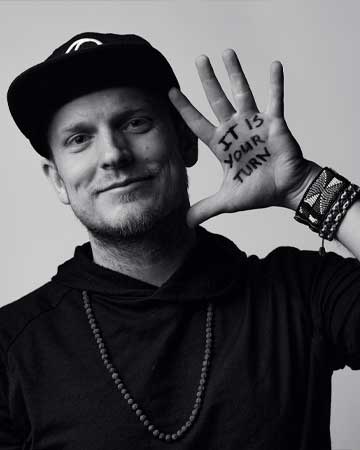
The Story Worth Telling Is Already The One You’ve Lived
If there is one thing I hope readers take from this conversation, it is that the story you have been hesitant to tell, whether it is about a failure, a fear, or an ordinary moment you have never thought to mention out loud, is very likely the exact story someone else needs to hear. Robert’s entire career has been built on the belief that every story is worth telling, and every time I revisit that idea, I find it holds up under pressure in ways that most leadership advice does not. You do not need the perfect stage, the perfect résumé, or the perfect ending.
You only need to be willing to take the shot before you feel ready, because the story that follows will be more honest and more useful to the people around you than the polished version you were waiting to be prepared enough to share.
🎤 Explore keynote speaker Robert X. Fogarty and bring his story to your next event
📞 Schedule a quick call to talk through your event theme
📩 Email us your audience and theme and we will tell you if Robert is the right fit
Discover More Insights


Get in TouchContact US
Fill out the form so we can best understand your needs.
A representative from The Keynote Curators will reach out to you.
Our Services
Keynote Speakers Topics
© 2026 The Keynote Curators. All Rights Reserved | Terms and Conditions
The Keynote Curators, 8275 South Eastern Avenue, Suite 200, Las Vegas, NV 89123
Local (310) 299-4595 | Toll Free (888) 585-8715 | info@thekeynotecurators.com
The Keynote Curators - Top Keynote Agency, USA.