
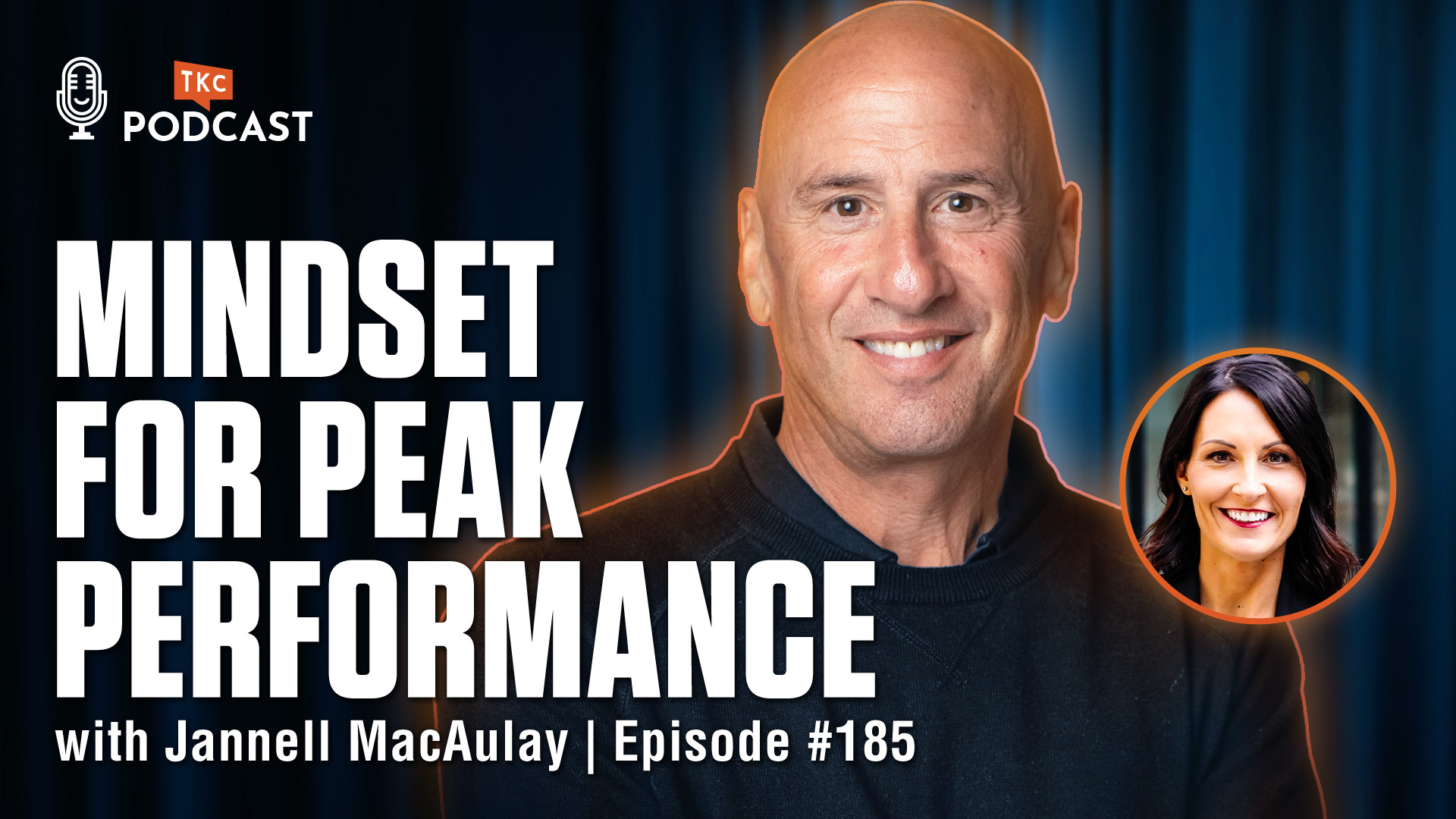
July 30, 2026Peak Performance Starts With Self-Talk, with Jannell MacAulay
Jannell MacAulay explains how self-talk, mental flexibility, and recovery habits shape performance under pressure.
Performance is not what happens when everything goes right. Performance is what happens the moment something goes wrong. That single reframe changes how you think about pressure, mistakes, and the voice in your head that shows up right when you need it most.
Dr. Jannell MacAulay spent 20 years as a U.S. Air Force pilot, commander, and special operations consultant before she became one of the first people in the military to treat mindfulness as a performance strategy instead of a soft skill. She now works with the Department of Defense, corporate teams, and professional athletes through Warrior’s Edge, the program she co-built with Pete Carroll and sports psychologist Dr. Michael Gervais. When someone with that background talks about performance, I listen a little differently than I do with most guests.
This is not a conversation about hustle or grinding harder. It is about training your mind the same deliberate way an athlete trains a body, so that when the moment gets hard (and it will), you already know how to respond.
I have booked plenty of speakers who talk about performance in a general sense, using it as a word attached to almost anything. Jannell is different. As a performance keynote speaker, Jannell MacAulay has actually lived inside environments where performance gets measured in far higher stakes than a quarterly target. That background gives everything she says a weight that is hard to fake, and it is part of why this conversation felt less like a podcast episode and more like a working session on how the mind actually holds up under real pressure.
🎧 Watch and listen to the podcast episode: YouTube • Spotify • Apple Podcasts • Amazon Music
Embracing the Sweet Uncomfortable
One of the first things that caught my attention was how Jannell MacAulay talks about discomfort. Most of us are wired to avoid it. We build routines, habits, and even careers around staying inside the zone where things feel manageable. But she describes discomfort as something closer to a signal than a threat, a sign that you are standing right at the edge of growth instead of retreating from it.
I think that is the part people miss when they talk about performance. We tend to imagine peak performance as a state of ease, a moment when everything clicks, and nothing feels hard. What Jannell’s work suggests is closer to the opposite. The people who reach the highest levels of performance are not the ones who avoided discomfort. They are the ones who learned to stay present inside it long enough to adapt.
That is a hard sell in a culture built around comfort and convenience. And yet every leader I have ever admired has some version of this story, a season where things got uncomfortable and they chose to lean in rather than step back. The discomfort was not the obstacle to their performance. It was the training ground for it.
What I appreciate about the way Jannell frames this is that she does not romanticize suffering for its own sake. She is not suggesting that more difficulty automatically produces more growth. The point is subtler than that. It is about noticing discomfort as information, then choosing to stay present in it long enough to learn something rather than fleeing to whatever feels safer. That small shift, from discomfort as danger to discomfort as data, is the difference between people who plateau early in their performance and people who keep improving for decades.
Building Psychological Flexibility
A pilot does not get to choose a smooth flight. Weather changes, equipment fails, plans fall apart mid air, and the mission still has to get done. Jannell brings that same reality into how she talks about military leadership and human performance more broadly. Plans will change. That is not a possibility to prepare for. It is a guarantee.
What struck me most is how she frames psychological flexibility as a trainable skill rather than a personality trait. Some people are not naturally calm when a plan collapses, but that does not mean they are stuck being rigid forever. The mind can be trained to bend instead of break, the same way a body is trained to absorb impact instead of snapping under it. That distinction matters because it turns adaptability from something you either have or do not into something you can actually build.
I have seen this pattern play out in plenty of teams outside the cockpit. The ones who perform well under pressure are rarely the ones with the most talent. They are the ones who expected the plan to shift and had already rehearsed how they would respond when it did. Performance under uncertainty is less about talent and more about preparation for the moment; talent alone will not be enough.
This is also where I think a lot of performance advice quietly fails people. It hands out mantras about staying positive without ever addressing the mechanics of how a person actually pivots when a plan falls apart in real time. Jannell’s approach treats flexibility as a rehearsed response, something you practice in low-stakes moments so it is available to you in high-stakes ones. That is a very different kind of confidence than simply telling yourself to stay calm. It is confidence built on repetition, not hope.
Deliberate Mental Skill Development
Here is where the conversation moved from interesting to genuinely useful. Jannell does not talk about mental toughness as something you either have from birth or spend your life wishing you had. She talks about it as a skill set, something built through repetition the same way a pilot logs flight hours or an athlete logs practice reps.
This reframe has real consequences for how organizations think about health & well-being and performance training. Most companies invest heavily in physical safety and technical skill, and almost nothing in the deliberate training of attention, recovery, and self-talk. Yet those are the exact skills that determine how someone performs when the technical training gets tested under real pressure.
The more I think about it, the more this feels like an obvious gap hiding in plain sight. We spend years teaching people how to do their job. We rarely spend even a single afternoon teaching them how to manage their mind while they do it. Jannell’s approach treats mental skill development as a discipline with reps and drills, not a vague aspiration you either have naturally or do not.
I think about the leaders I have interviewed over the years who describe their best decisions as instinct. What usually turns out to be true, once you dig a little deeper, is that the instinct was built on hundreds of smaller reps nobody saw. Jannell’s framing gives language to that process. Performance under pressure looks instinctive from the outside, but it is almost always the visible tip of a much longer, much less visible period of deliberate practice.
The Warrior’s Edge and Credible Self-Talk
This is the part of the conversation that I keep coming back to. Jannell co-founded Warrior’s Edge with Pete Carroll and Dr. Michael Gervais to build a mindset training program for people operating under real stress, and one of the central ideas is what she calls credible self-talk.
Credible self-talk is different from empty positivity. Telling yourself everything is fine when it clearly is not builds distrust in your own voice; it does not build performance. Jannell’s framing is that your internal dialogue has to be honest enough that you actually believe it in the moment it matters. That might sound closer to this is hard, and I have trained for hard than to I’ve got this when you clearly do not know if you do.
I think this distinction gets missed constantly in leadership and performance culture. We hand people affirmations and slogans and call it mindset work. What Jannell is describing is closer to evidence-based confidence, a form of self-talk rooted in actual preparation rather than borrowed enthusiasm. That is a much harder thing to build, and it is also the only version that holds up once the pressure is real.
What makes this especially interesting to me is the pedigree behind Warrior’s Edge. Pairing a combat veteran with a Super Bowl-winning coach and a sports psychologist is not a marketing gimmick; it is a signal that the same performance principles apply whether you are flying a mission or walking onto a field in front of eighty thousand people. Pressure does not care about the setting. The mind still has to be told something it can actually trust.
Executing High Performance Under Pressure
There is a phrase from this conversation that I have not stopped thinking about: B-plus execution can outperform a search for perfection. In a world obsessed with getting things exactly right, that idea feels almost uncomfortable to say out loud.
Jannell’s point connects directly to leadership under real conditions, where decisions rarely come with complete information and hesitation has a cost of its own. Waiting for the perfect plan often means missing the window where a good enough plan would have worked. High performance under pressure is not about achieving flawless execution. It is about executing decisively with what you have, then adjusting as new information comes in.
I have watched perfectionism quietly sabotage talented people more times than I can count. They delay a decision, rewrite a plan one more time, or hold back a launch because it is not quite ready, and the moment passes them by. Jannell’s take reframes performance as a series of imperfect actions taken with conviction, not a single flawless moment achieved through endless preparation. That is a more honest, and frankly more useful, definition of what performance actually requires.
This reminded me of a pattern I have seen in almost every high-functioning team I have come across. The teams that consistently perform well are rarely the ones with the most polished plan going in. They are the ones comfortable adjusting a B-plus plan in real time instead of standing still waiting for an A-plus plan that never quite arrives. Speed of adjustment beats quality of the original draft far more often than most planning cultures want to admit.
AI and The Value of Human Thinking
We spent part of the conversation on artificial intelligence, and I want to be honest that I expected this section to feel like a detour. It did not. Jannell’s perspective on AI circles right back to the same core idea running through the entire conversation, which is that performance is ultimately a human capacity, not a technical one.
Tools can process information faster than any person ever will. What they cannot do is sit inside genuine uncertainty, hold two conflicting truths at once, and choose how to respond with judgment shaped by lived experience. That capacity, the ability to think clearly and act with values intact when the outcome is unclear, is exactly what Jannell has spent her career training people operating in the most rugged environments imaginable.
This matters more than it might seem at first. As more decisions get automated or accelerated by technology, the premium on human judgment does not shrink; it grows. The people and organizations that will separate themselves are not the ones with access to the best tools. They are the ones who have deliberately trained the human thinking that decides how those tools get used. That is a performance question long before it is a technology question, and it connects directly to why education systems need to start treating mental skill training as seriously as they treat technical curriculum.
I have sat through a lot of conversations about AI that treat human judgment as an inconvenience to be automated away eventually. Jannell’s perspective flips that assumption. She is not dismissing the tools. She is pointing out that the tools are only as good as the person deciding when to trust them and when to override them. That decision, made under pressure and often with incomplete information, is a performance skill in its own right, and it is one no amount of processing power can substitute for.
Interpersonal and Intrapersonal Human Connection
One of the more personal moments in this conversation was Jannell talking about what our phones are quietly doing to our attention and our relationships. It is easy to nod along to that observation without letting it actually land. I think what makes her version of this point different is that she connects it directly back to performance, not just wellness.
Every time attention fragments, whether from a notification or a habit of checking a screen mid-conversation, something is lost in both directions. Intrapersonally, we lose the ability to sit with our own thoughts long enough to process them. Interpersonally, we lose the presence that real connection actually requires. Jannell’s point is that these are not separate problems. The relationship you have with your own mind shapes the relationship you are capable of having with everyone around you.
I think this reframes something people often treat as a minor lifestyle complaint into something closer to a performance issue. Leaders who cannot be fully present with their teams are not just being rude; they are quietly degrading the quality of every interaction that depends on real attention. The fix Jannell points toward is not a total tech detox. It is a deliberate practice of choosing presence on purpose, the same deliberate practice she applies to every other performance skill in this conversation.
This reminded me how often performance conversations focus entirely on the individual and skip over the relational side of the equation completely. A team does not perform well simply because each member is individually sharp. It performs well because people are actually paying attention to one another, catching small signals, and building the kind of trust that only comes from sustained presence. Jannell’s point is that attention is not a soft skill sitting off to the side of performance; it is one of the load-bearing walls holding the whole structure up.
Embracing Failure on The Path to Success
The conversation closed on a theme that ties everything else together, which is how quickly elite performers recover after a mistake. Jannell’s experience as a combat veteran and pilot gives her a perspective most performance conversations do not have access to, because in her world a mistake is not an abstract setback. It has immediate, sometimes serious, consequences.
What struck me is that the skill she describes is not about avoiding failure. It is about shortening the distance between the mistake and the recovery. Most people, when something goes wrong, spend real time and energy on the emotional aftermath before they even begin problem solving again. Jannell’s training compresses that gap. The self-talk, the psychological flexibility, and the deliberate mental skill work all show up here, in the seconds right after something breaks, when the instinct to spiral is strongest, and the need to refocus is highest.
This reminded me that performance is rarely about the absence of failure. It is about what a person does in the ninety seconds after it happens. The pilots, athletes, and leaders who separate themselves are not the ones who never miss. They are the ones who have trained themselves to miss well, recover fast, and keep moving toward the next decision that actually matters.
I think this is the piece that most performance cultures still get backwards. We build systems that punish mistakes so heavily that people spend more energy hiding them than recovering from them. Jannell’s approach treats the mistake as expected, almost boring, and puts all the attention on the recovery itself. That single shift, from fearing the miss to training the response, changes what an entire team is capable of under real pressure.

The Real Measure of Performance
The lesson that stayed with me long after this conversation ended is that performance was never really about talent, willpower, or even effort in the way we usually talk about those things. It is about the quality of the conversation you have with yourself in the moments that test you, and whether you have actually trained for that conversation before you needed it.
Jannell MacAulay’s work makes a strong case that performance is trainable in ways most of us never think to practice. The discomfort we avoid, the flexibility we assume is fixed, the self-talk we leave to chance, all of it can be deliberately shaped the same way a pilot trains for a flight or an athlete trains for a season. That is a more demanding definition of performance than most of us are used to, and it is also a far more useful one, because it puts the work back in our hands instead of leaving it to chance or circumstance.
🎤 Explore Jannell’s keynote speaker profile here
📞 Schedule a 15-minute call to talk about your event
📩 Send us your audience and event theme, and we’ll tell you if she’s the right fit
Discover More Insights





Get in TouchContact US
Fill out the form so we can best understand your needs.
A representative from The Keynote Curators will reach out to you.