
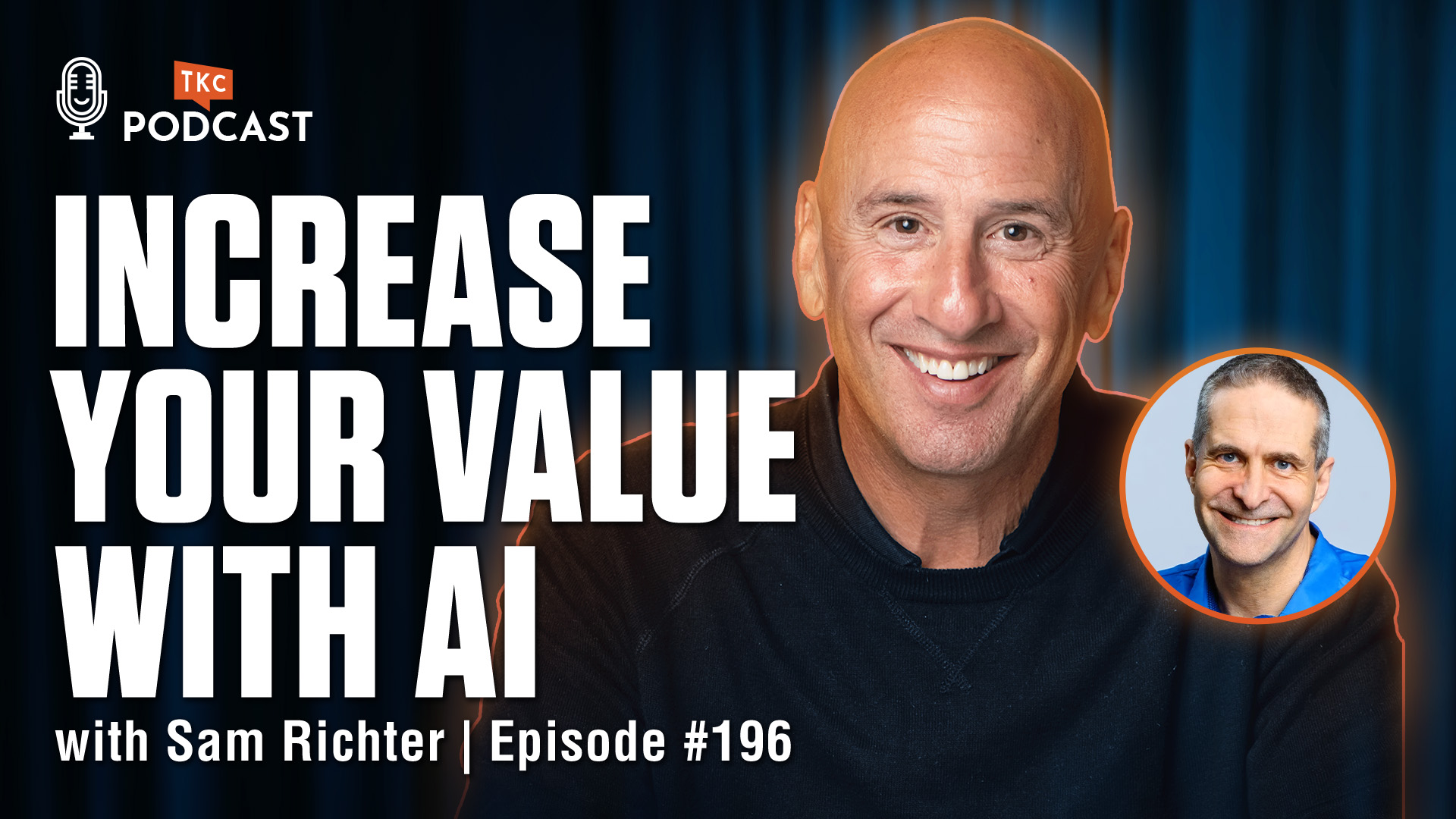
October 15, 2026How to Master AI to Deliver High-Value Results with Sam Richter
Learn how to master AI and deliver high-value results. Sam Richter explains where AI ends and human judgment begins.
AI will replace your job. That is not a scare line.
It is how Sam Richter answered me early in our conversation, and I have not stopped thinking about it since.
If you define your job as updating the CRM, building the deck, writing the first draft, or finding information, then AI is coming for a large part of it. But if you define your job by the value you create, that is a very different conversation. The distance between those two definitions is where careers will be won or lost, and it is what this article is about.
Sam is a Hall of Fame speaker and bestselling author who also builds custom AI resources for major companies.
That is why I wanted to talk with AI keynote speaker Sam Richter, who spends more time on human judgment than on tools. Every answer we explored kept circling back to one question:
When AI finishes the task, what are you adding that makes the result more valuable?
That question runs through everything below. Learning to master AI is not about collecting more tools. It is about knowing exactly where the machine stops and where you begin.
🎧 Watch and listen to the podcast episode: YouTube • Spotify • Apple Podcasts • Amazon Music
Understanding AI Is Different From Using AI
Most people I talk to are using AI. Far fewer understand it. Sam drew that line early, and I think it explains why some professionals get real value from these tools while others get polished nonsense.
Using AI means typing a request and accepting what comes back. Understanding AI means knowing what the machine is actually doing when it answers you. Sam was blunt about this. Generative AI is, at its core, a very large guessing engine. It predicts the next likely word based on patterns it has seen before. It does not know your buyer. It does not know your market. It does not know what you promised the client last Tuesday.
That sounds like a small technical point, but I think it changes how you work. If you believe the tool knows things, you trust it too much. If you understand that it is guessing, you treat every output as a draft that needs a thinking person behind it. That habit is what separates a professional from a passenger.
What struck me most is that Sam builds these systems for a living. He is not a skeptic standing outside the technology. He has created search engines and intelligence platforms powered by AI, and he still insists that the human part cannot be skipped. That credibility matters. When someone who works inside the technology tells you to slow down and think, it carries more weight than a warning from someone who simply fears it.
I’ve seen the same pattern in other fields. The people who gain the most from any new tool are rarely the ones who adopt it fastest. They are the ones who understand what it is good at and what it is not. The wider world of artificial intelligence moves quickly, and it is easy to feel behind. But here is where technology stops being a tool and starts being a test of judgment. With AI, the test is simple. Can you tell when the answer is wrong, thin, or beside the point? If you cannot, you are not using AI to move faster. You are using it to be wrong faster.
Your Buyer Cares Less About You Than You Think
One of the most useful ideas from our conversation had nothing to do with software. Sam said your buyer cares a lot less about you than you think. It is a hard sentence to hear, especially for people who have spent years building a reputation. But it is freeing once you accept it, because it tells you where to start.
We talked about the phrase “attention economy,” and Sam pushed back on it. His point was that the term is not precise. People say attention is shrinking, so you must be shorter, louder, and faster. Sam sees it differently. People will give their attention to things that matter to them, sometimes for hours. What they will not do is give attention to something irrelevant. So what we call short attention spans are often a relevance problem in disguise.
This matters a great deal in the age of AI. When anyone can generate a thousand emails, a hundred proposals, and a dozen decks in an afternoon, volume stops being an advantage. It becomes noise. The buyer’s inbox fills with messages that look fine and say nothing. In that world, relevance is the only thing that cuts through, and relevance cannot be pulled from a template. It comes from understanding the person on the other side.
I think this is where sales professionals have the most to gain and the most to lose. AI can find information about a prospect in seconds. That part is no longer scarce. What is scarce is knowing what that information means for this person, in this role, facing this problem right now. Information is easy. Knowing what it means is harder. That one idea could change how a sales team spends its week.
If your buyer cares less about you than you think, then your message has to start with them. Not your product, not your company history, not your list of awards. Their situation, their pressure, their goals. It is humbling. It is also the fastest path to being heard, and it is a skill that AI cannot practice for you.
The Them, Us, Fit, Proof Framework
Sam shared a simple framework he uses to build any message: Them, Us, Fit, Proof. I like it because it fits in your head, and good frameworks should.
You start with them. What is going on in their world? What do they care about, worry about, and want? Then you move to us. Who are we, briefly, and only as much as they need to know? Then fit. Why does what we do line up with what they need? And finally proof. What evidence shows we can deliver? Notice the order. Most people begin with themselves and stay there for the whole message. This framework forces the first move to be about the other person.
What I find interesting is how well it works as a check on AI output. Ask a tool to write a message and it will often produce something heavy on us and light on them, because it has no real knowledge of them. It fills the gap with general statements that could apply to anyone. Run that draft through Them, Us, Fit, Proof and the weakness shows up fast. The Them section is vague. The Fit is assumed instead of earned. The Proof is generic.
This is a good example of how human thinking and AI can work together. The framework supplies the judgment. The tool supplies the speed. But the framework only works if someone brings real knowledge of the buyer, and that knowledge comes from research, curiosity, and conversation. This is the heart of effective communication. It is not about saying more. It is about saying the right thing to the right person at the right moment, with enough proof that they believe you.
I would add one more thought. Frameworks like this protect you from your own ego. When you are excited about what you do, it is natural to lead with it. A simple structure reminds you that the listener did not wake up this morning wondering about you.
Why a Form Can Never Replace a Real Conversation
I see this issue from the event side of the table. Planners and speakers often begin with a pre-event form. It collects the audience size, the industry, the job titles, and the average age. Sam’s view is that a form is a fine starting point and a poor finish. It captures who is in the room. It does not capture what is in their heads.
That is the difference between demographics and psychographics. Demographics tell you the audience is three hundred sales leaders in financial services. Psychographics tell you they just lost two big accounts, they feel nervous about AI, and their CEO wants a plan by next quarter. One set of facts fills a slide. The other set shapes a message. A speaker who truly cares about an audience wants the second set, and you only get it by talking to a real person.
It made me think about how much of modern work is built on forms, dashboards, and templates. They give us the feeling of knowing something. But the feeling of knowing is not the same as knowing. A real conversation reveals what no field on a form would think to ask: the offhand comment about a failed project, or the hesitation before an answer. Those moments are where the useful insight lives.
This is also a lesson for business growth. Growth often depends on how well a company understands its customers, and understanding does not scale through automation alone. AI can summarize the survey data. It cannot hear the pause. The leaders who keep making time for real conversations will see things their competitors’ tools never surface. I would say this is one of the quiet advantages left to humans, and it is easy to give away by accident.
The Em Dash Tell and the Sea of Sameness
We had a funny stretch in the conversation about how to spot AI writing. The most famous tell is the em dash. Sam pointed out that many people now see that long dash and assume a machine wrote the text. It is a small clue, but it shows something larger. Readers have learned the rhythm of machine writing, and they tune out quickly when they recognize it.
We also talked about watermarking, the idea that AI systems can mark what they produce so the text can be identified later. Sam sees this as a good thing, and I agree with his reasoning. A world where people can tell what was machine-made is healthier than one where no one can. It protects trust. It also gives honest writers a way to stand apart.
Then came the question many people quietly ask: can you wash out the pattern? Can you edit machine text enough that no one can tell? Sam’s answer, as I understood it, is that this misses the point. If you spend your energy hiding where the words came from, you are still starting from a generic draft. The better goal is not to disguise a machine voice. It is to have a voice of your own before AI ever touches the work.
That is what Sam calls avoiding the sea of sameness. When everyone uses the same tools with the same prompts, everyone produces the same middle-of-the-road content. It reads smoothly and says nothing. The only way out is your take and your story. Your opinion, formed by your experience, told in your words. Nobody else has that, and no model can invent it for you.
I’ve been thinking about what this means for branding and marketing. Brands spend years trying to be distinct. Now AI can produce a competent brand voice in seconds, which means competent is no longer special. Distinct is the only thing left worth paying for. A company that hands its voice to a generic tool may find that customers cannot tell it apart from the three competitors doing the same. The em dash is just the visible symptom. The real risk is sounding like everyone else.
Authentic Insight and Actionable Intelligence
Sam explained why he describes his work as authentic insight and actionable intelligence, and I keep repeating the phrase. I like how much work those few words do.
Authentic insight means a view that comes from real experience, not from a database. Actionable intelligence means information that leads to a decision or a next step. Together they describe the part of the work that sits after the search results. Anyone can pull up facts now. Few people can say, here is what this means, and here is what you should do about it.
This is the same idea from the beginning of our conversation, seen from another angle. AI is excellent at the front end of work: gathering, sorting, and drafting. As I came to see it, AI can write the first 85 percent. The last 15 percent is where you show up. I find that ratio useful because it is neither alarmist nor naive. It admits the machine does most of the volume. It also insists the final stretch decides whether the work is average or valuable.
What goes into that last 15 percent? Context the tool never had. Taste about what to cut. Courage to say something a bit unexpected. A story only you can tell. A judgment about what this particular person needs to hear. These are not decorations. They are the reason someone would choose you over a free tool. In thought leadership, this is the whole game. A thought leader is not someone who produces more content. It is someone whose perspective changes how others see a problem.
If you want a practical test, take any piece of work you finished with help from AI and ask which parts only you could have written. If you struggle to find any, you have not added your 15 percent yet.
The Trap of AI Euphoria and the Easy Button
Every new technology brings a wave of excitement, and AI is no exception. Sam warned about what he called the trap of AI euphoria. When the results look this good this quickly, it is tempting to believe the hard work is over. You start to feel as if you have found a shortcut around thinking itself.
He was just as direct about the easy button. There is no such thing. Every tool that promises effortless results is quietly moving the effort somewhere else, usually to the person who has to check, fix, or live with the output. Automating the work is useful. Outsourcing the thinking is dangerous.
The difference between those two is worth slowing down on. Automating the work means the tool handles the repetitive, mechanical steps: formatting, sorting, first drafts, data pulls. That frees up time. Outsourcing the thinking means you let the tool decide what matters, what to say, and what to recommend. That frees up nothing. It hollows out the skill that made you valuable in the first place. And because the output looks confident, the damage can go unnoticed for a long time.
This is where leadership enters the picture. Leaders set the habits of their teams. If a leader treats AI as an oracle, the team will too. If a leader models the practice of questioning every output, asking what is missing and what is assumed, the team learns to use the tool as a partner. I would argue the most important task in business leadership right now is not choosing which tools to buy. It is deciding what thinking must stay human.
I have seen organizations rush into AI with great energy and no clear view of what they want to protect. They measure speed and volume because those are easy to count. They fail to measure judgment because it is harder. A smart strategy starts by naming the decisions, relationships, and ideas that should never be automated, then lets AI handle what is left.
Expertise Still Has to Be Earned
The point that landed hardest for me came near the end. Sam said being a subject matter expert matters more than having AI skills. That runs against the grain of a lot of current advice, which tells people to learn prompting or fall behind. Prompting matters. But a prompt is only as good as the person writing it.
Think about why. An expert asking a tool for help knows what a good answer looks like. They can spot the missing nuance, the wrong assumption, the generic claim. A beginner cannot. The same tool gives both of them the same response, and only one of them knows what to do with it. This is why expertise has to be earned. It cannot be downloaded, and it cannot be skipped by clever prompting. It comes from years of practice, mistakes, and close attention.
I find that oddly comforting. It means the long path still has value. The hours spent learning a craft are not wasted by AI. They are what make AI useful to you. The person with deep knowledge and decent tool skills will beat the person with great tool skills and shallow knowledge, because the first person can tell when the machine is wrong.
We also talked about what this means for keynote speakers, and it applies far beyond the stage. A speaker can use AI to research an audience, outline a talk, test ideas, and prepare for questions. All of that saves time. But the moment on stage, the story told with real feeling, the read of the room, belongs to the human. Audiences can sense when a speaker is sharing lived experience and when they are reciting something they never owned. The same is true for any professional. Clients feel the difference between advice that came from experience and advice that came from a prompt.
For innovation, this has a practical meaning. Real innovation tends to come from people who know a field deeply enough to see what is missing. A tool trained on what already exists can remix the past very well. It is less able to notice the gap nobody has named yet. That gap is still a human discovery, and it is still worth chasing.

When the Task Is Done, the Real Work Begins
So where does this leave us? I keep returning to the question Sam left with me. When AI finishes the task, what are you adding that makes the result more valuable? The answer will look different for each person, but the shape is the same. You add your understanding of the buyer. You add your story. You add judgment, taste, and the experience that took years to build.
I do not think the future belongs to people who use AI the most. I think it belongs to people who use AI with the clearest sense of what only they can do. Sam’s message, delivered with the credibility of someone who builds these systems, is not to fear the technology or to worship it. It is to stay genuinely human while it does more of the work.
If you take one thing from this, let it be the 85 and 15 idea. Let the machine do what it does well. Then show up for the last stretch, where relevance, trust, and meaning are decided. That is how you master AI and deliver results people value. If you want to hear Sam Richter make the case in his own words, I hope you will watch the full conversation and decide what your 15 percent will be.
🎤 Explore Sam Richter’s keynote speaker profile on our website.
📞 If your audience needs a message on AI, communication, sales, and staying genuinely human while technology does more of the work, Sam delivers. Schedule a time here and let’s talk.
📩 Or send your audience and event theme, and I’ll tell you if he’s the right fit: info@thekeynotecurators.com
Discover More Insights


Get in TouchContact US
Fill out the form so we can best understand your needs.
A representative from The Keynote Curators will reach out to you.