
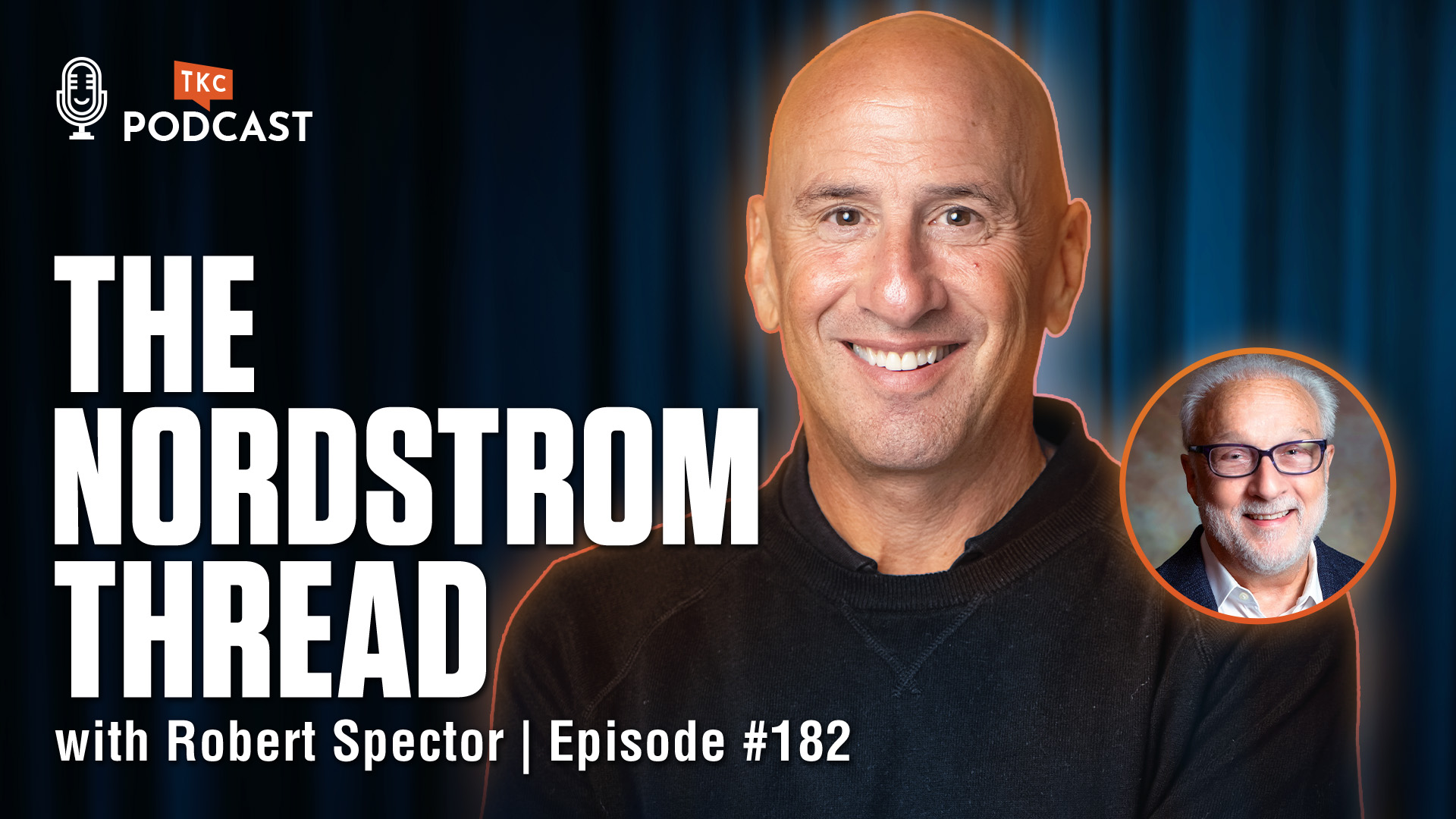
July 13, 2026The Nordstrom Way: Business Culture Lessons From Robert Spector
Robert Spector explains why business success breeds complacency and how a strong culture keeps a business relevant for decades.
Success can be the most dangerous thing that ever happens to a business. It arrives looking like a reward, and it quietly turns into a trap. A business that wins big starts to believe the formula that got it there will keep working forever. That belief is usually where decline begins, and most leaders do not see it coming until it is already too late to reverse.
I sat down with Robert Spector, the world’s leading independent authority on Nordstrom, to talk about why some companies stay relevant for decades while others fade after one great run. Robert has spent more than three decades studying Nordstrom’s culture, and as a business keynote speaker, he has also written extensively about Amazon and other companies built in the Pacific Northwest. What struck me most in our conversation was how much business longevity depends on habits that most leaders never stop to examine.
This is not a conversation about tactics. It is a conversation about what keeps a business honest with itself long after the applause fades.
🎧 Watch and listen to the podcast episode: YouTube • Spotify • Apple Podcasts • Amazon Music
The Nordstrom Culture of Continuous Improvement
Robert has written four editions of The Nordstrom Way, and he told me that each edition exists because the company kept changing underneath him. That fact alone says something important. A best-selling author does not usually need to revisit the same subject four times across three decades unless the subject refuses to sit still.
What I took from this is that Nordstrom never treated its reputation as finished. Most companies build a strong culture once and then spend years defending it instead of improving it. Nordstrom did the opposite. Its leaders kept asking what needed to change even while customers were praising them for what already worked. That is a hard thing to do. It requires a kind of discomfort that most successful businesses try to avoid, the discomfort of questioning your own strengths while they are still working.
I have seen this same pattern in smaller businesses too. The ones that last are rarely the ones with the best original idea. They are the ones willing to keep rebuilding the idea. A corporate culture that treats itself as a finished product is a culture already starting to decay, even if the sales numbers have not caught up to that truth yet.
Building A Business Culture That Can Adapt Without Losing Its Soul
The harder question Robert and I got into is how a business adapts without turning into something unrecognizable. Plenty of companies change so much trying to stay current that they lose the thing that made customers trust them in the first place. Nordstrom’s answer, as Robert explained it, is to hold two things at once: a fixed set of values and a flexible set of methods.
The values do not move. Service to the customer, trust in employees to make judgment calls, and a family culture that survived multiple generations of leadership. The methods move constantly, from store layout to technology to how employees are trained. What stays constant is the reason behind the methods, not the methods themselves.
This distinction matters far beyond retail. Any business leadership team facing disruption has to answer the same question. What is actually sacred here, and what is just the way we have always done it? Confusing the two is one of the most common reasons a business either freezes under pressure or changes so fast it forgets who it is. The businesses that handle this well tend to write their values down clearly enough that new employees can repeat them, and loosely enough that those values can survive a change in leadership, a new competitor, or an entire shift in how customers shop.
What Amazon’s Day One Philosophy Teaches Every Business
Robert is also one of the few authors who has studied Amazon as closely as he has studied Nordstrom, and this is where the conversation turned toward Jeff Bezos and the idea of Day One. Bezos has talked publicly for years about the difference between Day One and Day Two inside a company. Day One is when a business still acts hungry, still moves fast, and still treats every customer complaint like new information. Day Two, in his framing, is what happens when a business starts protecting what it built instead of building what comes next. Day Two eventually leads to what he has called stasis, followed by decline, followed by an extremely painful death.
What I found useful about this idea is how ordinary the warning signs are. A business in Day Two does not usually announce itself with a dramatic failure. It shows up in small ways first. Meetings get longer, and decisions get slower. Process starts to matter more than judgment. People start optimizing for not getting blamed instead of for solving the customer’s actual problem. None of that feels like a decline while it is happening. It feels like maturity.
This is where the conversation moved naturally into the future of work, because the businesses Robert studies most closely, Amazon, Nordstrom, Starbucks, and Costco, all seem to understand that staying young as a company is a discipline, not an accident. It takes a deliberate strategy to keep a large business acting like a small one, and most companies never build that discipline on purpose. They just hope size does not slow them down, and then it does.
Why Copying A Successful Business Model Rarely Works
One of the sharpest points Robert made in our conversation is also one of the most uncomfortable for a lot of leaders to hear. Copying a winning company almost never works, because the thing you can see from the outside is never the thing that actually made the company win.
Everyone can see Nordstrom’s return policy or Amazon’s fast shipping or Starbucks’ comfortable stores. What is much harder to see is the culture underneath those visible choices, the years of hiring decisions, the internal trust, the specific way a company handles a mistake when a customer is standing in front of an employee, and something has gone wrong. A competitor can copy the policy in a weekend. They cannot copy the culture that makes the policy actually mean something.
This is a lesson every business leader eventually has to learn the hard way, usually after a strategy meeting where someone says, why don’t we just do what they do. The honest answer is that you can borrow an idea, but you cannot borrow the years of consistency behind it. A business growth strategy built entirely on imitation tends to plateau quickly because imitation has no story behind it, and customers can tell the difference between a policy and a promise even when they cannot explain why.
I think this is also true in sales. The best salespeople are not the ones repeating a script someone else wrote. They are the ones who understand why the script exists in the first place, and who know when to set it aside because the moment in front of them calls for something the script never anticipated.
Inside Jeff Bezos’s Meeting Culture
We also talked about something smaller and more specific: the way Bezos structured meetings at Amazon. Instead of opening with a slide deck, meetings famously began with everyone reading a written memo in silence for the first several minutes. No presentation, no persuasion built into slick graphics, just a document that had to stand entirely on the strength of its own thinking.
I find this detail more interesting the longer I sit with it. A slide deck lets a weak idea hide behind good design. A written memo cannot hide anything. If the thinking is thin, everyone in the room reading it in silence will feel that thinness immediately, and there is nowhere for the presenter to redirect attention with enthusiasm or a well-timed joke.
That is a business leadership habit worth stealing even outside of Amazon. Most organizations reward whoever presents best in the room, not whoever thought most clearly beforehand. Flipping that incentive, forcing the thinking to happen on paper before the room ever gets a chance to be charmed by delivery, changes the quality of decisions a business makes. It is a small structural choice with a large downstream effect on how carefully people actually think before they speak.
The Nordstrom Thread And A Framework For Lasting Business Relevance
Robert also described what he calls the Nordstrom thread, the idea that runs through the company from its earliest days as a shoe store to its current position as a national retailer. The thread is not a slogan. It is closer to an instinct, passed down across generations of the Nordstrom family, about what the customer relationship is actually for.
Alongside that thread, Robert talks about a framework built around staying relevant, a way of checking whether a business is still built for its customer or has quietly started being built for its own convenience instead. The specifics of the framework matter less to me than the question underneath it, which is one every business should be asking on a regular schedule rather than only after a crisis forces the question. Are we still solving the customer’s problem, or are we just protecting our own process?
That question connects directly to branding & marketing, because a brand promise that the operation cannot actually deliver on the ground is not a brand at all. It is a slogan waiting to be exposed. The strongest brands Robert studies are the ones where the marketing and the daily operation say the exact same thing, because the operation was built first and the marketing simply describes it honestly.
What Taking Nordstrom Private Reveals About Business Legacy
We spent time on the Nordstrom family’s decision to take the company private again, after generations of being publicly traded, and this part of the conversation stayed with me the longest. Going private is usually described in financial terms, but Robert framed it as a cultural decision as much as a financial one.
Public markets reward predictability on a quarterly cycle. A family that has run a business for more than a century is thinking in a much longer unit of time, closer to a generation than a fiscal quarter. Taking the company private was, in part, a way of protecting the freedom to make decisions on that longer timeline again, decisions about employees, about stores, about the pace of change, without a quarterly earnings call shaping the calendar.
This matters for employee engagement in a way that is easy to miss. Employees can feel the difference between a business making a decision because it is right for the customer and the culture, and a business making a decision because a quarterly number needs to look a certain way. Over enough years, that difference shows up in trust, and trust is the thing that is hardest to rebuild once it has quietly eroded. Robert’s read on the Nordstrom family is that they understood this at a level most boards never get the chance to act on, because most boards do not get to choose their own time horizon.
Leading A Business Through Crisis With Honest Communication
Robert has also studied how Nordstrom handled genuine crises, including moments that threatened the business in ways no strategy meeting could have fully prepared for. His observation was simple and, I think, correct: the businesses that get through a crisis well are almost always the ones that overcommunicate rather than the ones that wait for certainty before saying anything.
Waiting for certainty feels responsible in the moment. It rarely is. Employees and customers fill silence with their own assumptions, and those assumptions are usually worse than the truth. A leader who says Here is what we know, here is what we do not know yet, and here is when we will update you again, is doing more to protect the business than a leader who waits three extra days for a perfectly worded statement.
I found this especially useful to think about for anyone doing inspirational & motivational work in front of a live audience, because the same instinct applies on a stage as it does inside a crisis room. People forgive an honest answer that is still forming far more easily than they forgive silence, and silence is very often mistaken for either indifference or hiding something. Overcommunication is not about talking more for its own sake. It is about closing the gap where fear and rumor tend to grow.
Customer Service Lessons From Costco, Starbucks, And The Limits Of AI
Robert also compared Nordstrom’s approach to two other companies he studies closely, Costco and Starbucks, and the comparison was more interesting than a simple ranking of who serves customers best. Costco earns trust through consistency and a membership relationship built on delivering exactly what it promises, nothing flashy, just reliable value delivered the same way every time. Starbucks built its version of customer experience around a physical space, the idea of a third place between home and work, where the product is almost secondary to the feeling of being welcome there.
Nordstrom’s model is different from both, built around individual employee judgment rather than a fixed system or a designed environment. That is where the conversation turned toward artificial intelligence, and Robert’s view was measured rather than alarmist. AI can absolutely handle transactional service well, tracking an order, answering a routine question, resolving something predictable. What it struggles to replace is the judgment call a trained employee makes in an unusual moment, the kind of decision that requires reading a person rather than a policy.
That distinction matters for any business trying to decide where technology belongs in the customer relationship. The mistake is not adopting AI. The mistake is assuming AI can absorb the parts of the job that were never really about efficiency in the first place. Those parts were always about a human being deciding, in the moment, that a customer mattered more than the rule in front of them.
Aligning Technology With Customer Needs
This led us to a broader point about technology generally, one that applies well beyond customer service. Robert’s view is that technology should serve the customer relationship, not simply serve the budget. A lot of businesses adopt new systems because they are cheaper or faster to run, and then discover months later that customers can feel the difference, even when they cannot name exactly what changed.
The businesses that get this right ask a different question before adopting anything new. Not only does this save money, but does this make the customer’s experience better, and only after answering yes to that question do they ask whether it also happens to save money. Reversing that order, leading with cost and hoping the customer experience keeps up, is how a lot of well-intentioned technology investments quietly damage the relationship they were meant to strengthen.
For anyone in the events and communication space, and this includes many of the people who listen to conversations like this one for their own success in front of an audience, the same principle holds. A tool, a script, a format change, all of it should be judged first by whether it serves the person receiving the message, and only second by whether it makes the job easier for the person delivering it. Robert’s decades of studying Nordstrom, Amazon, Costco, and Starbucks all point back to that same simple test.
Communication Lessons For Event Professionals
Toward the end of our conversation, Robert connected all of this back to something practical for anyone who works in events, speaking, or communication generally. The companies he studies that last the longest all share a habit of communicating clearly and often, inside the business and out. That habit is not a personality trait some companies happen to have. It is a discipline they built on purpose, the same way Nordstrom built its culture of continuous improvement, one decision at a time, over a very long stretch of years.
The lesson I keep returning to from this conversation is that a business does not stay great by accident, and it does not stay great by protecting what already worked. It stays great by treating its own success as unfinished, by asking uncomfortable questions on a regular basis instead of only after something breaks, and by trusting employees enough to let culture do the work that policy alone never quite manages.

The Real Test Of A Business Built To Last
What I keep coming back to after this conversation with Robert is that longevity in business is not a reward for getting something right once. It is the result of refusing to treat any single win as proof that the formula is finished. Nordstrom has lasted more than a century not because it found a perfect system and defended it, but because it kept treating its own success as a question rather than an answer.
That is the real difference between a business that survives one great decade and a business that survives several. The first believes its own story a little too much. The second keeps rewriting the story, one uncomfortable, honest conversation at a time, long after anyone would have blamed it for simply enjoying the win. If there is one thing worth carrying out of this conversation, it is that a business earns its future the same way it earned its past, by staying just a little bit unfinished, on purpose, forever.
🎤 Explore more on Robert Spector’s keynote speaker profile.
📞 If your audience needs a message on business culture, customer service, or staying relevant in a changing market, Robert delivers. Schedule a time here and let’s talk.
📩 Send us your audience and event theme, and we will tell you if he is the right fit: info@thekeynotecurators.com
Discover More Insights




Get in TouchContact US
Fill out the form so we can best understand your needs.
A representative from The Keynote Curators will reach out to you.