
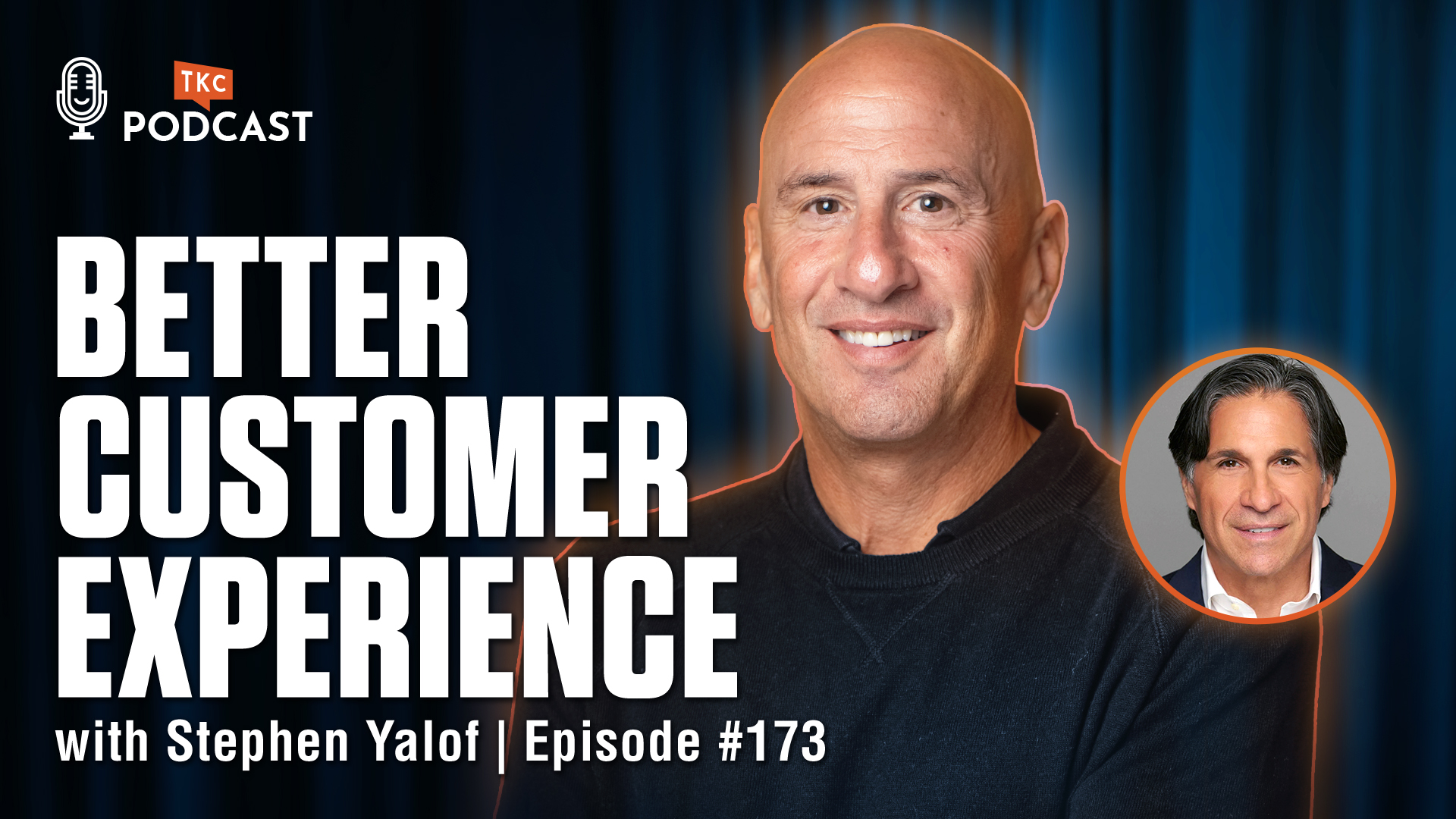
June 11, 2026The Future of Retail and Customer Experience, with Tanger’s Stephen Yalof
Learn customer experience insights from Tanger's CEO transformed retail into experience-driven hospitality.
The most dangerous assumption a business leader can make is that their customers want what they’re selling.
I sat down recently with Stephen Yalof, CEO of Tanger Outlets, and within the first few minutes, he articulated something that’s been quietly reshaping every successful retail business in America: the product isn’t the product anymore. Your customer experience is.
This insight isn’t theoretical. It’s born from two decades of building real estate portfolios, managing hundreds of retail locations, and watching how people actually behave when given choices. What struck me most was how Stephen sees the retail industry not as a transaction problem to be solved, but as a human experience to be designed. The businesses that are thriving aren’t the ones obsessing over inventory or pricing strategy. They’re the ones building destinations—places people choose to visit because of how they feel there.
This distinction matters whether you run a shopping center, lead a technology company, manage a nonprofit, or oversee a team of any size. The frameworks Stephen shared reveal why customer experience has stopped being a nice-to-have competitive advantage and has become the foundation of survival itself. In an era where products are increasingly commoditized, where price comparison is instantaneous, and where loyalty is genuinely optional, the only sustainable moat is how you make people feel.
What I’ve been thinking about since our conversation is how few leaders truly understand this difference. Most businesses talk about customer experience as something that happens in a department—handled by a customer service team or a marketing group tasked with engagement. Stephen’s approach reveals why that’s fundamentally wrong. Customer experience isn’t something you bolt onto your business. It’s the business.
🎧 Watch and listen to the podcast episode: YouTube • Spotify • Apple Podcasts • Amazon Music
The Pandemic Taught Him What Customers Actually Want
One of the clearest lessons Stephen shared came from what he observed during the pandemic shutdown. When Tanger’s outlets closed, the company didn’t just wait passively for reopening. They watched. They paid attention to how customers were actually using their physical spaces once they reopened.
What they discovered was revelatory. People weren’t primarily coming for the shopping. They were coming for the environment—for the outdoor space, the gathering place, the escape from being trapped inside. During lockdown, when Tanger centers reopened before many retailers inside them were ready, Stephen watched customers walk through empty storefronts just to be in that outdoor environment. Families would come together in a place designed for gathering. Community groups would find their way to these spaces because they were open, accessible, and designed for human connection.
This observation is more profound than it initially appears. Most retail leaders would see empty storefronts as a problem—vacant real estate bleeding opportunity cost. Stephen saw them as data. He understood that customers were telling him something fundamental about what they actually valued. They weren’t running to the outlets because they desperately needed to buy something. They were coming because Tanger had created a destination worth visiting.
What makes this especially interesting is how Stephen translated this observation into strategy. Rather than rushing to fill every vacant storefront with another retailer, he asked a different question: what if we designed this space explicitly for the experience people were already seeking? This is the moment when many leaders fail. They see an insight but fail to act on it boldly. Stephen did the opposite. He made a deliberate choice to lean into what the data was showing him, even though it meant rethinking decades of traditional retail real estate orthodoxy.
The lesson for any leader is this: your customers are always sending you signals about what they actually want versus what you think they want. During normal operations, these signals are often drowned out by transactions and more transactions. But when conditions change—when the normal rhythm is disrupted—those signals become clear. The pandemic wasn’t an aberration that Tanger had to survive and then forget. It was a window into the truth about human behavior that Stephen refused to ignore once it was revealed.
Hospitality, Not Retail
I’ve been reflecting on how Stephen reframed the entire industry conversation during our interview. He kept returning to one core idea: the future of retail looks more like hospitality than shopping.
On the surface, this might sound like semantic reframing. But it’s actually a complete mindset shift with profound operational implications. In retail, you’re optimizing for transactions. In hospitality, you’re optimizing for how guests feel, how long they stay, whether they want to return, how they talk about you to others. A retailer asks: “How can we move more product?” A hospitality director asks: “What experience can we create that makes people grateful they came?”
When you’re operating from a hospitality mindset, everything changes. Your metrics change. Your hiring changes. Your investment priorities change. Your employee training changes. You stop measuring success primarily on square footage occupied or sales per square foot. You start measuring success on the intangible dimensions that actually drive long-term loyalty: atmosphere, cleanliness, sense of safety, community, entertainment value, quality of human interaction.
Stephen’s insight here connects to something broader about how competitive advantage actually works in mature markets. When products are similar, when prices are knowable, when options are abundant, the only durable advantage is emotional. And emotion doesn’t come from the transaction itself. It comes from the entire context in which the transaction occurs—the journey, the environment, the people involved, the feeling of being welcomed and valued.
This is why he’s been studying how sports stadiums, concert venues, and entertainment destinations operate. These aren’t primarily selling seats. They’re selling belonging, excitement, memory-making, community. The food and beverage business within a stadium isn’t the purpose—it’s one component of an experience ecosystem. Stephen recognized that Tanger needed to learn from these sectors because they’ve already solved the experience equation that traditional retail had ignored.
For leaders operating in any industry, the question becomes: are you still thinking like a retailer in a world that’s demanding a hospitality mindset? Are you optimizing for transactions when your customers are actually seeking experiences? This pivot isn’t optional for businesses trying to build genuine loyalty. It’s becoming the price of entry.
Empty Storefronts as Opportunity, Not Liability
What caught my attention most powerfully was how Stephen described the moment he reframed one of retail’s fundamental challenges: empty storefronts.
Traditionally, vacant retail space is treated as a burden. It’s carrying costs without generating revenue. The default response is to fill it—get another tenant, any tenant, quickly. This thinking assumes that occupied space is inherently better than empty space. But Stephen asked a more fundamental question: what if we designed these vacancies intentionally?
This is where his thinking became genuinely innovative. Instead of rushing to backfill every empty location with another retail operation, Tanger began experimenting with what these spaces could become. Temporary art installations. Community gathering spaces. Event venues. Pop-up experiences. Outdoor dining areas. Performance stages. The spaces transformed from liabilities into opportunities to strengthen the overall destination.
What’s remarkable about this approach is that it’s simultaneously more patient and more confident than traditional retail thinking. It’s patient because it refuses to fill space just to fill it. It’s confident because it trusts that a stronger overall experience will generate more long-term value than maximizing occupancy rates. This is the opposite of the desperation that often characterizes struggling retail centers.
The business case is actually straightforward once you see it. A well-designed community event space that hosts concerts, farmers’ markets, or cultural events might generate less direct revenue than a traditional retail tenant. But it drives significantly more foot traffic, increases dwell time, strengthens brand affinity, generates social media content, builds community connection, and makes the entire destination more valuable. That higher-value destination attracts better retail tenants and commands higher rents. The short-term sacrifice in occupancy rates is more than offset by long-term value creation.
This principle extends far beyond real estate. Any leader working within a complex system—whether that’s a product ecosystem, an organizational structure, or a customer journey—can ask the same question Stephen did: what if we designed the gaps intentionally rather than rushing to fill them? What if we used the constraints as design opportunities rather than problems to be solved?
The deeper lesson is about strategic patience. Fast fills and empty storefronts represent a false choice. Stephen refused both. Instead, he asked: What’s the experience we’re actually trying to create? How does this space serve that vision? If it doesn’t serve the vision well, leaving it empty for now is better than filling it poorly.
Customer Insights as Your Actual Product
One story Stephen shared has stayed with me. It involved a customer calling with a specific problem—one that seemed like a simple complaint on the surface but actually revealed a much deeper opportunity.
The caller was frustrated because they wanted to browse and buy products without the pressure of navigating a traditional retail environment. A reasonable request. A problem that could be solved by improving the retail experience. But someone at the company—someone who was truly listening—heard something deeper in that feedback. The customer wasn’t asking for a better store. They were describing a different kind of value proposition entirely.
This insight led to an entirely new business line. Not a minor adjustment to the existing model. An entirely new way of serving a customer need that the traditional business structure had overlooked. This is what happens when you stop treating customer feedback as complaints to be managed and start treating it as product development input.
What makes this especially powerful is that the insight came not from a focus group or market research report. It came from someone actually listening to a customer conversation and recognizing that the complaint contained a larger truth. This is Stephen’s “rule of notes”—the practice of actually writing down what you hear, reflecting on it, recognizing patterns, and acting on those patterns with intention.
For any leader, this is a fundamental shift in how you think about customer interaction. Your customers aren’t primarily interested in validating your current business model. They’re trying to tell you what they actually need. The question is whether you’re listening at the level where you hear not just what they’re saying, but what they’re revealing about their underlying desires and unmet needs.
The businesses that win over the next decade won’t be the ones that are best at executing their current strategy. They’ll be the ones that are most effective at listening to what their customers are teaching them about what strategy should actually be. This requires a different kind of organizational humility—an acknowledgment that your customers understand their own needs better than you do, and your job is to interpret what they’re telling you and help them articulate the solutions they’re actually seeking.
The Power of “No Sacred Cows”
Perhaps the most leadership-relevant insight from Stephen came when discussing how Tanger actually implements these observations. He emphasized a simple principle that sounds obvious but is shockingly rare in practice: there are no sacred cows.
What he meant was that no existing strategy, no inherited way of doing things, no previous investment or historical commitment is protected from questioning. If the data suggests a different direction, if customer behavior reveals that an assumption is outdated, if the world has changed in ways that make your previous strategy suboptimal, then that strategy changes. Period.
This is profoundly different from how most organizations operate. Most companies protect their existing business models with a fierceness that approaches religious conviction. “This is how we’ve always done it.” “This is our competitive advantage.” “This is what our shareholders expect.” “This is what our partners understand about how we operate.” These become walls against change, even when change is clearly needed.
What I’ve observed about organizations that successfully disrupt themselves is that they’ve somehow created cultural permission to question everything. Stephen had made that explicit at Tanger. You can challenge any assumption. You can ask whether any strategy still makes sense. You can propose that something foundational might need to change. This isn’t anarchy—it’s directed toward the core question of what actually serves the customer and the business’s long-term health.
This mindset is particularly important in industries like retail that are experiencing fundamental disruption. You cannot navigate disruption successfully if you’re defending your way of doing things from before the disruption. You need to be willing to look at empty storefronts and see opportunity. You need to be willing to reimagine what your business actually is. You need to be willing to learn from industries that have already figured out the experience equation. You need to be willing to abandon what worked before in service of what needs to work now.
For leadership in any sector, this is the real challenge. How do you build organizational cultures that can genuinely question themselves? How do you create spaces where challenging assumptions is welcomed rather than seen as disloyalty? How do you prevent previous success from becoming an anchor that prevents future evolution? Stephen’s emphasis on “no sacred cows” suggests that this requires deliberate, intentional leadership that creates explicit permission for this kind of thinking.
The Role of Risk, Timing, and Luck
As our conversation progressed, Stephen shared something candid about leadership that I found refreshing. He acknowledged the role of luck while simultaneously arguing that luck isn’t something you simply experience. Luck is something you can create through positioning, preparation, and willingness to take intelligent risks.
This is a more honest way of thinking about leadership than the narrative you typically hear. Most success stories present a linear trajectory: the leader had a vision, executed flawlessly, and achieved their goals. This narrative is comforting but incomplete. The truth is more nuanced. Good leaders create conditions that make them more likely to benefit from luck when it arrives. They position themselves and their organizations in spaces where unexpected opportunities are more likely to occur.
Stephen’s thinking here is sophisticated. He wasn’t arguing that you can control everything. You can’t control market conditions, competitor actions, regulatory changes, or global pandemics. But you can control whether you’re poised to take advantage of opportunity when it appears. You can control whether your organization has the flexibility and clarity of vision to pivot quickly when circumstances shift. You can control whether you’re taking calculated risks that expand your options or playing it so safe that you’re unprepared for change.
The pandemic is a perfect example. Tanger couldn’t control the fact that the pandemic happened. That was pure misfortune. But Stephen’s organization was positioned to respond quickly because they were willing to question their assumptions, because they were observing customer behavior carefully, and because they had created cultural permission to pivot rapidly. When the opportunity to redefine Tanger’s purpose emerged from the crisis, they were ready to move toward it while competitors were still trying to get back to normal.
This reframes how leaders should think about risk-taking. It’s not about recklessness or blind optimism. It’s about creating organizational optionality. It’s about building teams that can respond to changing circumstances. It’s about maintaining clarity about your actual purpose while being flexible about the tactics for achieving it. It’s about positioning yourself in spaces where good luck, when it arrives, can actually be leveraged.
The Simple Rule That Changes Everything
Toward the end of our conversation, Stephen shared something he called his “rule of notes”—a practice so simple that it’s easy to dismiss, but so powerful that it’s become the foundation of how he operates.
The rule has three components, and I’ve been reflecting on how radical they actually are when implemented with genuine intention. First: take notes. Actually write things down. Don’t assume you’ll remember. Don’t trust your memory of conversations or commitments. Create a record. Second: read the room. Pay attention to what’s actually happening, not just what’s being said. Notice the energy. Notice the unspoken dynamics. Notice what people really care about beneath their words. Third: be present. When you’re in a conversation, actually be in the conversation. Not half-present while thinking about your next meeting. Not present in body while mentally already somewhere else.
These sound so obvious that it’s almost embarrassing to state them. Yet watching how many leaders violate all three simultaneously is striking. They don’t take notes because they believe their experience is sufficient. They don’t read the room because they’re too focused on their own agenda. They’re not actually present because their attention is divided between the conversation and their phone.
What makes Stephen’s rule so powerful is how these three practices compound. When you take notes, you’re forced to listen more carefully—you can’t write everything down, so you have to discern what’s important. When you read the room, you’re forced to pay attention beyond just the explicit content of what’s being said. When you’re present, you create space for the actual human exchange to happen rather than just going through the motions of a meeting.
For leaders focused on improving customer experience and business growth, this rule becomes foundational. You cannot actually understand what your customers need if you’re not taking notes on what they’re telling you. You cannot read the market if you’re not reading the room during actual customer interactions. You cannot build something meaningful if you’re not actually present with the people you’re serving.
The deeper insight is about information asymmetry. In any relationship—customer to business, employee to leader, investor to founder—the person who’s actually paying attention has profound advantages. They understand needs that others have articulated but not acted on. They notice patterns that less attentive competitors miss. They build relationships of deeper trust because they’ve demonstrated genuine engagement. The rule of notes isn’t a productivity hack. It’s a way of creating sustained competitive advantage through deliberate attentiveness.
Learning From Industries That Have Cracked Experience
What struck me throughout our conversation was Stephen’s intellectual humility. Rather than assuming that retail had all the answers about how to create destination experiences, he was deliberately learning from other industries that had already solved this problem.
Sports stadiums. Concert venues. Entertainment destinations. These sectors had already figured out how to make people willing to travel, willing to spend significant money, willing to return repeatedly, and willing to evangelize to others. The reason wasn’t the core product—the game or the show itself. It was the entire ecosystem surrounding that product. The environment. The food and beverage quality. The entertainment between events. The social experience. The feeling of belonging to a community of fans. The intangible sense of mattering.
Stephen’s insight was that retail could learn everything from studying how these industries operate. When you go to a stadium, you’re not just paying for a seat. You’re paying for an experience that’s been carefully designed in every detail. The entrance experience. The ease of finding your section. The friendliness of the staff. The quality of food options. The entertainment during slower moments. The bathroom facilities. The ease of parking. The way the venue makes you feel special. Every single element has been considered.
Most traditional retail had ignored this level of intentional experience design. Retailers focused on merchandising, pricing, and foot traffic conversion. They optimized for transactions. The stadium model showed a completely different path: optimize for experience, and the transactions follow naturally. People will spend more money in a well-designed environment where they feel valued and entertained. They’ll return more frequently. They’ll bring others. They’ll recommend it.
This is not a coincidence or luck. This is the result of deliberate, intentional design. And those lessons are transferable to any business trying to build sustainable loyalty. For innovation keynote speakers and leaders in any sector, the question becomes: what industry is solving a problem similar to what I’m trying to solve? What can I learn from how they’ve approached the challenge? How can I import their solutions into my context?
The Advantage of Being Physical in a Digital World
One nuance that emerged subtly throughout our conversation deserves explicit attention. Stephen acknowledged that physical retail is facing real headwinds from e-commerce. That’s not going away. But he identified something important: the one sustainable advantage that physical retail has is the customer service dimension.
You cannot replicate the human interaction of walking into a physical space and getting expert guidance, personalized attention, and genuine service from someone who cares. You can fake this through customer service departments and chatbots, but it’s not the same. The real thing—actually being present with someone, reading their needs, anticipating their preferences, creating a moment of genuine human connection—cannot be scaled digitally.
This is why the future of physical retail isn’t about competing with e-commerce on price or selection. It’s about competing on the dimension where physical retail has an inherent advantage: the human experience. This means investing in staff quality, training employees to genuinely serve customers, creating an environment where human connection is prioritized, and making the physical space itself a reason to come.
What makes this particularly relevant is that this advantage is available to any physical business, regardless of what you’re actually selling. A hotel. A restaurant. A service business. A nonprofit. Any organization with physical spaces has the opportunity to compete on the dimension where human experience creates the most value.
For leaders in business focused on customer experience, this clarifies where to invest. Don’t try to beat digital businesses at scale and efficiency. Those aren’t your competitive advantages. Your competitive advantage is the quality of human interaction, the thoughtfulness of your physical environment, and the genuine care you show toward the people you serve. That’s not a backup strategy for failing e-commerce. That’s your actual strategy.
Redefining What the Business Actually Is
By the end of our conversation, I realized Stephen had done something quite profound. He’d helped his entire organization move beyond the traditional definition of what Tanger is. They’re not a real estate company leasing space to retailers. They’re not even a shopping center operator. They’re a destination company—a curator of experiences designed to bring people together, make them feel valued, and create memories.
This redefinition changed everything about how the organization thinks about itself, makes decisions, and allocates resources. It changed what they look for in potential tenants. It changed how they design physical spaces. It changed what metrics they track. It changed how they talk to investors and employees about the company’s purpose and future.
The power of this redefinition is that it makes decision-making clearer. When you know what you actually are, you can say no to opportunities that don’t serve that purpose. You can make investments that seem counterintuitive through a traditional lens but make perfect sense through your actual lens. You can attract employees who are genuinely excited about the purpose you’re pursuing rather than just showing up for a paycheck.
Most organizations are operating with definitions of themselves that are either outdated or never served the actual purpose of what they’re trying to accomplish. They define themselves by what they do rather than by the value they create. They describe themselves in narrow terms that limit the possibilities they can imagine. They accept inherited definitions rather than choosing definitions that truly reflect what they want to become.
The lesson for any leader is this: do you know what your organization actually is? Not the traditional definition. Not the industry classification. Not what you inherited when you took the role. But what are you actually trying to accomplish? What value are you actually trying to create? What are you actually here to do? And does that definition guide your decision-making, or are you still operating according to an old definition that’s become invisible to you?
From Transaction to Belonging
The through-line of everything Stephen shared points to a single, transformative realization: the future belongs to organizations that understand the difference between transactions and belonging.
A transaction is a single, isolated moment. You want something, I provide it, we exchange value, and the relationship ends. Most of commerce has historically operated on transaction logic. You come to a store, you buy something, you leave. The store’s job is to optimize that moment—make the transaction as frictionless as possible and at the highest profit margin.
Belonging is different. It’s the feeling that you matter to someone. That they know you. That they’re genuinely invested in your wellbeing. That being in their presence is nourishing rather than extractive. That you’re part of a community of people who share values and identity. Belonging is durable. Belonging keeps people coming back. Belonging makes people willing to defend you to others. Belonging is the foundation of genuine loyalty.
Most businesses understand this intellectually but still operate on transaction logic in practice. They say they value relationships but measure success on transaction conversion rates. They say they want loyalty but invest in discount campaigns that train customers to wait for a deal rather than valuing the brand itself. They say they care about experience but make decisions based on short-term cost savings that degrade the experience.
Stephen’s work at Tanger is a demonstration of what happens when an organization genuinely believes that belonging matters more than transactions. It changes where you invest money. It changes what you measure. It changes how you talk to employees about their job. It changes what you’re willing to admit you don’t know and need to learn. It changes everything.
For any leader trying to build durable competitive advantage, this is the core question: are you designing for transactions, or are you designing for belonging? Because in a world where transactions are increasingly easy to complete, belonging is the only source of sustainable advantage left.

The most important thing I took away from my conversation with Stephen is that customer experience isn’t something you can outsource to a department or solve through a program. It’s a choice about what your organization actually is and what you’re willing to do in service of that choice.
That choice appears in thousands of decisions: whether you fill an empty storefront because it generates immediate revenue or leave it vacant because it doesn’t serve your larger vision. Whether you defend how you’ve always done things or question every assumption. Whether you listen to customer feedback at the level of transactions or at the level of what customers are revealing about their deeper needs. Whether you optimize for short-term metrics or long-term belonging.
These are leadership choices. They’re difficult because they often require sacrificing some conventional measure of success in service of something less tangible but ultimately more valuable. They require patience, clarity, and genuine commitment to something beyond immediate returns.
The retail industry is being disrupted. That’s not debatable. But what Stephen understands is that disruption isn’t primarily a threat. It’s an opportunity to reconsider what you should have been doing all along. It’s a chance to stop optimizing for what’s measurable and start investing in what actually matters. It’s a moment to ask the hardest questions about what your organization is really here to do.
For leaders in retail and beyond, that’s the real opportunity. Not surviving disruption. But using disruption as the catalyst to become the organization you should have been building from the start.
📊 Discover more resources on leadership and business strategy from top executive speakers
🏆 Explore how leaders are reshaping the future of work and customer experience
🎨 Learn innovation strategies from industry leaders and speakers
💼 Discover branding and marketing insights from thought leaders
📞 If your organization needs a customer experience keynote speaker who understands how to build destinations people want to belong to, Stephen delivers authentic, actionable insights. Schedule a consultation here, and let’s discuss how he can impact your audience.
Discover More Insights




Get in TouchContact US
Fill out the form so we can best understand your needs.
A representative from The Keynote Curators will reach out to you.