
September 24, 2026Customer Service Strategies That Actually Work in the Real World
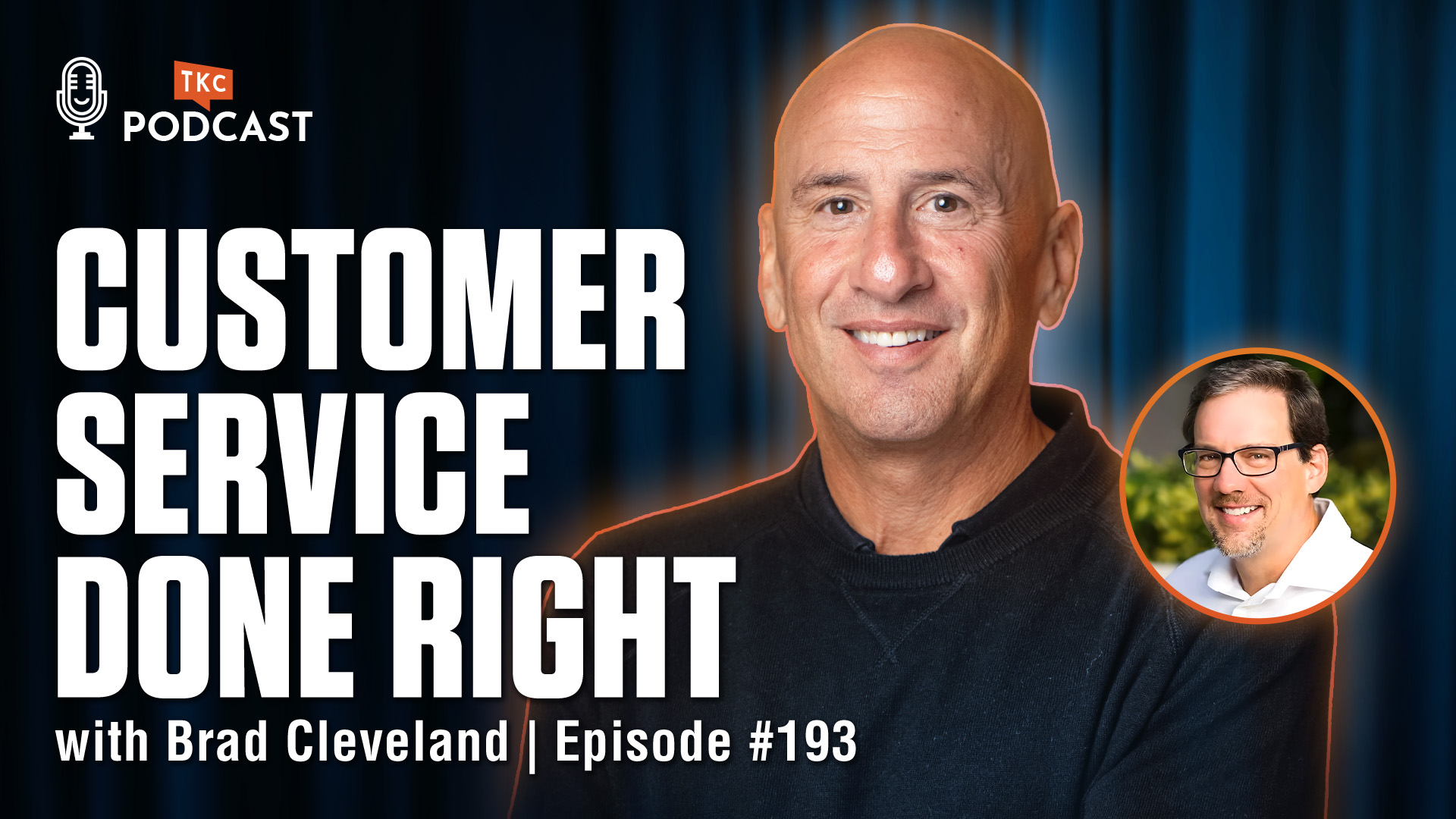
Brad Cleveland breaks down why good customer service is hard work in disguise, and what it takes to get it right in the AI era.
Good customer service looks simple from the outside. You wait a short amount of time. You get a clear answer. A chatbot knows when to stop pretending it can help and hands you off to a real person. The problem gets fixed, and it doesn’t come back. That’s it. That’s the whole experience most people want.
But simple isn’t the same as easy. I talked with Brad Cleveland about this, and the thing that stuck with me is how much invisible work sits behind every “easy” customer service interaction. Training. Staffing decisions. Systems that actually talk to each other. Values that hold up under pressure. None of that shows up on the surface, but all of it decides whether a customer walks away feeling cared for or feeling like a number.
🎧 Watch and listen to the podcast episode: YouTube • Spotify • Apple Podcasts • Amazon Music
Brad has spent decades inside this world. He has advised organizations like Apple, USAA, Samsung, and government agencies across dozens of countries, and he’s worked with the majority of companies that top the net promoter score charts in their industries. When someone with that much exposure to different companies tells you customer service isn’t where problems go to die, it’s where companies go to learn, you pay attention. That single reframe changed how I think about the whole topic of customer experience, and it’s the thread running through everything below.
A Crisis Doesn’t Create Culture, It Reveals It
One of the first things Brad and I got into was what happens to a company during a crisis. His point was pretty direct: a crisis doesn’t build your culture. It shows the culture you already had.
I’ve seen this play out with companies I’ve worked with too. When something goes wrong at scale (a system outage, a product recall, a shipping disaster during the holidays) you find out fast whether “the customer comes first” was ever true or just something printed on a wall in the break room.
Teams that had already built trust, already trained their people to make judgment calls, and already had leaders who backed those calls under pressure, tend to handle the moment with something close to grace. Teams that hadn’t done that work fall apart in exactly the places you’d expect: slow responses, confused messaging, employees who don’t know what they’re allowed to say or do. This is really a leadership question as much as an operations one, because it’s leadership that decides whether people are trusted to act before the crisis ever hits.
This is a harder truth than it sounds. It means you can’t fix your customer service during the crisis. You can only find out, during the crisis, whether you fixed it beforehand. That’s a sobering thought for any leader who treats customer service as something to worry about later, once things calm down. Things rarely calm down for long enough.
The Danger of “CX Slop”
Brad used a phrase in our conversation that I haven’t stopped thinking about: CX slop. It’s what happens when companies rush artificial intelligence into customer service without doing the harder work first.
Here’s the thing about that danger. AI can absolutely make customer service faster and cheaper on paper. It can answer basic questions at 2 a.m. It can handle volume no human team could keep up with. But if you drop a chatbot on top of a broken process, you haven’t fixed the process. You’ve just made the broken thing move faster and sound more polished while doing it. Customers feel that gap immediately. They can tell the difference between a system that understands their problem and a system that’s been trained to sound like it does.
What struck me most in this part of the conversation is that AI isn’t the villain here. Rushed thinking is. A company that uses AI to remove friction from a process it actually understands can create something genuinely better than what came before. A company that uses AI as a shortcut to avoid fixing a broken process just creates a faster, more convincing version of the same disappointment.
Do Customer Expectations Differ by Generation?
We also talked about whether younger customers and older customers actually want different things from customer service, and Brad’s answer was more nuanced than a simple yes or no. Preferences around channels do shift. Some people would rather text than call. Some still want to hear a human voice when something matters enough. But the underlying expectation, that a company respects their time and actually solves the problem, doesn’t really change by age group.
This matters because a lot of companies build their customer service strategy around the wrong variable. They assume that if they just get the channel right (chat for the younger crowd, phone lines for everyone else), they’ve solved the problem. But channel preference is a delivery detail. What people actually judge you on is whether the interaction respected their time and intelligence. Get that wrong, and no amount of channel optimization saves you.
Why “Easy” Customer Service Is Actually Hard
This is where the whole conversation kept circling back. Easy, for the customer, requires hard, behind the scenes. Every smooth interaction a customer has is the visible tip of a much larger structure: hiring the right people, training them properly, giving them technology that doesn’t fight against them, and building enough slack into the operation that a busy day doesn’t turn into a bad day for everyone involved.
I think this is the part companies get backwards most often. They chase the appearance of ease (short scripts, quick resolutions, high first-call-close rates) without doing the harder work that actually produces those outcomes. It’s the same mistake as trying to look calm without actually being prepared. Customers can tell the difference between genuine ease and a rushed version of it, the same way you can tell when someone is confident because they know the material versus confident because they’re hoping you don’t ask a follow-up question.
Where Brands Get the Human-Tech Balance Right
Not every company gets this wrong, though, and Brad pointed to examples of brands that blend technology and human interaction well. The pattern he described is consistent: technology handles the repetitive, predictable parts of the interaction, and humans step in exactly at the point where judgment, empathy, or a nonstandard situation is involved. The technology isn’t trying to replace the human moment. It’s trying to clear the path to it.
This is a useful test for any company evaluating its own customer service setup. Ask where the handoff points are between the automated system and the human being. If those handoff points are smooth and happen at the right moment, the system is doing its job. If customers have to fight their way through several layers of automation before they reach a person who can actually help, the technology isn’t clearing a path. It’s building a wall.
The Psychology of Waiting
We spent real time on waiting, and I think it’s one of the most underrated parts of customer service. Brad’s point was that how a company handles the wait says almost as much about how it values people as how it handles the actual problem.
Think about the difference between waiting on hold with no information and waiting on hold with a clear estimate and regular updates. The actual wait time might be identical. The experience of it is completely different. Silence during a wait reads as indifference, even if that’s not the intent. A little transparency (how long, why, what’s happening) turns the same amount of time into something a customer can tolerate, sometimes even appreciate.
This connects to something bigger than customer service and closer to basic human psychology. People can handle discomfort. What they struggle with is uncertainty layered on top of discomfort. A company that removes the uncertainty, even while the wait itself stays the same, is doing something that costs almost nothing and changes the entire emotional shape of the experience.
Turning Service From a Cost Center Into a Strategy
Here’s where the conversation moved from tactics to something closer to a leadership philosophy. A lot of organizations still treat customer service as a cost to minimize: a department to keep lean, a line item to shrink every budget cycle. Brad’s argument, and one I fully agree with, is that this framing gets the whole thing backwards for any business trying to grow.
Customer service touches more customers, more often, than almost any other part of the business. It’s a direct line into what’s working and what isn’t. Treated as a cost center, it gets squeezed until it barely functions. Treated as a strategic asset, it becomes one of the richest sources of insight a company has access to, feeding directly back into product decisions, process fixes, and even leadership decisions about where the company is heading next.
From Toll Booths to Spray Nozzles: Turning Complaints Into Fixes
One of the most memorable parts of our conversation was Brad’s comparison between toll booths and spray nozzles, and I want to sit with it for a second because it captures something important about how complaints should be used.
A toll booth is designed to slow you down and take something from you. If a company treats complaints that way (an obstacle to get through, a moment to survive) the complaint gets closed and nothing changes. A spray nozzle, on the other hand, redirects flow toward something useful. The best organizations treat complaints the same way: not as friction to minimize, but as a signal pointing toward exactly what needs to change next.
This reframe has a real practical consequence. Most companies measure customer service by how fast a complaint got resolved. Brad’s advice, and the line I keep coming back to, is to ask a different question: why did the customer have to contact you in the first place? That single question, asked consistently, turns a customer service team from a group that closes tickets into a group that prevents the next hundred tickets from ever happening.
The Danger of Misleading Metrics in Customer Experience Data Analysis
We also got into something that doesn’t get talked about enough: how easy it is for the wrong metric to quietly steer a whole company in the wrong direction. Average handle time is a good example. Optimize hard enough for speed, and you’ll get speed, but you might get it by training your team to rush people off the phone before the actual problem is solved.
The deeper lesson here is that metrics aren’t neutral. They shape behavior, whether or not that was the intent behind choosing them. A company that measures the wrong thing will, eventually, get exactly what it measured, and it usually isn’t what leadership actually wanted. This is why customer service leaders need to treat metric selection as a strategic decision, not an administrative one. The wrong number, tracked long enough, can quietly undo years of good intentions.
Where Human Interaction Still Wins
We closed the conversation on a note that felt almost like relief: despite everything AI can now do, there are still moments where human interaction is simply better, and probably always will be. Complex, emotional, or high-stakes situations (a cancellation during a family emergency, a billing dispute tied to something painful, a complaint that’s really about feeling unheard) call for a level of judgment and empathy that current technology can’t fully replicate.
The lesson that stayed with me is that the goal isn’t to automate everything possible. It’s to figure out, honestly and specifically, which parts of the customer journey genuinely benefit from automation and which parts need a human being on the other end. Getting that split right is quietly one of the hardest and most valuable decisions in customer service today, and it’s a decision that touches employee engagement as much as it touches the customer, because the people answering the hardest calls need to feel supported, not just measured.

The Discipline Behind Effortless Service
If there’s one thing I keep coming back to after this conversation, it’s that effortless customer service is never actually effortless. It’s the visible result of a lot of unglamorous work: training that holds up under pressure, technology applied at the right moment instead of everywhere, metrics that measure the right thing, and a genuine curiosity about why customers had to reach out in the first place.
Brad Cleveland has spent decades studying this, and what comes through clearly in his work is that customer service isn’t a department to manage down. It’s one of the clearest windows a company has into whether it’s actually keeping the promises it makes. Companies that treat customer service as a strategic asset, not a cost to minimize, end up learning things about their own business that no dashboard or quarterly report would ever surface. That’s the real opportunity here, and it’s available to any company willing to do the harder work behind the easy experience.
🎤 Explore Brad’s keynote speaker profile on our website
📞 Schedule a time here and let’s talk about booking Brad
📩 Send your audience and event theme to info@thekeynotecurators.com, and I’ll tell you if Brad is the right fit
Discover More Insights




Get in TouchContact US
Fill out the form so we can best understand your needs.
A representative from The Keynote Curators will reach out to you.