
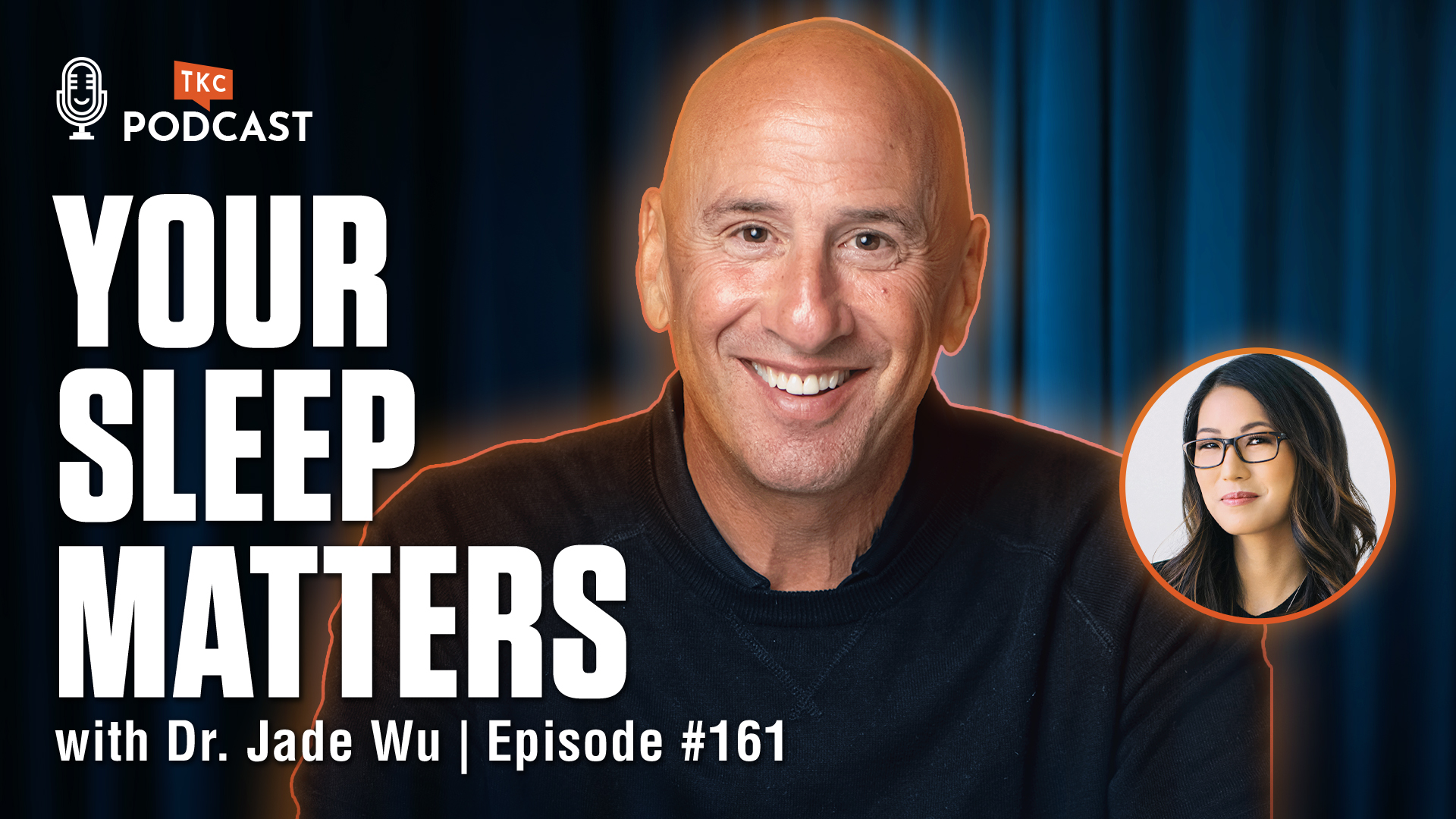
March 26, 2026Sleep Science Secrets That Actually Change How You Rest
Sleep science expert Dr. Jade Wu reveals how better sleep habits, not gadgets, unlock peak performance and lasting well-being.
What if everything you’ve been told about improving your sleep is actually making it worse?
Most people chase better sleep the same way they chase better productivity: with tools, trackers, and techniques. A new pillow. A weighted blanket. A white noise machine. A detailed evening routine pinned to the bathroom mirror. And still, the sleep doesn’t come. The irony is painfully familiar: the harder you try, the more elusive rest becomes.
That’s the insight at the core of my conversation with sleep science keynote speaker Dr. Jade Wu, and it’s one that reframes the entire conversation around rest, recovery, and performance. Sleep is not a system to be optimized. It’s a relationship to be repaired. And for high achievers especially, that distinction changes everything.
In this piece, I’m walking you through the most important ideas from that conversation: why your approach to sleep might be the very thing disrupting it, what your body actually needs to rest well, and how a few straightforward shifts in behavior (not your nightstand) can transform your nights.
🎙 Watch and listen to the podcast episode: YouTube • Spotify • Apple Podcasts • Amazon Music
Sleep Science Begins With the Right Question
The first thing Dr. Jade Wu challenges is the framing most people bring to the topic. We ask: “What should I do to sleep better?” But that question already assumes sleep is a performance task, something to be executed correctly. And when you treat sleep like a deliverable, you introduce the one thing that is most incompatible with rest: performance anxiety.
When sleep becomes a goal to achieve rather than a process to allow, your nervous system gets the wrong signal. Instead of winding down, it ramps up. Instead of releasing control, it reaches for it. The result is that bedtime feels more like a high-stakes presentation than a natural transition into rest.
Dr. Wu describes this as “unjunking your sleep”, which means stripping away the gadgets, the rigid protocols, and the obsessive monitoring, and replacing them with something more fundamental: trust. Trust that your body knows how to sleep. Trust that rest will come when conditions are right. Trust that chasing sleep is the surest way to lose it.
This is not a passive message. It’s a deeply practical one. If you have ever laid in bed mentally reviewing everything you did or didn’t do to optimize your night, you already know what she means. The optimization itself became the obstacle.
What Sleep Science Says About Sleepy vs. Tired
One of the most immediately useful distinctions Dr. Wu makes is the difference between being sleepy and being tired. These two states feel similar, but they operate through entirely different mechanisms, and confusing them leads to some of the most common (and counterproductive) sleep mistakes people make.
Tiredness is a general state of low energy. You might feel tired after a demanding day, after emotional stress, after intense physical exercise, or after sitting in too many Zoom calls. Tiredness is real, but it does not automatically translate into the ability to fall asleep or stay asleep.
Sleepiness, on the other hand, is a specific biological signal. It’s the pressure that builds in your body through a compound called adenosine, which accumulates the longer you’re awake. Sleepiness is what makes you yawn, makes your eyelids heavy, makes focusing feel effortful. That is the signal your body uses to initiate and sustain sleep.
The mistake most people make, and it’s an extremely common one, is going to bed when they’re tired but not yet sleepy. They lie down because the clock says it’s time, because they have an early morning, because they think getting more hours in bed will automatically mean more hours of sleep. But if the biological sleepiness signal isn’t strong enough, the body won’t cooperate. And lying in bed awake, watching the minutes pass, is one of the fastest ways to train your brain to associate the bed with wakefulness and frustration rather than rest.
This is part of why health & well-being experts increasingly move away from rigid bedtime schedules toward a more body-responsive approach: go to bed when you are genuinely sleepy, not just tired.
Your Chronotype Is Biology, Not a Character Flaw
Here’s something that matters enormously and gets very little airtime in mainstream sleep advice: not everyone is built to sleep and wake at the same time. Your chronotype, whether you’re naturally inclined toward late nights or early mornings, is a biological trait, not a moral position.
Dr. Jade Wu is direct on this point. Night owls are not lazy. Early birds are not more disciplined. These are circadian preferences shaped by genetics and age, and trying to override them through sheer willpower tends to produce chronic sleep debt rather than lasting habit change.
This has real implications for how we structure work, school, and performance. A night owl forced into a relentlessly early schedule is not struggling because of poor habits. They are struggling because their biological clock is genuinely misaligned with the social clock. And that misalignment has measurable effects on cognitive performance, mood, and physical health.
For event professionals and organizational leaders who book and design experiences around mental health and human performance, this is a meaningful insight. The expectation that everyone should function optimally at 7 am is not science-based. It’s a cultural convention. Dr. Wu’s work gives people permission to understand themselves more accurately and to stop blaming themselves for biological tendencies they didn’t choose.
How Daytime Behavior Builds the Foundation for Sleep
If there is one theme that runs through Dr. Wu’s perspective consistently, it is this: sleep is not a nighttime-only event. What you do during the day is what determines whether your body is ready to sleep when the night comes.
This starts with physical and mental engagement. When you do things during the day that build genuine adenosine pressure, you earn the biological sleepiness that makes sleep possible. A day of real effort, whether physical movement, focused cognitive work, or meaningful social connection, builds the foundation for rest. A day of passive, fragmented, low-engagement activity does not.
It also involves light exposure, which is one of the most powerful and underused tools in regulating the circadian rhythm. Morning light, specifically bright natural light within the first hour of waking, sends a powerful signal to your brain that anchors the start of the day and sets the timer on when melatonin will rise in the evening. Dr. Wu describes this as one of the simplest and most effective habits available to almost anyone, at essentially no cost.
The relationship between daytime effort and nighttime recovery is something I find personally compelling, and it resonates strongly with what I see in high performers across industries. People who do meaningful, effortful work during the day tend to sleep better, not because they are more disciplined about their routines, but because the sleep drive is genuinely there. For anyone exploring mindfulness and intentional living, this connection between engaged days and restorative nights is worth internalizing deeply.
Sleep Science and the Reality of Travel
Anyone who travels for work, whether for conferences, keynotes, client visits, or leadership summits, knows the particular exhaustion that comes from crossing time zones. The temptation is to manage it meticulously: calculate the time difference, log how many hours were lost, take melatonin at exactly the right moment, set multiple alarms, and arrive at each destination with a detailed recovery plan.
Dr. Wu offers a more grounded perspective: stop counting.
Obsessing over lost hours of rest, keeping a running tally of deficit, and treating each journey as a crisis to be managed, activates exactly the kind of vigilance and anxiety that make recovery harder. The stress response itself is sleep-disruptive. The mental hypervigilance around sleep loss compounds the original problem.
What works better is trusting the body’s adaptive capacity and giving it the right inputs. Align to the local light environment as quickly as possible. Get outside in natural light during local daytime hours. Keep moving. Stay hydrated. And stop treating every imperfect night as evidence of a deeper problem.
For the event professional community specifically, where travel is not occasional but structural, this shift in mindset is genuinely freeing. You are not managing a crisis. You are giving your body the information it needs to recalibrate. That distinction, between crisis management and environmental alignment, changes both the behavior and the outcome.
The Case for Behavior Over Medication
One of the most powerful threads in Dr. Wu’s work is the evidence base for behavioral approaches to sleep, as compared to pharmacological ones. This is not an anti-medication argument in any simplistic sense. It is a clear-eyed assessment of what the research actually shows.
Cognitive behavioral therapy for insomnia, known as CBT-I, consistently outperforms medications in long-term outcomes. It addresses the underlying thought patterns and behaviors that sustain insomnia, rather than chemically inducing a state that disappears when the medication stops. The gains are durable. The side effects are minimal. And the approach puts the person, rather than a substance, back in the driver’s seat of their own rest.
Dr. Wu’s book, Hello Sleep, is built around this framework. It is designed to give people a science-backed path out of insomnia that doesn’t require a prescription, and it reflects both her clinical training at Duke University School of Medicine and her research at Harvard Medical School. Her work through Thrive, the organization she founded, brings this approach to broader audiences who have often tried every gadget and supplement on the market and found none of them lasting.
What I find most compelling about this position is how it reframes the goal entirely. The goal is not to manufacture resting hours. It is to remove the obstacles that are preventing from happening naturally. That is a fundamentally different project, and it’s one that requires understanding rather than purchasing.

Why This Conversation Belongs on Every Stage
The relevance of sleep science extends far beyond the bedroom. Attention, memory consolidation, emotional regulation, decision-making, creative problem-solving: every cognitive function that matters in professional performance depends directly on your rest quality. When organizations talk about performance culture, resilience, or well-being strategy, they cannot credibly exclude the most basic biological driver of all of it.
Dr. Jade Wu brings something rare to a keynote stage: she combines clinical expertise, original research, and a communication style that her audiences consistently describe as liberating. Not prescriptive. Not fear-based. Not another list of things you’re doing wrong. What she offers is understanding, and with understanding comes genuine, lasting change.
For event professionals considering STEM programming or science-forward health content, her work bridges the research and the human experience in a way that resonates with audiences of every background. And for any organization navigating the intersection of performance and well-being, sleep is not a peripheral topic. It is the foundation.
If you want Dr. Jade Wu on your stage to speak about sleep, performance, and recovery, you can explore her full keynote speaker profile here.
Ready to bring this conversation to your audience? Schedule a quick call here, and let’s find the right fit for your event. 📅
Or send me your audience details and event theme at info@thekeynotecurators.com, and I’ll let you know if she’s the right voice for the room. ✉
Discover More Insights




Get in TouchContact US
Fill out the form so we can best understand your needs.
A representative from The Keynote Curators will reach out to you.
Our Services
Keynote Speakers Topics
© 2026 The Keynote Curators. All Rights Reserved | Terms and Conditions
The Keynote Curators, 8275 South Eastern Avenue, Suite 200, Las Vegas, NV 89123
Local (310) 299-4595 | Toll Free (888) 585-8715 | info@thekeynotecurators.com
The Keynote Curators - Top Keynote Agency, USA.