
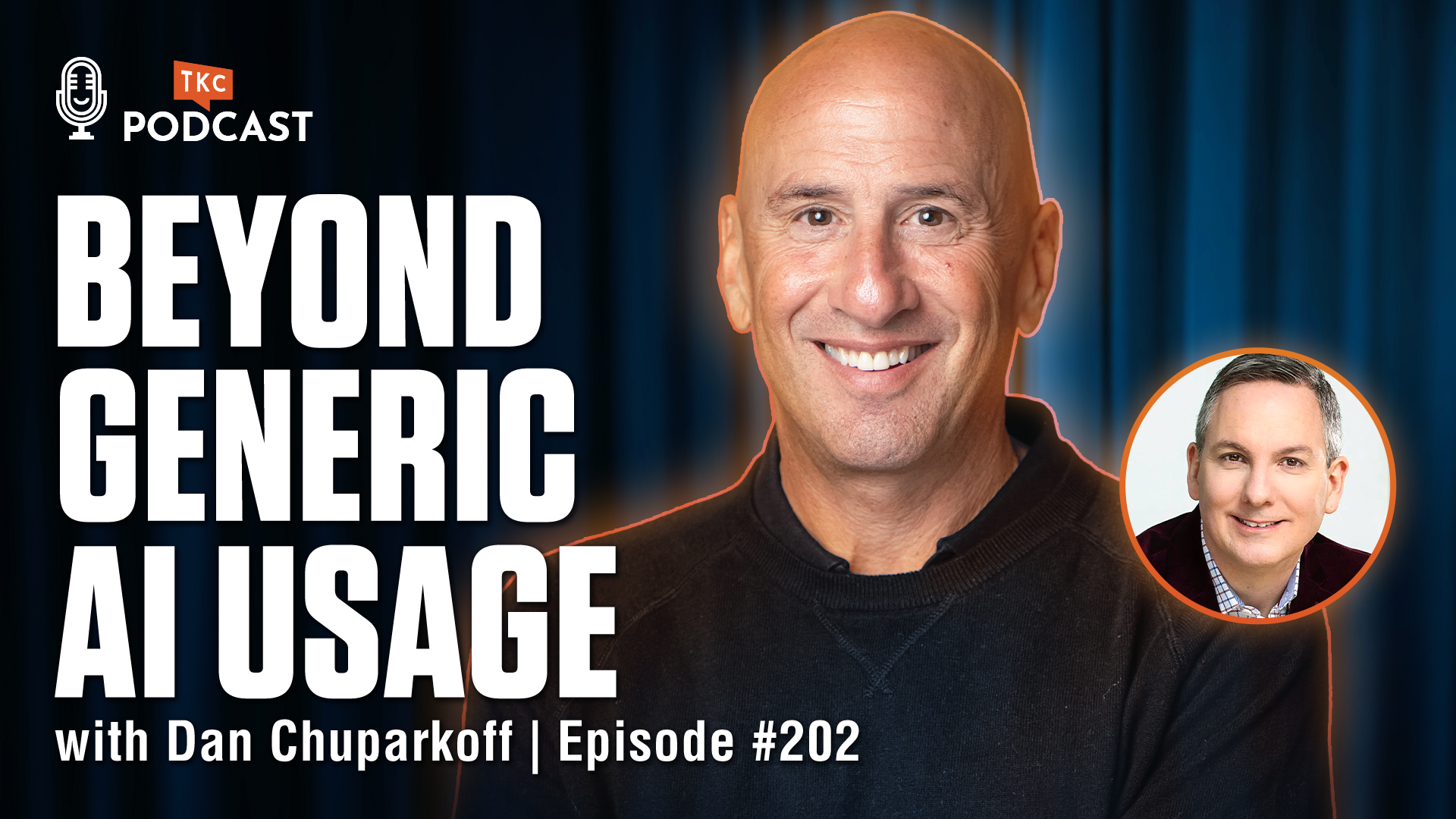
November 19, 2026Stand Out With AI When Everyone Else Sounds the Same with Dan Chuparkoff
Learn how to stand out with AI when everyone else sounds the same. Dan Chuparkoff shares how to use AI without losing your judgment.
Most leaders I know use AI every week now. Very few of them feel proud of what AI hands back. I noticed this again after my conversation with AI keynote speaker Dan Chuparkoff on The Keynote Curators Podcast. The tools are good. The results often read the same. And that sameness is becoming the real problem with AI.
Dan calls AI a B-minus assistant. He doesn’t say it to put the technology down. He says it because AI was trained on an enormous amount of average, and if you accept the first answer, average is what you get back. The more I think about it, the more I see this as a leadership issue and not a technology issue. When AI can raise your floor for free, the only way to stand out is to protect your ceiling. That is what this article is about, and it is why I think learning to stand out with AI matters more than learning to use AI faster.
🎧 Watch and listen to the podcast episode: YouTube • Spotify • Apple Podcasts • Amazon Music
Why Sounding Smart With AI Is Not the Same as Being Original
Here is the thing about a B-minus assistant. It almost never gives you an F. Everything it writes is readable, organized, and polite. That is exactly why it is risky. When the output is never bad, you stop questioning it. You accept the draft, change a word or two, and hit send. Multiply that habit across millions of people using AI, and you get a world where everyone sounds a little smarter and a little more alike.
What struck me in my talk with Dan is how simple the cause is. AI learned from an enormous amount of existing writing, so it leans toward whatever is most common. Most common is not wrong. It is just not yours. A leader’s value usually comes from the opposite direction: a specific story, a hard lesson, a strong opinion that grew out of years of doing the work. AI has none of that unless you bring it to the conversation.
I have seen this pattern before. Spreadsheets let everyone build a forecast, and soon the forecasts looked alike. Slide templates made decks easy, and soon the decks looked alike. Easy access raises the floor, and it also crowds the middle. The difference this time is speed. With these tools, the crowd forms in months, not years. The people who stand out will not be the ones who avoid AI. They will be the ones who know exactly what they add that AI cannot.
How AI Templates Make Every LinkedIn Post Sound the Same
One of the clearest places to see this is social media. Scroll LinkedIn for five minutes and you will notice the shape. A short hook line. A single-sentence paragraph. Another single-sentence paragraph. A neat lesson. A question at the end. Many of these posts were shaped by the same AI templates. Dan spoke about how these templates flatten voices, and I felt that right away. I have read posts from people I know well, and I could not hear them in the writing at all.
A template feels like help. It gives you structure and saves time. But a template also quietly decides what a good post looks like. When you let AI choose the shape, you also let it choose the rhythm, the tone, and often the point. That is a lot to give away to save ten minutes. What gets lost is the roughness that makes a person feel real: an odd phrase, a story that wanders a little, an opinion that not everyone will like.
There is a higher cost for anyone building thought leadership. Thought leadership only works when readers can tell who is doing the thinking. If your post could have been written by anyone with the same prompt, it is not leadership. It is filler. Readers are also getting better at spotting the pattern. Once they learn what machine-written posts look like, they skim past all of them, including yours. And they are right to, because the signal they came for, your actual point of view, was never there.
Treat Social Media Like a Real Conversation
Dan offered a simple test that I keep using. Treat social media like a real-world conversation. Think about how you behave at a conference. You do not walk up to a stranger and read a polished speech. You ask a question. You listen. You share a short story and react to what the other person says. Social media is that same room, only larger. If you send AI to write every post and every comment, you are sending a stand-in to a room full of people who came to meet you.
That does not mean AI has no role. It can help you tidy a sentence, test a headline, or point out where you ramble. But the first move should be yours. Start with what you actually think. Then let AI help you say it more clearly. Order matters here. When your idea comes first, AI works like an editor. When the idea comes from the tool, you become the editor of someone else’s thinking, and that is a weaker position to write from.
In business, people buy from people they trust. Trust grows when someone sounds like themselves over a long stretch of time. Every borrowed voice weakens that a little. Over months, a feed full of borrowed voices teaches your audience nothing about how you think, how you decide, or what you would do in a hard moment. That is the thing they are actually deciding whether to trust.
Use AI to Strengthen Your Expertise, Not Fake It
This is the center of the conversation for me. Dan’s view is that AI should strengthen what you already know. It should not stand in for knowledge you do not have. The difference sounds small, but it changes everything. A person with real expertise can look at an AI draft and see right away what is shallow, what is wrong, and what is missing. A person without it cannot. They see a confident paragraph and trust it.
Faking expertise with AI is a quiet risk. It works until someone asks a follow-up question. Then the gap shows, in a meeting, in front of a client, or on a stage. And the damage is bigger than one awkward moment. People start to wonder what else was borrowed. Real expertise gives you something no template can: the ability to say, “That sounds right, but it is not how it works in practice.” That sentence is worth more than any draft.
Dan’s background makes this point land for me. He has led technology change at Google, McKinsey, and Atlassian, and he is known for making complex things simple and useful. His work centers on combining the power of technology with the power of human expertise. That pairing is the whole point. When AI brings speed and breadth, and you bring experience and judgment, the result is better than either side alone. I find it helpful to remember that artificial intelligence is a way to amplify people, not a way to replace the part of them that took years to build.
Company Culture Is Often a Promise, Not a Record
One idea from the conversation surprised me. Dan pointed out that company culture is often aspirational, not historical. When a company writes down its culture, it usually describes who it hopes to be, not who it has been. The values on the wall are a promise. They are not a record of how people actually behaved last quarter. I have worked with enough organizations to know how true that is, and I had never heard it said so cleanly.
I think this connects to AI in a way that is easy to miss. If you ask AI to describe your culture, it will hand you the polished version, because polished versions are everywhere in what it learned from. It will sound lovely and be partly fiction. The same thing happens when leaders use it to write about teams, values, or mission. The words arrive smooth, and nobody checks them against what really happens on a Tuesday afternoon.
For anyone in business leadership, the lesson is to describe culture by what people do, not by what you hope they will do. Real culture shows up in who gets promoted, what happens when someone makes a mistake, and which meetings people dread. That kind of detail is the one thing AI cannot invent for you. It only comes from paying attention. And if you want a culture to move from aspiration toward reality, change has to be visible in daily behavior first. The story you tell can follow, but it cannot lead.
Do Not Outsource Your Thinking to AI
If there is one habit I would ask every leader to protect, it is this: let AI process information, but keep the decisions. Processing is the part machines do well. Reading a long report, pulling out themes, comparing options, sorting a messy pile of notes. These are tasks where speed matters and judgment is not the bottleneck. Deciding is different. A decision needs context, values, and someone willing to own the outcome.
I keep coming back to one idea from our conversation, and I will put it in my own words: Let AI handle the repeatable work. Keep the work that requires you to think. It sounds almost too simple. But when I apply it to my own week, it is surprisingly sharp. Writing the same status update again is repeatable. Deciding which project to drop is not. Formatting a table is repeatable. Deciding what the table should prove is not.
Good leadership has always meant taking responsibility for choices. “The tool recommended it” will never be a satisfying answer to a team, a board, or a customer. When thinking gets outsourced, accountability gets blurry, and blurry accountability is how small errors become big ones. There is also a quieter cost. Thinking is a muscle. If you stop using it for the hard questions, it gets weaker, and you may not notice until the day you really need it.
The Six Layers of Work and Where AI Belongs
Dan shared a way of looking at work in six layers. I will not try to list each layer here, because I would rather you hear him explain it in the full interview. What I can share is the idea underneath it. Work is not one solid block. It is made of different kinds of effort, and those kinds are not equal when it comes to AI. Some layers are routine and rule-based. Some depend on relationships. Some need creative leaps. Some need judgment that only comes from living through real situations.
Once you see work in layers, the question changes. You stop asking, “Can AI do my job?” and start asking, “Which layer of this task should AI touch?” That is a much more useful question. It also explains something Dan raised, which is why most people use it backwards. They hand over the thinking, the writing, and the opinion, then spend their own hours on formatting, chasing details, and cleaning up. That is the reverse of what makes sense. The tedious work should be the first thing to go, and Dan encourages people to look for the shortcuts that remove it.
This matters for creativity too. Creative work often feels inefficient, and it is tempting to speed it up. But the slow parts, the false starts and odd connections, are often where the good ideas come from. Protect the layers where you make something new, and let the machine take the layers where you only repeat something old. I like how this view treats people. It does not ask them to compete with software. It asks them to point the software at the right layer of the job.
Ask AI to Critique Your Work Instead of Creating It
The most practical shift Dan offered is also the easiest to try. Instead of asking AI to create your work, ask it to evaluate your work. Write the draft yourself. Make your argument, tell your story, build your plan. Then ask for a critique. Where is this unclear? What would a skeptical reader push back on? What am I assuming without saying it? This keeps the first idea in your hands and uses the tool as a sharp second reader.
I like this because it fits what a B-minus assistant is actually good at. A model trained on a vast amount of average can often tell you where your draft sounds like everyone else. It knows the common phrases because it has seen them so many times. That makes it a useful mirror for sameness, even when it is a weak source of originality. You write something with a real point of view. You ask where it feels generic. You fix those spots with your own experience. The final work is yours, and it is tighter.
There is also a link to innovation. Innovation often starts with a better question, not a better answer. Using it as a critic trains you to ask better questions of your own work. And Dan made another point I appreciated: you do not need special prompt tricks to do this. You can use natural language. Talk to it the way you would talk to a smart colleague, and give it context. The skill is not in clever wording. The skill is in knowing what good looks like, which brings us right back to expertise.
Helping Teams Handle AI Change With Confidence
A lot of the fear around AI is really fear of change. People worry about being replaced, being left behind, or looking foolish while they learn. Dan’s work with teams is built around that reality. After years of leading technology transformations, he focuses on making sense of it all in plain words, so people can act with confidence instead of anxiety. I find that more valuable than any tool tutorial. When people understand what a tool is for and what it is not for, the fear shrinks and the curiosity grows.
Good teamwork matters here. Teams that learn together tend to adopt new tools better than teams where each person quietly experiments alone and hides what they find. Share the prompts that worked. Share the outputs that embarrassed you. Agree on where the team will and will not use it. Clear norms turn a source of anxiety into a shared skill, and they make it easier for quieter people to ask the questions they are afraid to ask.
One more idea from the conversation was about time. Dan encouraged listeners to stop sitting through meetings where they are only a spectator. I think this connects to the future of work in a practical way. If you are not deciding, contributing, or learning, then your hour is being spent on someone else’s agenda. Ask whether you need to be there, whether someone can share notes afterward, or whether technology can help you catch up in five minutes. Time reclaimed from passive attendance is time you can spend on the thinking only you can do. That is what a good use of this technology looks like in real life: not a flashy demo, but a calmer week with more room for the work that matters.

The Ceiling Is Still Yours to Raise
When I look back at this conversation, I keep landing on the same picture. AI raises the floor for everyone. That is a real gift. Fewer people will write badly, plan poorly, or miss obvious points. But a higher floor means the middle gets crowded, and the middle is where sameness lives. The ceiling is the part that still depends on you.
Standing out with AI does not require special talent. It requires a few habits. Start with your own thinking. Let the tool process what is repeatable, and keep the decisions. Use it to critique before you use it to create. Bring the experience, judgment, and perspective that no model has lived through. And protect your time so you have energy left for the work only you can do.
I think that is the quiet message of this whole conversation. The goal is not to be the person who uses AI the most. It is to be the person whose work still sounds like a person, even in a world full of B-minus assistants. If you want to hear Dan explain these ideas in his own words, the full interview is worth your time. In the end, AI is a very good assistant and a poor substitute for you.
🎤 Explore Dan’s keynote speaker profile on our website.
📞 If your audience needs a message on AI, leadership, focus, productivity, and using tech without outsourcing human judgment, Dan delivers. Schedule a time here and let’s talk.
📩 Or send your audience and event theme and I’ll tell you if he’s the right fit: info@thekeynotecurators.com
Discover More Insights





Get in TouchContact US
Fill out the form so we can best understand your needs.
A representative from The Keynote Curators will reach out to you.