
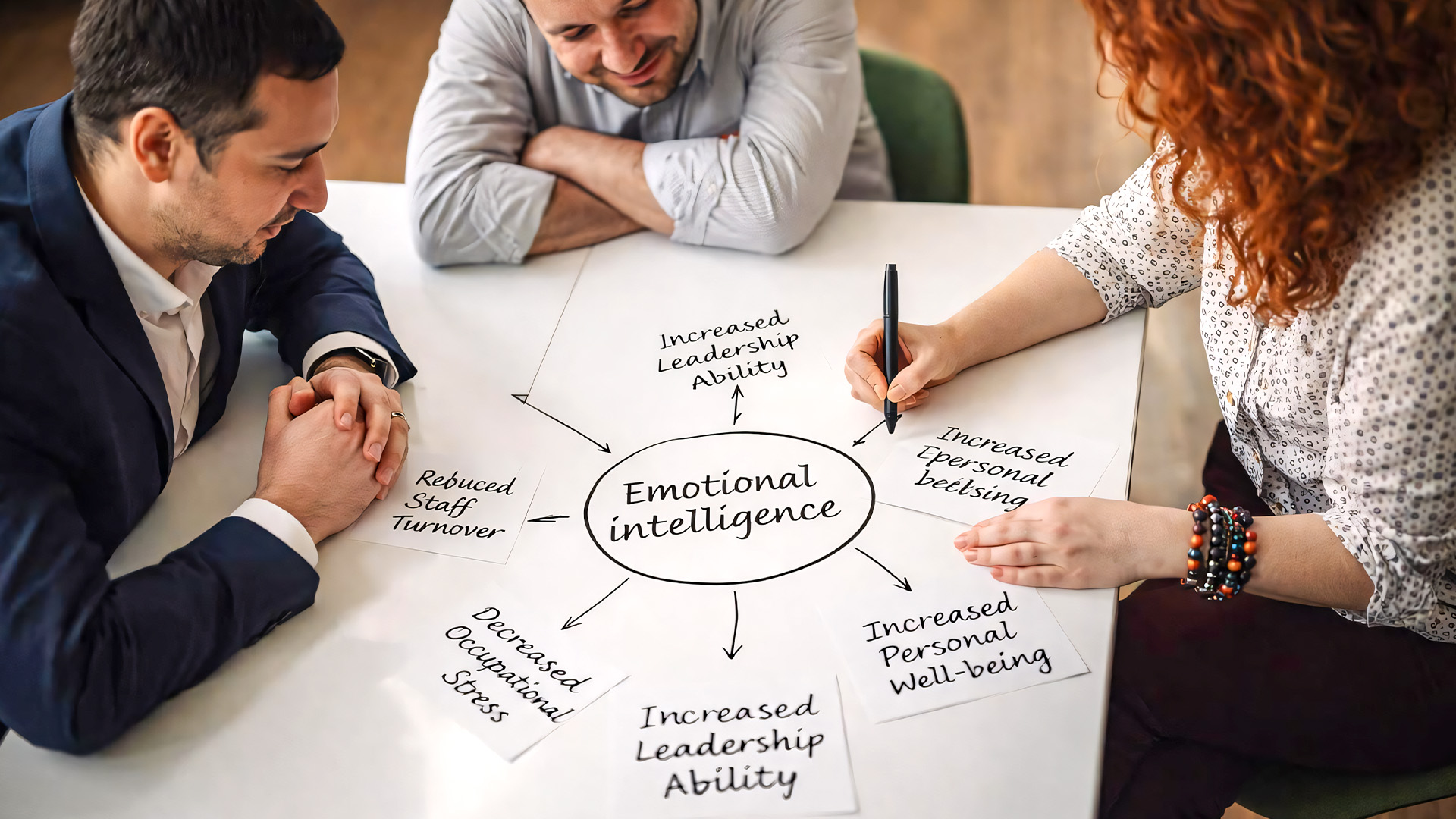
February 24, 2026Emotional Intelligence Skills That Hold Up Under Pressure
Emotional intelligence is more than a buzzword. Here's what real EQ looks like under pressure, and the keynote speaking voices building it on stages in 2026.
Emotional intelligence is having a moment. It’s in dating app bios, on resumes, in leadership decks, and in the apology texts people still don’t send. And like anything that trendy, it’s getting watered down.
“Emotionally intelligent” is starting to mean: I’m nice. Or worse: I’m calm while I control the room.
Here’s what’s actually happening in the real world. We’re living inside constant friction — screens, speed, always-on opinions. People are tired, overstimulated, and one Slack message away from spiraling. So emotional intelligence became the new status symbol. The problem is that a lot of people are using EQ the way they use “strategy” or “authenticity“: as a label, not a practice. And the world doesn’t need more labels.
So let’s get specific. In 2026, EQ isn’t a vibe. It’s a capability.
Why Emotional Intelligence Is Tested in the Moments You Don’t Plan For
Real leadership moments don’t announce themselves. They show up as a tense meeting you didn’t plan for, feedback someone’s been avoiding giving, a teammate who’s quietly burning out, a customer who isn’t “difficult” — they’re disappointed — or a decision where half the room feels unseen. And adaptive leadership is simply this: can you stay human and effective at the same time under pressure? Not on a good day. On the day your nervous system wants to hijack the room.
That’s the real test. Not the version of yourself that reads leadership books on Sunday mornings. The version that shows up at 4 pm on a Thursday when two urgent priorities are colliding, someone on your team is shutting down, and you’re already three conversations behind. That version. What does that person do?
Most of what gets labeled “people problems” is actually nervous-system problems. When people feel unsafe, they don’t become bad. They become predictable — defensive, performative, sarcastic, quiet, reactive, and “fine” (but absolutely not fine). The behavior is a response to a perceived threat, not a character flaw. Which means if you want a better culture, the most direct path is lowering the threat, not raising the performance bar.
This distinction changes everything about how you design teams, conversations, and the environments people work inside. It also changes what you ask of your leaders. You’re not asking them to be endlessly patient. You’re asking them to understand how the nervous system works — and to stop accidentally activating threat responses when they think they’re being direct.

Three Emotional Intelligence Strategies That Actually Work
The first is to name what’s true, cleanly. Most conflict drags on because people keep speaking in fog. They hint. They soften. They “circle back.” They talk around the thing so they can avoid the feeling. Clean truth is a gift — not blunt, not brutal, just clear. A format that works: “Here’s what I’m seeing. Here’s what I’m concerned about. Here’s what I need or propose. What am I missing?” That last line is the secret weapon. It turns a statement into a conversation, which is the only version of the conversation that actually resolves anything.
The second is to slow your response by two beats. Most people don’t have an emotional intelligence issue. They have a timing issue. They respond at the exact moment their nervous system is trying to protect them, which means the response is optimized for self-defense, not leadership. Two beats are tiny. But they create space for the adult brain to come back online. A useful cheat code before you speak: ask yourself, do I want to be right, or do I want this to work? Same person. Different outcome. That pause is where your emotional intelligence actually lives — not in what you feel, but in what you choose to do with what you feel before it exits your mouth.
The third is to design for recovery, or your culture will design for burnout by default. This is the sleeper issue most leadership conversations completely miss. If your culture rewards constant urgency, your people lose the ability to regulate. Then you get shorter tempers, worse listening, more misread tone, more drama, less creativity, and that particular flavor of “we’re fine” energy that means nothing is fine. You’ll call it communication problems. It’s not communication. It’s capacity.
Recovery is not a wellness perk. It’s a performance requirement. Build it into the system with buffer time, fewer meetings that don’t matter, clearer priorities, real breaks that are socially safe to take, and intentional decompression after high-stakes stretches — even for your highest performers. Especially for them. Because people can’t lead adaptively when they’re running on fumes, and the leaders most likely to claim they “don’t need recovery” are often the ones creating the most damage in the room without realizing it.
Emotional Intelligence Keynote Speakers Who Teach It as a Capability
And this is where the experts separate from the influencers. Emotional intelligence as a stage topic is crowded with people who make it feel good. The voices worth booking are the ones who make it feel useful — who help people handle the moment they’ve been circling, not just the philosophy behind why they should.
Teamwork expert keynote speaker Mike Robbins reframes authenticity as a daily practice, not a personality trait. A lot of leaders say they value authenticity right up until it costs them something. Mike’s work is about what happens after that — the balance of truth, less judgment, and the courage to be human on purpose. Because “telling the truth” isn’t the whole game. Plenty of people tell the truth in a way that burns trust to the ground. The real move is making honesty feel like a connection, not a confrontation.
What shifts in the room: leaders stop performing confidence and start building trust — one honest, human moment at a time.
Change keynote speaker April Rinne goes deeper than “change is constant.” We all say that line. But when life actually hits — when it’s messy, personal, and not on your timeline — that phrase stops being comforting and starts sounding like wallpaper. April’s work shows why your own change story is the real resilience engine. When people claim their personal history with change — what they survived, adapted to, learned from — it unlocks something most organizations can’t buy: empathy, trust, and shared momentum. This isn’t “be adaptable” advice. It’s a practical method for turning chaos into connection.
What shifts in the room: leaders stop treating change like a disruption and start treating it like a capability the team can build together.
Emotional intelligence keynote speaker Dr. JP Pawliw-Fry focuses on the last 8% — the part of the conversation that most people never actually finish. Most people are emotionally intelligent right up until the conversation gets real. That final stretch is where honesty, accountability, and trust either get built or quietly broken. JP brings the research and the practical tools on how to stay in it: how to push through discomfort without getting sharp, defensive, or performative, and how to finish the hard conversation in a way that moves the relationship forward instead of just ending the discomfort.
What shifts in the room: people stop avoiding the hard part and start handling it — cleanly, directly, without collateral damage.
Innovation expert keynote speaker Lisa Bodell comes at it from an angle that’s underrepresented in this conversation: overwhelm kills regulation. When people are buried in meetings, time-sucks, and unclear priorities, they don’t become more emotionally intelligent — they become more reactive. Lisa’s approach is deceptively simple: don’t overhaul everything. Create one small win in your sphere — kill one time-suck, cancel one useless meeting, remove one blocker — and watch what comes back online: clarity, patience, better listening, cleaner decisions. That’s not productivity. That’s capacity. And capacity is the foundation of emotional intelligence.
What shifts in the room: teams stop glorifying busy and start reducing noise so people can lead like adults again.
Five More Emotional Intelligence Voices Worth a Stage in 2026
The bench runs deeper than four names. These are additional emotional intelligence voices I’d put in front of an audience, depending on the specific moment you’re trying to create.
Emotional intelligence keynote speaker Abigail Posner is sharp on what drives human behavior, especially when technology is shaping attention, identity, and belonging. She’s particularly strong for leaders who want to communicate in a way that actually lands in a world where people’s attention is perpetually fragmented. Her work sits at the intersection of human truth and digital culture, which is exactly where most leadership challenges now live.
Emotional intelligence keynote speaker Sara Ross helps leaders get real about confidence, communication, and how to lead without shrinking or steamrolling. She’s smart, direct, and uncomfortably useful — the kind of session where people laugh in recognition and then sit with it for a week. Emotional intelligence with passion and enough humor to make the hard parts land.
Emotional intelligence keynote speaker Heather Younger makes “care” practical — not as a sentiment but as a set of daily behaviors that determine whether people stay engaged or quietly check out. Listening, trust, and the micro-interactions that add up to either a culture people want to be in or one they’re tolerating. Her work is measurable, which makes it rare in this space.
Emotional intelligence keynote speaker Dr. Taryn Marie brings depth on regulation, resilience, and the science behind why calm leadership isn’t a personality type — it’s a practice you build. Her work connects the nervous system research to practical leadership behavior in a way that makes people stop thinking of regulation as a soft concept and start treating it as a skill.
Emotional intelligence keynote speaker Emma Seppälä bridges performance and wellbeing without the fluff. Her work makes the case — backed by research — that compassion, recovery, and emotional fitness aren’t luxuries or alternatives to high performance. They’re how you avoid crashing. She’s particularly effective for audiences that have been trained to see self-regulation as weakness, because she reframes it entirely through the lens of results.
The Question I’m Asking Planners Right Now
If your next event includes leadership, culture, performance, or change, do you want your audience to leave feeling inspired or more capable? Those aren’t the same thing, and the difference lies in which speaker you choose and how the session is framed.
Emotional intelligence speakers shouldn’t just make people feel good. They should help people handle the moment they’ve been avoiding. The conversation they keep starting and never finishing. The feedback they keep softening until it means nothing. The team dynamic they’ve been managing around instead of through. That’s the value a well-chosen session delivers — not a lift of enthusiasm that fades by the flight home, but a shift in how someone shows up the following Monday.
If you’re building 2026 agendas and want the right voice for the exact moment you’re trying to create, I’d love to help you think it through. Tell me the audience, the pressure point — whether that’s change, burnout, conflict, performance, or trust — and what you want to be different after. I’ll send back a few speaker fits and how I’d frame the session so it lands.
Schedule a 15-minute conversation, and let’s build something worth the room.
If this made you think, subscribe so you don’t miss the next one — it lands directly in your feed.
Or reach out directly at info@thekeynotecurators.com — always glad to hear what you’re working on. 📬
Discover More Insights




Get in TouchContact US
Fill out the form so we can best understand your needs.
A representative from The Keynote Curators will reach out to you.