
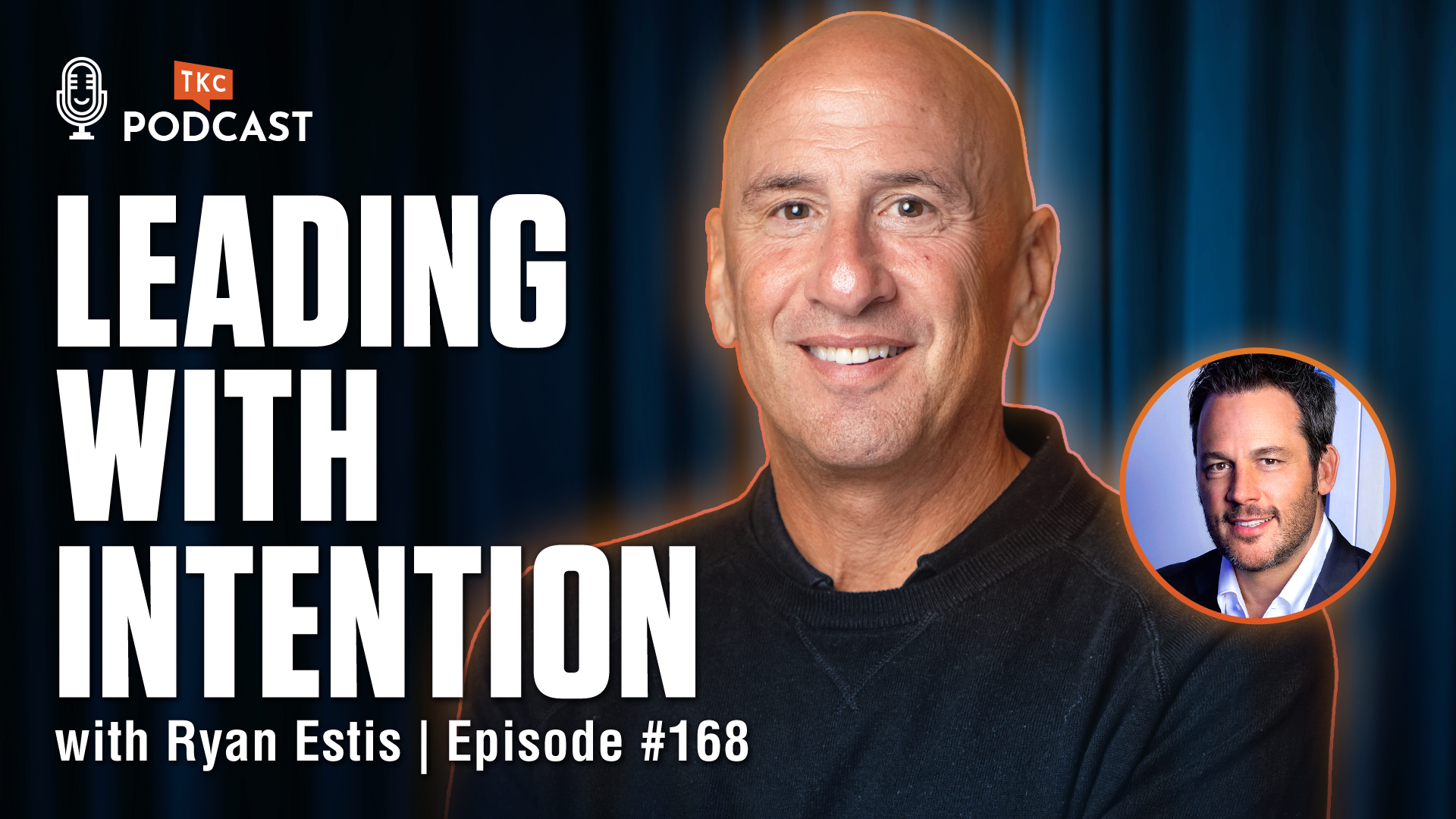
May 14, 2026Opportunity Hides in Change: How to Lead Through It, with Insights from Ryan Estis
Learn from Ryan Estis how opportunity hides inside pressure, burnout, and constant change, and what leaders must do differently to find it.
What if the disruption your team is dreading right now is actually the opportunity you’ve been waiting for?
That’s not a motivational slogan. It’s a pattern that shows up consistently in high-performing organizations, and it’s one of the central ideas at the heart of my conversation with Ryan Estis, one of the most compelling voices in business leadership today. Ryan brings more than two decades of experience as a top-performing sales professional and leader, including his time as chief strategy officer at the McCann Worldgroup advertising agency NAS, and he’s spent years helping world-class organizations navigate exactly the kind of environment we’re all operating in right now: high burnout, low engagement, rapid technological change, and constant pressure to do more with less.
What I walked away with from this conversation is a clearer understanding of how opportunity doesn’t arrive on a silver platter. It arrives dressed up as volatility, overload, and friction. And whether you’re a leader, a sales professional, or someone trying to build something meaningful inside a fast-moving organization, learning to recognize opportunity in those moments is the skill that separates people who thrive from people who just survive.
In this post, I’m pulling together the most important ideas from our conversation: what’s driving burnout, why the language leaders use matters more than most people realize, how to filter the noise and focus on what actually drives performance, what the AI moment actually demands from leaders and professionals, and why authenticity and storytelling are not soft skills but competitive advantages. If your team is navigating change, and I don’t know a single team that isn’t right now, this is worth your time.
🎧 Watch and listen to the podcast episode: YouTube • Spotify • Apple Podcasts • Amazon Music
Opportunity Is Often What Pressure Is Hiding
Ryan opened our conversation with a framing that stuck with me. Opportunity, he said, rarely shows up looking calm. It typically arrives disguised as pressure. That pressure might be a market shift, a restructuring, an economic contraction, or the kind of widespread uncertainty that organizations have been managing for years now. The instinct for most people is to wait for the pressure to ease before moving. But the leaders and teams that Ryan has studied, and the clients he works with across brands like Liberty Mutual, Goodyear, Medtronic, and the Dallas Cowboys, don’t wait. They move through the pressure, and in doing so, they find things that more comfortable conditions would never have surfaced.
This is worth sitting with, because it changes how you look at difficulty. When you understand that business growth often accelerates during periods of constraint rather than ease, you stop treating hard moments as obstacles to endure and start treating them as signals to pay attention to. What is the pressure asking you to improve? What outdated system or assumption is it exposing? What space is opening up that wasn’t there before?
Ryan’s perspective here is not abstract. He has worked with enough high-performance organizations to trace the pattern clearly: the teams that come out of disruption stronger are the ones that intentionally looked for the opportunity embedded in the difficulty, not the ones that simply waited for things to stabilize.
Burnout Is a Business Problem, Not a Personal Weakness
One of the most important reframes in this conversation happens around burnout. The word gets used a lot, often in ways that place the burden of it squarely on the individual. You’re burned out because you need better boundaries. You’re burned out because you’re not prioritizing wellness. Ryan pushes back on this sharply, and I think he’s right to do it.
Burnout, in his view, is not primarily a personal failure. It is a business problem, one that organizations create when they stack constant change on top of unclear priorities and depleted capacity without giving people the support, clarity, or resources they need to succeed. When you look at it that way, the solution changes entirely. You don’t fix a structural organizational problem with individual wellness tips. You fix it by redesigning how work is structured, how communication flows from the top, and how leaders show up for their people.
This matters enormously for leaders who are trying to retain talent and drive performance. The organizations seeing the worst attrition and disengagement right now are often the ones treating burnout as a personal issue to be managed at the individual level, through apps, perks, or platitudes, rather than as a systemic signal that something in the work environment needs to change. Ryan’s work with some of the largest and most complex organizations in the country confirms it: when leaders treat burnout as actionable organizational data rather than a character flaw, they get different results.
The opportunity embedded in a burned-out team is the chance to redesign the conditions of work. That requires honesty, and it requires leaders who are willing to look at what they’re creating rather than what they’re asking their people to fix in themselves.
The Words Leaders Use Either Create or Destroy Opportunity
There’s a section in our conversation about language that I’ve been thinking about ever since we recorded it. Ryan has a strong view on the way leaders talk about change, and he makes the case that fear-based language is one of the most destructive forces inside an organization.
It shows up in ways that can seem harmless. Phrases like “brace yourself,” “these are uncertain times,” or “we just have to get through this” are often intended to be honest or empathetic, but what they actually do is spread anxiety, lower agency, and signal to the team that the leader doesn’t have a direction to offer, only a warning to issue. Ryan’s point is direct: leaders don’t get paid to spread anxiety. They get paid to provide clarity and direction.
This doesn’t mean pretending that difficulty doesn’t exist. Authentic leadership, which Ryan talks about at length, requires acknowledging reality. But there’s a meaningful difference between acknowledging difficulty and amplifying fear. The language you choose signals to your team whether they should brace for impact or lean into what’s possible. “We’re navigating this together and here’s where we’re going” is not a spin. It’s a fundamentally different choice, one that opens up capacity and builds trust rather than draining both.
For leaders who want to create the conditions where opportunity can actually be recognized and acted on, the discipline of intentional language is not optional. It is foundational. And according to Ryan, it’s one of the most consistently overlooked leadership levers that organizations have access to without spending a dollar.
Too Many Priorities Is the Same as Having None
I’ve sat in enough planning sessions to know how common this problem is. The quarter starts, and somehow the team ends up with seventeen strategic priorities. Every one of them is important, every one of them is urgent, and the net result is that nothing moves with the kind of momentum or intention it deserves.
Ryan talks about this directly, and his framing is useful: too much change without clarity kills engagement. When people can’t see a clear line between their daily work and what actually matters to the organization, they disengage. Not because they don’t care, but because the cognitive and emotional load of navigating constant noise without a clear signal is exhausting. Productivity doesn’t suffer because people aren’t working hard enough. It suffers because the environment makes it structurally difficult to do the right work well.
The leaders Ryan has studied who consistently drive high performance operate with ruthless prioritization. They are willing to say no to genuinely good ideas in order to protect bandwidth and attention for the things that move the needle most. They understand that clarity is not a luxury but a condition for excellent work. And they communicate that clarity not once in a town hall, but consistently and specifically, in the daily rhythms of how the team operates.
For anyone reading this who leads a team or manages a function: if you can’t articulate your top three priorities to a new hire in under two minutes, your team is probably operating in a fog of competing demands. The opportunity to improve engagement, retention, and output is often sitting right there, inside the discipline of radical prioritization.
Agility and Emotional Intelligence Are Now Core Competencies
Ryan makes a distinction in our conversation that I found genuinely clarifying. Rigid formulas and fixed playbooks worked well when environments were stable enough for consistency to be a reliable advantage. But the pace of change in virtually every industry right now has made rigidity a liability rather than a strength. What organizations need, and what leaders need to model, is agility: the capacity to learn quickly, adjust accordingly, and bring their people along through that process without creating chaos.
The emotional intelligence piece is inseparable from this. Agility without EQ tends to manifest as reactive volatility, making decisions quickly but without the emotional awareness to understand how those decisions land on the people responsible for executing them. Ryan’s view, and it’s borne out in the research he and his team publish, is that the leaders who navigate change most effectively are not necessarily the ones with the highest IQs or the most sophisticated strategy frameworks. They are the ones who can read their people accurately, communicate with empathy and precision, and create enough psychological safety that their teams feel empowered to take smart risks rather than waiting for permission to act.
This combination, agility plus EQ, is increasingly what corporate culture looks like in the organizations that are pulling ahead. And it’s not a personality trait that you either have or you don’t. It’s a set of practices, disciplines, and habits that can be developed, if leaders are willing to prioritize the work.
AI Should Scale Your Thinking, Not Replace It
The section of our conversation on AI is one I want to spend real time on, because I think the way Ryan frames this issue is more useful than most of what I’ve heard on the topic.
The conversation around AI in most organizations tends to cluster around two poles. On one end, existential fear: AI is coming for jobs, AI will make human expertise obsolete, AI changes everything and nothing we know applies anymore. On the other end, breathless optimism: AI will solve your workflow problems, AI will write your content, AI will automate the repetitive parts of your work and free you up for strategic thinking. Ryan’s take lands somewhere more grounded and more actionable than either.
He argues that AI is a powerful tool for scaling and amplifying human capacity, but that the professionals who will thrive in an AI-powered environment are not the ones who use it as a replacement for thinking. They are the ones who maintain what he calls authentic intelligence: the judgment, the creativity, the human insight, the relationships and contextual understanding that AI doesn’t replicate, and probably won’t. If you outsource your thinking to a model, you also outsource your perspective, your voice, and eventually your value.
For leaders, this has practical implications for how they develop their teams. The question is not which tasks AI can handle, it’s what uniquely human capabilities your people need to develop and protect as AI takes on more of the routine cognitive load. Thought leadership in this environment is not about knowing the most. It’s about thinking well, connecting ideas in ways that tools can’t, and communicating those ideas with the kind of authenticity that generates trust. That’s the opportunity AI is actually creating, for the people who are willing to see it that way.
Storytelling Is the Competitive Advantage Nobody Is Protecting
If there’s one theme that runs through everything Ryan Estis talks and writes about, it’s this: authenticity and storytelling are not soft skills. They are competitive advantages that most professionals are actively neglecting, especially now that AI makes it easy to produce polished content without investing the thought or experience that gives content its actual weight.
Ryan’s language here is evocative: he describes storytelling as a “digital campfire,” a place where people gather not just for information but for meaning, connection, and shared experience. In an environment where content is cheaper and more abundant than ever, the scarcity that creates value is not polish or production quality. It’s genuine human perspective. It’s the story only you can tell because it comes from your actual experience, your real failure, your specific insight. Borrowed ideas, no matter how well packaged, don’t create the kind of resonance that drives lasting influence or trust.
This applies directly to the way Ryan thinks about his own keynotes, and it applies equally to how leaders communicate inside organizations and thrive through opportunity. The leaders who have the most durable influence are not the ones with the most impressive decks or the most sophisticated frameworks. They’re the ones whose teams feel genuinely seen and understood, whose messages have a human texture that stays with people long after the meeting ends. That texture comes from story, from specificity, from a willingness to be real rather than just polished.
For the leaders and event professionals who work with me, this is a reminder worth taking seriously. When you’re choosing a keynote speaker for an audience that’s navigating change, the speaker who delivers borrowed wisdom cleanly is not the same as the speaker who shares earned perspective authentically. Ryan belongs firmly in the second category, and it shows in the way audiences respond.
The Customer Experience Is Where Opportunity Shows Up First
One area of Ryan’s expertise that doesn’t always get enough attention is his thinking on customer experience. Before he became a keynote speaker, Ryan spent years in the trenches of high-performance sales, and he’s worked with enough client-facing organizations to understand something important: the customer experience is almost always the first place that opportunity becomes visible, and the last place that most organizations are actually paying attention.
When markets shift, when competitors emerge, when buyer behavior changes, those signals usually show up first in the moments of friction, delight, or indifference that customers experience in their interactions with you. Organizations that have built the discipline of listening deeply to customer experience data, not just tracking scores but genuinely understanding what customers are telling them, are the ones that see opportunity before their competitors do.
This is a point Ryan makes in the context of sales performance as well: the professionals who consistently outperform in any market condition are not always the ones with the most product knowledge or the most polished pitch. They’re the ones who listen better, understand more deeply, and bring a level of genuine curiosity to each customer relationship that turns a transactional interaction into something more durable. That kind of relationship-driven performance doesn’t get automated away, and it doesn’t become obsolete when the market shifts. It becomes more valuable.
Adversity Reveals What Comfort Conceals
Ryan closed our conversation with something that stayed with me, and I think it’s the clearest expression of the opportunity theme that runs through everything we discussed. Adversity, when you learn to look at it the right way, reveals things that comfort and stability tend to conceal. It reveals your actual strengths. It reveals the assumptions you’ve been operating on that no longer hold. It reveals the relationships that are real versus the ones that were only maintained by convenience. And it reveals what you actually value, when the noise of ordinary busyness falls away.
This isn’t toxic positivity. Ryan is not saying that hard things are secretly good or that difficulty is always a gift. He’s saying that, within difficulty, if you’re paying attention and willing to be honest, there is usually something worth finding. A capability you didn’t know you had. A direction you wouldn’t have considered from a position of comfort. A version of yourself or your organization that only becomes possible because something forced you to rethink the way you were operating.
For leaders navigating great change right now, this is the core of what Ryan brings to the room: not a formula, not a checklist, but a genuinely different orientation toward the moments that most people are trying to get through as fast as possible. The opportunity to find what those moments are creating, rather than just enduring what they’re taking away, is available to every leader willing to look for it. That shift in perspective, more than any tactical framework, is what separates the organizations that emerge from disruption with new momentum from the ones that simply survive it.

Change and opportunity expert Ryan Estis is the kind of speaker who transforms the room not by delivering information, but by shifting the orientation of everyone in it. If your audience is dealing with burnout, navigating constant change, trying to figure out what AI means for the way they work, or simply looking for a message that cuts through the noise and lands with real weight, Ryan delivers it with the kind of authenticity and earned insight that sticks long after the event ends.
I’m proud to represent leaders and communicators like Ryan, and conversations like this one are exactly why I do this work. Business growth doesn’t happen in spite of disruption; it happens because of what leaders and teams are willing to do inside it.
📩 If your audience needs a speaker on opportunity, leadership, burnout, and navigating change in a fast-moving world, schedule a conversation, and let’s find the right fit
Explore Ryan Estis’s full keynote speaker profile here and see if he’s the right voice for your next event
Or send your audience details and event theme directly: info@thekeynotecurators.com
Discover More Insights




Get in TouchContact US
Fill out the form so we can best understand your needs.
A representative from The Keynote Curators will reach out to you.