
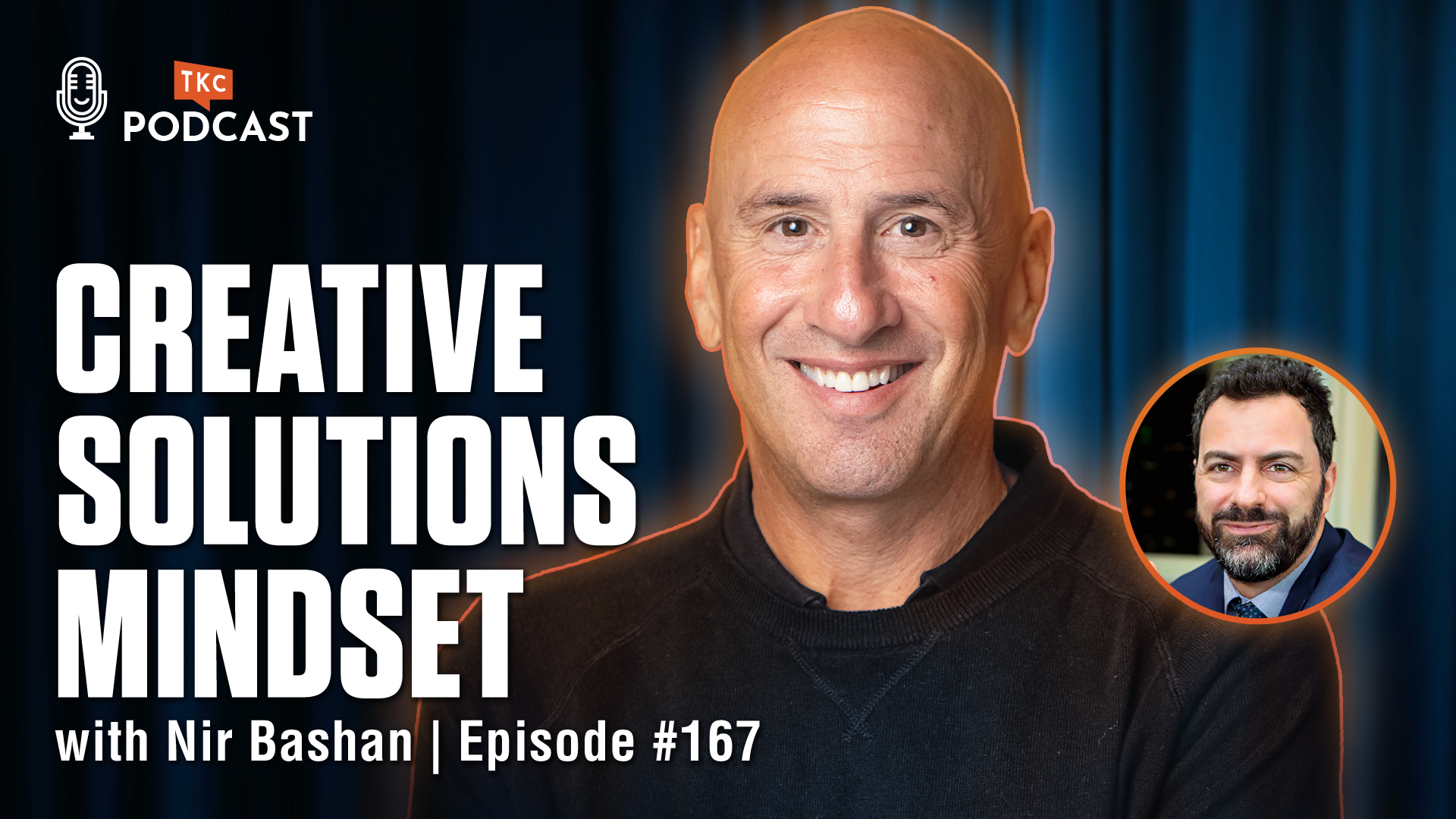
May 7, 2026Creativity Strategies That Transform Workplace Culture, with Nir Bashan
Creativity transforms workplace culture when leaders treat it as a learnable skill, not a personality trait. Nir Bashan explains how.
Creativity is the most misunderstood competitive advantage in business today. What if the reason your team keeps hitting the same walls, generating the same tired solutions, and cycling through the same unproductive conversations has nothing to do with talent, resources, or strategy, and everything to do with how you think about creativity in the first place?
That’s the question at the center of my conversation with creativity keynote speaker Nir Bashan, a world-renowned expert on creativity and innovation, and the bestselling author of The Creator Mindset, named one of the top 100 nonfiction books of all time. Nir has worked with everyone from Hollywood stars and music industry icons to Fortune 500 companies, including AT&T, Microsoft, EA Sports, and JetBlue, and what he’s discovered is both surprising and immediately actionable.
Creativity, it turns out, is not a gift. It’s a skill. It’s learnable, repeatable, and when applied correctly, it transforms not just how teams solve problems but how they experience their work entirely. In this conversation, we go deep on the practical mechanics of building a creativity-driven culture, why the language your team uses every day might be killing innovation, how to turn broken processes into forward momentum, and what it really means to lead with a creator mindset.
If you care about innovation, communication, and building teams that not only survive change but also generate it, this one is worth your full attention.
🎧 Watch and listen to the podcast episode: YouTube • Spotify • Apple Podcasts • Amazon Music
Creativity as a Business Tool, Not a Personality Trait
One of the first things Nir dismantles in our conversation is the myth that creativity belongs to a certain type of person. It’s a belief so widespread that most organizations have quietly organized themselves around it, assigning “creative work” to design teams or marketing departments while everyone else gets on with the “real” business. The problem is that this framing leaves the vast majority of your workforce, and their ideas, completely untapped.
Nir’s work with entertainers, artists, and high-profile performers taught him something counterintuitive. These people aren’t wired differently. They haven’t been blessed with some rare neurological gift. What they have is a method. A repeatable, learnable process for generating creative solutions consistently, regardless of mood, circumstance, or whether inspiration happens to show up that day. And the same method that works on a film set or in a recording studio works just as well in a boardroom, a call center, or a product development meeting.
This reframing matters enormously for business leadership because it shifts creativity from something you either have or you don’t into something you build, practice, and deploy deliberately. It means that when your team hits a wall, the answer isn’t to bring in an outside creative agency or wait for a moment of inspiration. It means you have everything you need to move forward, as long as you know how to activate it.
What Nir teaches, and what he’s proven across thousands of leaders and organizations globally, is that creativity is most powerful not as a brainstorming exercise or an offsite activity, but as an integrated, daily discipline. It’s how you approach the problem in front of you right now, with the team you already have, using the language you’re already using. Which, as it turns out, is exactly where most of the leverage is.
The organizations that treat creativity as a core business function, not an occasional luxury, are the ones that consistently outperform on profitability, customer satisfaction, and employee engagement. Nir has seen this pattern repeat across industries, company sizes, and cultures. Creativity isn’t extra. It’s foundational.
Why Innovation Dies Inside Most Organizations
Before you can build a creativity-driven culture, you have to understand what kills creativity in the first place. In our conversation, Nir is direct about this: innovation rarely collapses from a lack of talent or effort. It collapses from accumulated bad habits, specifically the habit of defaulting to the same thinking patterns, the same framing of problems, and the same language to describe them.
Most teams, when they get stuck, don’t realize they’re stuck in a linguistic rut as much as a strategic one. They keep trying harder at the same approaches, hoping volume will produce a breakthrough. It rarely does. What Nir describes is a kind of creative lock, where teams are working in problem-focused mode rather than solution-focused mode, and the difference between the two isn’t semantic. It’s neurological.
The way a problem is framed determines the range of solutions your brain can generate in response. When a team spends most of its energy describing what’s wrong, what’s broken, and what can’t be done, it’s quite literally narrowing the cognitive field from which solutions can emerge. This is backed by neuroscience, and Nir grounds his work in it deliberately, because leaders respond differently when they understand that the issue isn’t attitude or effort but brain function.
This is why thought leadership that focuses on creativity isn’t soft. It’s one of the hardest, most precise disciplines in business. Getting a team to shift from problem-mode to solution-mode requires intentional design of the environment, the conversations, and the language that fills both.
Nir’s work provides a toolkit for exactly that shift. And it begins, perhaps unexpectedly, not with exercises or workshops, but with the words you choose in an ordinary Tuesday morning meeting.
The Language of Creativity and What Your Words Are Actually Doing
This is one of the sections of our conversation I keep coming back to, because it’s both the most counterintuitive and the most immediately applicable insight Nir shares. The first move when a team gets stuck, he says, is to change the language.
Not the strategy. Not the team. Not the budget. The words.
Nir cites a striking piece of linguistic research: in every human language studied, the ratio of negative words to positive words is roughly six to one. We have six times as many ways to describe what’s wrong, broken, insufficient, or unacceptable as we do to describe what’s working, growing, or possible. This isn’t a personality problem. It’s a structural feature of how human language evolved, rooted in our ancestral need to identify and communicate threats quickly.
But here’s where it becomes a business problem. When your team defaults to that six-to-one ratio in its daily communication, every meeting, email, and feedback session is weighted overwhelmingly toward what isn’t working. And brains operating in threat-detection mode don’t produce creative solutions. They produce defensive responses, risk aversion, and status quo thinking.
What’s remarkable is the physical dimension of this. Nir references MRI studies showing that positive language actually reduces the brain’s perception of pain, while negative language activates stress responses in ways that shut down creative processing. This isn’t metaphor. It’s measurable physiology. The language your corporate culture normalizes is shaping the cognitive capacity of every person in your organization, every single day.
When teams consciously shift toward solution-oriented framing, even in how they describe existing problems, the measurable outcomes follow. Nir shares examples of organizations where simple, deliberate changes to the language used in customer-facing and internal conversations produced direct improvements in call center satisfaction scores, team engagement metrics, and sales conversion rates. The mechanism isn’t mysterious. Better words create better thinking environments, and better thinking environments produce better ideas.
This doesn’t mean toxic positivity or pretending problems don’t exist. It means being precise and deliberate about how you frame challenges so that your brain, and your team’s brains, remain in a state where solutions are actually accessible.
Turning Problems Into Games, and Why It Works
One of Nir’s most practically useful concepts is the idea of reframing broken processes as games. When something in your organization isn’t working, one of the most powerful things you can do is give it a game-like structure: clear rules, a defined goal, and a way to measure progress. This sounds almost too simple, but the results Nir describes are hard to argue with.
The reason it works comes back to the neuroscience of creativity. Games are, by definition, structured around positive forward motion. You’re trying to reach a goal, not avoid a punishment. That directional framing, toward rather than away, opens the cognitive space where novel solutions emerge. It also tends to increase engagement and reduce the kind of paralysis that comes from staring at a problem that feels permanent.
Nir describes teams that took processes everyone had resigned themselves to as “just how things are” and reframed them as creative challenges. Not by ignoring the dysfunction, but by pointing the energy toward what a better version could look like and making the pursuit of that version feel achievable and even energizing. The shift in team behavior and output is, as he puts it, measurable.
This kind of reframing is also a core skill for leaders navigating change and disruption. When external circumstances force adaptation, the organizations that recover fastest are almost always the ones with leaders who know how to recast a threat as a puzzle to be solved. It’s not spin. It’s design. And it’s a skill that can be taught, practiced, and embedded into how a team operates.
The Ski Industry Case Study and What It Teaches About Bold Creative Thinking
One of the most compelling examples Nir shares is the story behind the Epic Pass, now a staple of the ski industry and a model for how a struggling business can be rescued through creative thinking. The ski industry was in serious decline. Resorts were facing shrinking audiences, aging demographics, and a cost structure that was making the sport inaccessible to new generations of potential customers.
The traditional response would have been incremental: cut costs, adjust pricing, improve marketing. What happened instead was a genuinely creative leap. The idea of a multi-resort season pass that made skiing affordable, accessible, and social was, at the time, laughed out of the room. Nir is candid about this. The person who brought this idea forward was not celebrated initially. They were dismissed. The idea sounded impractical, too generous, financially risky.
And then it became a billion-dollar business transformation.
This story is worth sitting with because it illustrates several things simultaneously. First, truly creative ideas almost always face resistance, not because people are malicious but because genuinely new thinking violates our existing mental models of what’s possible. Second, the path to breakthrough often runs directly through the discomfort of being laughed at. And third, creativity isn’t just about generating ideas. It’s about having the courage and the framework to stay with an idea long enough for others to catch up to it.
For leaders and entrepreneurs who want to build organizations capable of this kind of thinking, the lesson is structural: you have to create environments where ideas that seem wrong at first glance are not immediately discarded. You have to build the psychological safety and the deliberate pause that allows a strange-sounding idea to be examined rather than reflexively rejected.
Storytelling as a Creativity Multiplier Inside Teams
Nir is adamant that creativity without storytelling is incomplete. And this is one of the insights from our conversation that I think gets under-applied in most business contexts. Leaders spend enormous energy on strategy, execution, and measurement. They spend comparatively little on the narrative that makes all of it meaningful to the people doing the work.
Storytelling isn’t just a communication technique. In Nir’s framework, it’s a creativity multiplier. When people understand the story behind why their work matters, who it serves, and what larger purpose it connects to, they engage with it differently. They bring more of themselves to it. They generate better ideas, because meaning activates the same cognitive states that creativity requires.
He shares a case study from a Fortune 100 company where a product launch was transformed not by changing the product itself but by changing the story around it. The connection to something human, specific, and emotionally resonant, in this case a grandmother’s recipe and the values it represented, gave a mass-market product an authenticity that no amount of traditional marketing had been able to manufacture. The sales results followed the story.
This is a principle that applies far beyond marketing. Storytelling in the context of professional development means helping people connect their daily work to something that matters. It means leaders who can articulate not just what the team is doing but why it counts. It means onboarding processes, team meetings, and performance conversations that include the human context, not just the metrics.
Authenticity, Nir emphasizes, is the through line. You can’t manufacture meaning. The story has to be true, and it has to connect to something people actually care about. When it does, it changes not just how work feels but what people are capable of producing.
Creativity Is in Our DNA, and How We Lose It
One of the most personally resonant parts of our conversation is when Nir talks about what happens to creativity over the course of a life. Children are extraordinarily creative. They invent, experiment, recombine ideas without self-consciousness, and generate solutions that adults would never consider, precisely because they haven’t yet learned to be embarrassed by originality. And then, somewhere in the process of growing up, moving through institutional education, and entering workplaces that reward conformity over creativity, most people quietly conclude that they are not, in fact, creative people.
Nir is clear: that conclusion is wrong. Creativity is not something that some people have and others don’t. It’s something almost everyone has and most people have been trained, often quite systematically, to suppress. The path back to it isn’t talent acquisition or hiring differently. It’s unlearning the specific habits and beliefs that close off creative thinking in the first place.
This is where personal development and business growth intersect in Nir’s work. When individuals reclaim their creative capacity, it doesn’t just improve their work output. It changes how they experience work, how they relate to problems, and how much agency they feel in shaping their own professional trajectory. The ripple effects into team culture, customer experience, and organizational performance are real and documented.
Nir also makes a point about reading that I found genuinely refreshing: reading broadly and consistently, not just in your field, is one of the most underrated creativity practices available. Exposure to different ideas, contexts, and modes of thinking cross-pollinates the mental landscape from which creative connections are made. The leaders who are most consistently creative are almost always people who read widely, not just efficiently.
Workplace Relationships, Friendship, and the Creativity of Honest Connection
Nir takes a position in our conversation that tends to generate strong reactions: he’s skeptical of the push to make deep friendships at work, at least in the way it’s often promoted. This isn’t a cynical position. It comes from a careful examination of what actually serves people well over the long arc of a career.
His argument is nuanced. Meaningful, trusting communication at work is essential. Psychological safety, mutual respect, and genuine care for colleagues are not just nice-to-haves; they are structural requirements for creativity to flourish. But when commerce and friendship become deeply entangled, the results can be messy in ways that harm both the relationship and the work. The dynamics of performance management, promotion decisions, honest feedback, and professional accountability all become complicated when strong personal friendships are layered on top.
Research on lifelong happiness consistently identifies the quality of relationships as one of the most important determinants of wellbeing. Nir doesn’t contest that. His point is more specific: the relationships that sustain us over a lifetime are usually not the ones forged primarily in workplace competition and commercial pressure. Protecting the integrity of both the professional relationship and the personal one sometimes means not collapsing them into each other.
For leaders building corporate culture and designing the conditions for creativity to thrive, this is a useful frame. You can build teams with extraordinary trust, openness, and genuine mutual investment without requiring or encouraging the kind of deep personal entanglement that can complicate professional judgment. The goal is psychological safety and authentic connection, not the performance of friendship.

How to Apply the Creator Mindset Starting Now
Nir’s practical framework comes back to a few core principles that are immediately actionable regardless of your industry, role, or the size of your team. The first is to audit the language in your environment. Not once, in a workshop, but as an ongoing practice. Notice the ratio of problem-focused to solution-focused framing in your meetings, your internal communications, and your own self-talk. Then begin deliberately shifting it.
The second is to treat creativity as a daily discipline rather than an occasional event. You don’t become more creative by going to a brainstorming retreat once a year. You become more creative by practicing solution-oriented thinking in the small, daily moments where problems arise and the instinct is to catalogue what’s wrong rather than ask what’s possible.
The third is to invest in storytelling, both as a leader and as a team. Ask yourself whether the people doing the work can articulate why it matters. If they can’t, that’s not a communication gap. It’s a creativity gap, because meaning is one of the primary fuels that keeps creative engagement alive over time.
For organizations serious about embedding creativity as a competitive advantage, keynote speaker Nir Bashan offers something rare: a framework that is simultaneously grounded in science, tested in practice across some of the world’s largest companies, and communicated with the kind of clarity and energy that actually moves people to change. If your team is ready to stop cycling through the same stuck patterns and start building a genuine culture of creativity and innovation, this is where to start.
The creator mindset isn’t reserved for artists. It never was. It’s the most human thing any of us can bring to work, and with the right guidance, every person on your team already has it.
🎤 If your audience needs a speaker who can make creativity feel urgent, practical, and genuinely exciting, explore Nir Bashan’s full keynote speaker profile here
Ready to talk? Schedule a 15-minute call and let’s find the right fit for your event
Have an audience in mind? Send your event theme, and I’ll tell you if Nir is the right fit: info@thekeynotecurators.com
Discover More Insights



Get in TouchContact US
Fill out the form so we can best understand your needs.
A representative from The Keynote Curators will reach out to you.
Our Services
Keynote Speakers Topics
© 2026 The Keynote Curators. All Rights Reserved | Terms and Conditions
The Keynote Curators, 8275 South Eastern Avenue, Suite 200, Las Vegas, NV 89123
Local (310) 299-4595 | Toll Free (888) 585-8715 | info@thekeynotecurators.com
The Keynote Curators - Top Keynote Agency, USA.