
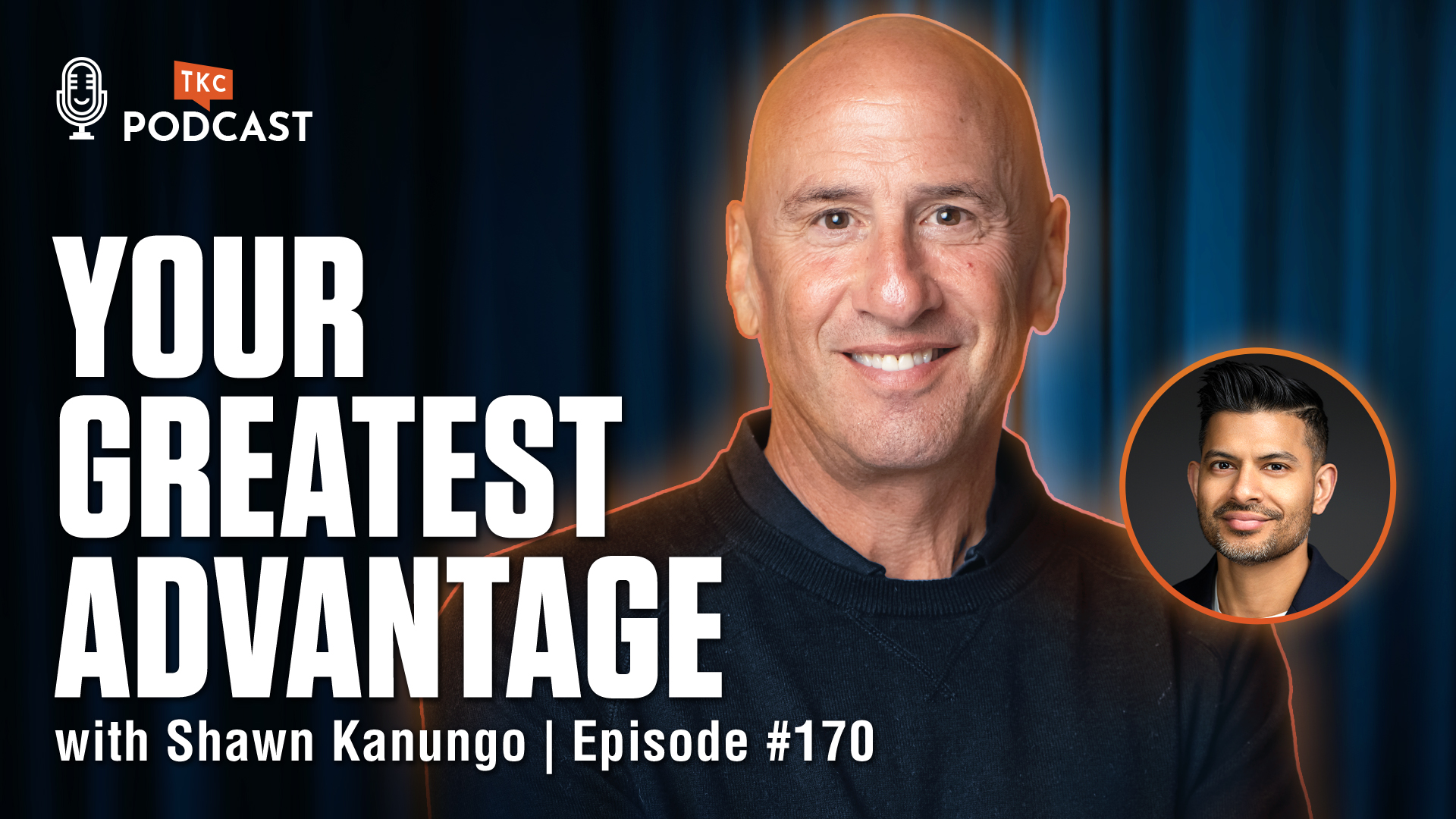
May 28, 2026Human Skills That AI Will Never Replace: Insights from Shawn Kanungo
AI won't save a broken workflow. Discover the human skills that matter most in an AI-driven world with innovation keynote speaker Shawn Kanungo.
What if the biggest risk of AI isn’t that it replaces us, but that we hand it things it was never supposed to hold?
That question sits at the center of my conversation with Shawn Kanungo, one of the most compelling voices in the world right now on AI, disruption, and the future of work. What makes Shawn different from most people talking about this topic is that he refuses to traffic in fear or hype. He comes at it from the inside: twelve years at Deloitte working shoulder to shoulder with leaders navigating real transformation, followed by years of building a global following of millions who want honest, grounded thinking about where work is headed.
And where work is headed, according to Shawn, has very little to do with which AI tool you adopt next. It has everything to do with whether the humans inside your organization understand their own irreplaceable role in the system. AI is accelerating fast. The organizations that thrive won’t be the ones that automate the most. They’ll be the ones who get extraordinarily clear on what humans still need to own, protect, and lead.
In this conversation, we go deep on why most companies are approaching AI backwards, what “robot work” actually means, why taste and cultural instinct matter more now than ever, and how fully remote teams may be quietly losing their edge when it comes to the kind of friction that actually produces breakthrough ideas. If you work in events, lead a team, or are trying to build something that lasts in an era of constant disruption, this one is worth your full attention.
🎧 Watch and listen to the podcast episode: YouTube • Spotify • Apple Podcasts • Amazon Music
Why Most Companies Are Getting AI Completely Backwards
The conversation about AI inside most organizations starts in the wrong place. Leaders hear about a new tool, see a competitor using it, feel the pressure to act, and then go searching for problems that the tool can solve. That’s the backwards part. The tool comes first. The problem comes second. And that sequence, Shawn explains, is exactly why so many AI initiatives stall, underdeliver, or quietly get abandoned six months after launch.
The better sequence is obvious once you hear it: start with the problem. A genuinely painful, specific, documented problem that costs your organization time, money, trust, or competitive ground. Then ask whether AI can address it. That sounds simple, but it runs against the grain of how most organizations actually behave in a moment of technological hype. When something new arrives with this much noise behind it, the pressure to adopt quickly overrides the discipline to think clearly.
What gets lost in that rush is diagnosis. AI is powerful at accelerating execution. It is not powerful at identifying whether you’re executing the right things. If your sales process is broken, if your onboarding is confusing, if your internal communication is siloed and dysfunctional, AI will not fix any of that. It will help you move faster through the brokenness, which often makes things worse, not better.
Shawn is direct about this in a way that most speakers and consultants are not. He’s not anti-AI. He’s pro-clarity. And clarity, in his framework, always starts with the human beings who understand the problem at a level no algorithm can replicate. The people who have sat in the room, watched the workflow fail, talked to the customers who churned, and felt the cultural drag that’s slowing everything down. Those people need to lead the AI conversation inside their organizations, not just receive it from a vendor or a C-suite mandate. When innovation is driven by genuine problem awareness rather than tool enthusiasm, the outcomes are dramatically better.
The “Robot Work” Framework and What Humans Should Protect
One of the most useful things Shawn offers in this conversation is a clear way to think about the division of labor between humans and machines. He calls it the distinction between “robot work” and the work humans should protect, and once you hear it framed this way, it becomes hard to unsee.
Robot work is the repetitive, rule-based, pattern-matching work that consumes enormous amounts of human time and energy while producing very little in the way of meaning or differentiation. Formatting documents. Pulling reports. Routing requests. Summarizing information that already exists somewhere. Scheduling. Sorting. These are tasks that AI handles well, often better and faster than humans, and they are tasks that most knowledge workers spend a shocking percentage of their week doing. Offloading that work to AI isn’t a loss. It’s a recovery of capacity.
The work humans should protect is everything that depends on judgment, relationship, context, and creativity. Reading a room. Knowing when a client is about to leave before they say so. Making a call that the data doesn’t fully support because you have fifteen years of pattern recognition that no model can replicate. Building trust with a team that’s been through a difficult transition. Creating something genuinely new rather than something that recombines what already exists. These are not tasks where AI adds value. These are tasks where human presence is the entire point.
The danger, Shawn is careful to point out, is that when organizations automate indiscriminately, they sometimes automate things that were generating real human value. A customer service interaction that felt personal gets replaced by a chatbot that’s technically efficient but creates no emotional connection. A mentorship moment gets replaced by a knowledge base article. A creative brainstorm gets replaced by a prompt. The output might look similar on paper. The long-term organizational cost can be significant. Protecting the customer experience means knowing where human presence generates irreplaceable value, and refusing to automate it away in the name of efficiency.
The Hidden Danger of Skill Atrophy in an AI-Assisted World
Here’s a risk that doesn’t get nearly enough attention in the mainstream AI conversation: what happens to the skills you stop using?
Shawn raises this directly, and it’s one of the more sobering threads in our conversation. When AI handles the work that used to develop your judgment, your craft, or your problem-solving instincts, you don’t just get more efficient. You may slowly lose the capacity that made you valuable in the first place. Skill atrophy is real. It happens in physical performance, in language acquisition, and it happens in professional expertise, too.
Think about what it means for a junior analyst who never has to wrestle with a dataset manually because AI generates the summary automatically. Or a writer who never labors through a first draft because AI produces a serviceable version in thirty seconds. Or a sales professional who never has to build a pitch from scratch because templates handle everything. In each case, the output arrives faster. But the process that would have built the capability, the frustration, the iteration, the hard-won pattern recognition, doesn’t happen. Over time, the person may find themselves deeply dependent on the tool in a way that leaves them genuinely less capable when the tool isn’t available, or when the situation requires something the tool can’t produce.
This isn’t an argument against using AI. It’s an argument for using it deliberately. To know which skills you need to keep practicing, even when a machine could do it faster. For treating some parts of your workflow as a training ground rather than a task to be optimized. The future of work won’t belong to people who can use AI tools. It will belong to people who can use AI tools while maintaining the depth of human judgment that those tools are supposed to augment.

Why Taste, Creativity, and Cultural Instinct Are the New Competitive Edge
If AI can generate content, images, code, analysis, and strategy frameworks at scale, what’s left? Shawn’s answer is one of my favorite parts of this conversation: taste.
Taste is not a soft skill. It is a competitive advantage. It is the capacity to know what’s good before a dataset tells you it’s good. To feel when something is off before the metrics confirm it. To make a creative call that a majority vote or a model would have gotten wrong. Taste is accumulated through exposure, experience, failure, and genuine curiosity about the world. It is not learnable from a prompt. It is not transferable through automation. And in a world where AI dramatically raises the floor of what any organization can produce, taste is what creates the ceiling.
Cultural instinct is closely related. This is the ability to understand what a particular community, audience, or moment actually needs, not just what they say they need or what past behavior predicts. It is the skill of reading context at a level that requires lived experience. A marketer with genuine cultural instinct knows that a campaign landing perfectly in one city will feel tone-deaf in another. A product leader with cultural instinct can sense when their target user is shifting before the data shows up in the dashboard. An event designer with cultural instinct knows how to create an experience that feels alive rather than assembled.
These capabilities matter more now, not less, precisely because AI is so effective at producing the competent and the average. When competent and average become cheap and fast, the premium goes to the exceptional and the resonant. Thought leadership in the AI era is not about knowing the most. It’s about perceiving the most and having the taste to translate that perception into something others can’t replicate.
How AI Agents Are Reshaping Workflows from the Ground Up
We’re moving past AI as a single-point tool and into AI as an orchestrated system. Shawn talks about this shift in terms of AI agents, and it’s worth understanding what’s actually changing here because it’s more significant than most workflow conversations acknowledge.
An AI agent isn’t just a tool you prompt when you need something. It’s a system that can autonomously take sequences of actions, check its own outputs, pull information from multiple sources, and hand off to other systems or other agents to complete a broader task. When you chain multiple agents together, you’re not automating a task. You’re automating a workflow. And when workflows become automated at that level, the design of the workflow itself becomes the critical variable.
This is where Shawn’s advice about rebuilding from zero becomes essential. When people first adopt AI, they tend to layer it onto existing processes. They automate the same steps in the same order that humans used to perform them manually. That creates incremental gains. But the organizations getting real results are the ones that throw out the legacy process entirely, ask what the ideal end state actually looks like, and then design a workflow from scratch with AI capabilities built in from the beginning.
That kind of redesign requires a different kind of strategic thinking. It requires people who can hold both the vision of what’s possible and the practical understanding of what the business actually needs. It requires leaders who aren’t afraid of the blank page. And it requires a willingness to question processes that worked fine before AI arrived, but now represent a ceiling rather than a foundation.
The organizations that do this well will look, within a few years, fundamentally different from the ones that don’t. Not because they adopted more tools, but because they reimagined their operations at a structural level while keeping human judgment at the center of the decisions that matter most.
Fast Companies Versus Magical Companies
One of the frameworks Shawn shares that stuck with me long after our conversation is the distinction between fast companies and magical companies.
Fast companies use AI to do more, quicker. They cut production time, reduce headcount, increase output volume, and report the efficiency gains to the board. These are real gains, and they’re not nothing. But speed alone is not a moat. If your primary competitive advantage is that you can move fast, you are one well-funded competitor away from irrelevance, because they can move fast too.
Magical companies use AI differently. They use the time and capacity that AI frees up to do something their competitors can’t easily copy: build deeper relationships, create more surprising experiences, develop a more nuanced understanding of their customers, and take bigger creative risks. They treat AI as a way to buy back the human bandwidth that was previously consumed by routine work, and then they invest that bandwidth in the things that generate genuine differentiation.
The gap between these two types of companies is not a technology gap. It’s a leadership philosophy gap. It’s a question of whether the people at the top of the organization understand that efficiency is a starting point, not a destination. That business growth in this era comes from being exceptional, not just being fast. That magic, in a business context, means doing something that makes people stop, feel something, and want to tell someone else about it.
Shawn’s point is that most organizations have the capacity to become magical companies. Most of them are choosing to become fast companies because it’s easier to measure and easier to justify in a quarterly earnings context. The ones that make the harder choice are the ones worth watching over the next decade.
Why Innovation Still Depends on Trust, Friction, and Human Connection
There’s a dimension of the AI conversation that almost never makes it into the keynote slides or the LinkedIn posts, and Shawn surfaces it plainly: innovation requires friction, and friction requires humans in the same room.
This is not nostalgia. It’s organizational science. The research on where breakthrough ideas actually come from consistently points to the informal, unplanned, high-context interactions between people who trust each other enough to say something half-formed, something risky, something they’re not sure is right yet. The hallway conversation. The lunch table argument. The whiteboard session that runs forty-five minutes over because no one wants to stop. These are the conditions where genuine novelty tends to emerge, and they are conditions that are extremely difficult to replicate in a structured remote meeting.
Shawn’s point about fully remote teams is not that remote work is bad. It’s that the specific kind of innovation that comes from serendipitous human friction is genuinely harder to generate when every interaction is scheduled, screened, and mediated by a platform. Something gets lost. Often it’s the ideas that were almost too weird to say in a formal context but turned out to be exactly right. The ones that needed a raised eyebrow and a “wait, say more about that” to develop into something real.
Change at the organizational level almost always traces back to a moment of human connection where someone felt safe enough to challenge the current model. AI can surface data that supports the challenge. AI cannot create the psychological safety that allows it to happen. That’s a leadership and culture problem, and it belongs entirely to the humans in the room.
Trust is the infrastructure that innovation runs on. Without it, you can have all the tools in the world and still produce nothing that surprises anyone.

What It Means to Be a Futurist Who Actually Delivers
A final thread worth pulling from this conversation is about what it means to take the future of work seriously as a practitioner, not just as a topic.
There are a lot of people right now who are technically qualified to talk about AI. There are far fewer who can take an audience of senior leaders, event professionals, or creative teams and leave them with something they can actually use on Monday morning. The difference, in my experience of working with speakers across every major topic in the industry, comes down to the gap between explanation and activation.
Explanation tells you what’s happening. Activation changes how you think and what you do next. Shawn operates entirely in the activation space. He’s not reciting trends or reading from a research deck. He’s taking the real, lived experience of working inside organizations that are navigating disruption right now, and translating it into frameworks that make immediate sense to the people sitting in front of him.
His book, The Bold Ones, celebrated by McKinsey as essential reading for decision-makers, is a good example of how he thinks about this. The argument isn’t that you need to be reckless or move fast and break things. It’s that bold, principled, human-centered innovation is not optional anymore. The organizations that treat disruption as someone else’s problem will be disrupted by the ones that treat it as an opportunity. That framing is something audiences feel rather than just hear, and it’s what makes his work genuinely memorable.
If your audience is made up of leaders trying to figure out how to bring artificial intelligence into their organizations without losing the culture, creativity, and human judgment that got them where they are, this is the conversation they need to have. Not later. Now.
The most important thing I took from my time with Shawn is this: the question isn’t whether AI belongs in your organization. It does. The question is who’s doing the thinking about how it gets used, what it replaces, and what it must never be allowed to touch. That thinking is human work. It always will be. And the leaders who own that thinking with clarity and courage will be the ones still standing when the next wave arrives.
📞 If your audience is trying to understand AI without losing creativity, culture, or human connection in the process, AI keynote speaker Shawn Kanungo delivers a conversation that actually moves beyond the buzzwords. Schedule a time and let’s talk.
🎤 Explore Shawn’s full profile and topics, including business, technology, and futurist keynotes.
📩 Or send your audience details and event theme, and I’ll tell you if he’s the right fit: info@thekeynotecurators.com
Discover More Insights





Get in TouchContact US
Fill out the form so we can best understand your needs.
A representative from The Keynote Curators will reach out to you.