
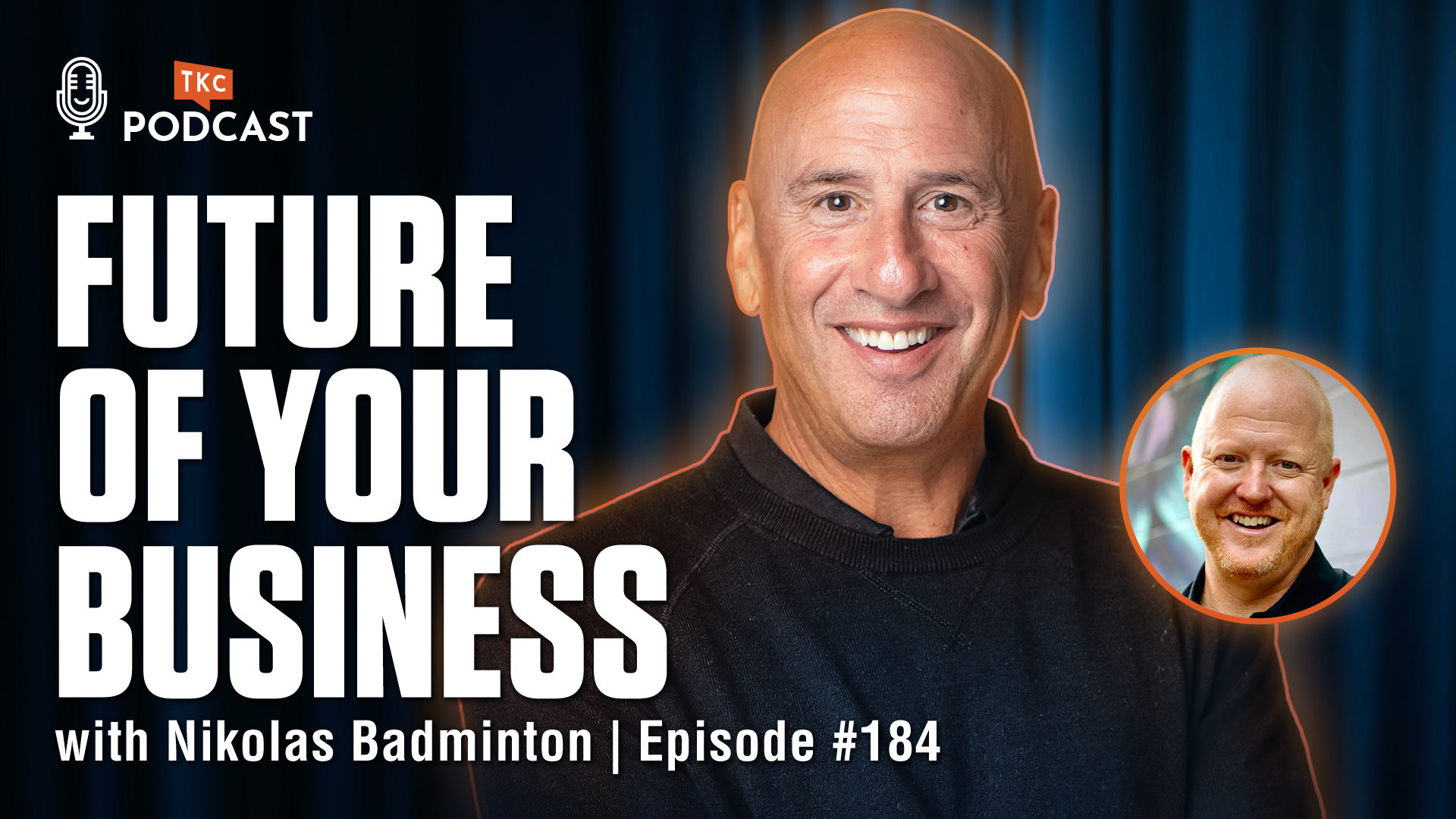
July 23, 2026Planning for The Future of Your Business Today, with Nikolas Badminton
Futurist Nikolas Badminton on why leaders who plan for the future outperform those stuck in short-term thinking.
Most companies have quietly shrunk their sense of the future down to something they can fit inside a quarterly report. Three years now counts as a bold strategy. Five years sounds ambitious. Ten years sounds like science fiction.
I sat down with Nikolas Badminton, a futurist who has spent over 30 years helping the world’s biggest organizations think past the next earnings call, and the conversation left me questioning how much of my own planning is really about the future at all. What struck me most is that the future isn’t a distant, abstract thing waiting out there for us to react to. It’s something we’re building, decision by decision, whether we admit it or not. And the leaders who understand that difference tend to build organizations that last.
🎧 Watch and listen to the podcast episode: YouTube • Spotify • Apple Podcasts • Amazon Music
Why Short-Term Thinking Leaves Companies Exposed
Nikolas opened our conversation by naming something a lot of leaders feel but rarely say out loud: there’s a deficit of long-term planning inside most organizations. It’s not that people don’t care about the future. It’s that the pressure of quarterly targets, annual reviews, and constant reporting cycles trains everyone to think in smaller and smaller windows. The horizon keeps shrinking, and nobody decided that on purpose. It just happened, one short-term decision at a time.
Here’s the part that stuck with me. A company that only plans a year ahead isn’t protecting itself from risk. It’s just choosing which risks it gets to be surprised by. When you stop imagining what’s coming, you don’t become leaner or more focused. You become easier to blindside. Short-term thinking feels safe because it’s measurable and immediate. But that safety is an illusion. The businesses that got flattened by shifts in consumer behavior, supply chains, or technology weren’t unlucky. Many of them simply never built the habit of looking past next quarter.
This is where the idea of the future stops being philosophical and starts being practical. Planning for the future isn’t about predicting exactly what will happen. It’s about building the muscle to notice change early and respond before you’re forced to. Nikolas has spent his career convincing business leaders that this muscle can be trained, and that most organizations have simply let it atrophy.
Fifty Years of Hype Cycles and What They Actually Teach Us
One of the more grounding parts of our conversation was Nikolas walking through roughly 50 years of technological hype cycles. Personal computers, the internet, mobile, cloud, blockchain, and now AI. Each one arrived with promises of instant transformation. Each one took far longer to actually change how business gets done than the hype suggested.
I’ve seen this same pattern play out again and again. A new technology shows up, headlines declare that everything is about to change overnight, and leaders scramble to react immediately instead of planning properly. Then the technology takes five, ten, sometimes fifteen years to actually embed itself into how organizations function. The gap between hype and reality is where a lot of bad decisions get made. Companies overinvest early out of fear of missing out, or they dismiss a technology entirely because the first version didn’t live up to the noise.
What Nikolas offers instead is patience grounded in pattern recognition. As a futurist who has watched this cycle repeat itself across five decades, he’s built a rare kind of credibility around it. If you understand the shape of past hype cycles, you stop overreacting to the current one. That’s not complacency. It’s a more accurate read of how the future actually unfolds. Real transformation is slow, layered, and uneven. Understanding that history is one of the clearest advantages a leader can have when trying to separate genuine signals about the future from noise.
The Productivity Myth Behind AI Governance
This next part of our talk is the one I keep coming back to. Artificial intelligence is currently framed as an instant productivity multiplier, something you plug into a workflow and immediately get more output for less effort. Nikolas pushed back on that framing hard. AI, in his view, is a slow transformation, not a quick fix. The productivity gains are real, but they arrive after significant work: rebuilding processes, training people, rethinking governance, and being honest about where AI actually adds value versus where it just adds speed to bad decisions.
That distinction between speed and value matters more than most leaders admit. A team that uses AI to produce more content, more code, or more analysis faster isn’t automatically producing better outcomes. Sometimes it’s just producing more of the same mistakes at a faster rate. Governance isn’t a bureaucratic afterthought here. It’s the thing that determines whether AI actually serves your future or just accelerates whatever direction you were already headed in, good or bad.
I think this is the piece a lot of business conversations skip. Everyone wants to talk about AI’s potential. Fewer people want to talk about the discipline required to govern it responsibly, especially when the pressure to show immediate returns is so strong. Nikolas’s argument is that the organizations who take governance seriously now are the ones who will actually benefit from AI later, while the ones chasing quick wins will spend years cleaning up the mess.
Imagination as a Leadership Skill, Not a Luxury
Something shifted in the conversation when we got into the value of imagination and design. Nikolas doesn’t treat imagination as a soft skill reserved for creative teams. He treats it as core innovation infrastructure for leadership. If you can’t imagine multiple versions of the future, you can only plan for the one you assume is coming, and assumptions are exactly where organizations get blindsided.
This reframes what strategic planning is supposed to do. It’s not just about setting a target and working backward. It’s about deliberately exploring several possible futures, including ones that feel uncomfortable or unlikely, so that when reality shifts, you’re not starting from zero. Futures design, as Nikolas practices it, is less about forecasting and more about preparation. You’re not trying to be right about what happens. You’re trying to be ready for a range of what could happen.
The more I sat with this, the more I realized how rarely leadership teams actually practice this. Most strategy sessions ask “what do we want to happen” and stop there. Very few ask “what else could happen, and are we ready.” That second question is where real resilience gets built, and it requires imagination that most business cultures actively discourage in favor of certainty and confidence.
What Gets Lost When Technology Replaces Human Connection
We also talked about something quieter but just as important: the hidden costs of replacing humans with AI. It’s easy to calculate what you save when a task gets automated. It’s much harder to calculate what disappears along with it. Nikolas pointed to the relationships, mentorship, and informal knowledge transfer that happen when people work alongside each other, things that don’t show up on a spreadsheet but absolutely show up in the long-term health of an organization.
This is the part of the future conversation that gets skipped most often. Leaders model the efficiency gains of automation carefully. They rarely model the erosion of trust, culture, and institutional memory that comes from stripping out human connection too aggressively. And once that erosion happens, it’s slow and expensive to rebuild.
I think this matters because the future we’re building isn’t just technological. It’s cultural. A company can automate its way to short-term efficiency and still lose the thing that made it resilient in the first place: people who understand each other well enough to adapt together when conditions change. Planning for the future has to include planning for what stays human.
Short-Term vs Long-Term Strategy in a Global Economy
Nikolas also drew a clear line between how businesses operate depending on their relationship with time. Some organizations, often shaped by quarterly reporting pressures, default to short-term thinking almost by structural necessity. Others, frequently in industries with longer production cycles or in cultures less obsessed with quarterly results, build genuinely long-term strategies as a matter of course. Nikolas has advised on this exact tension across the global economy, from government bodies to private enterprise.
This isn’t just an academic distinction. It shapes everything from hiring to capital investment to how a company responds to disruption. Organizations wired for the short term tend to optimize for the next visible milestone. Organizations wired for the long term tend to invest in capabilities that won’t pay off immediately but compound significantly over time. Neither approach is inherently wrong, but the mismatch happens when a company operates in a long-cycle industry while thinking with a short-cycle mindset.
What I took from this part of the conversation is that the future rewards patience unevenly. Some sectors punish you for being patient. Others punish you for not being patient enough. Knowing which one you’re actually in, rather than which one feels comfortable, is a genuinely underrated leadership skill.
The Seven-Year Plan: A Case Study in Patience
The clearest illustration of long-term thinking Nikolas shared was a case study involving a seven-year plan in dairy production. On the surface, that’s an industry most people wouldn’t associate with cutting-edge futures thinking. But the team behind it committed to a horizon most businesses would consider impossibly long, and that patience is exactly what produced results.
Livestock cycles, breeding programs, land use, and supply chains in dairy don’t move on a quarterly rhythm. They move on a biological and generational one. A company that tried to force a one-year strategy onto that reality would constantly be fighting against the natural pace of its own industry. By committing to a seven-year plan instead, the team aligned their strategy with how their business actually functioned, and the improvements they saw were not incremental. They were structural.
What makes this especially interesting to me is that the seven-year plan didn’t just improve results seven years later. It improved results now, because it changed how decisions were made in the present. When you know you’re building toward a target years out, you stop making decisions that optimize for this quarter at the expense of the following five years. The future, once it’s clearly defined, changes present-day behavior. That’s the real payoff of long-term planning. It’s not just about where you end up. It’s about how differently you act along the way once you know where you’re headed.
From Positive Dystopia to High-Hope Leadership
One of the more unexpected turns in our conversation was Nikolas’s move from what he calls positive dystopia toward what he describes as high-hope leadership. A lot of futurist conversations lean heavily into worst-case scenarios, and there’s value in stress-testing for the worst. But Nikolas has increasingly focused on cultivating hope as a strategic asset, not a naive one. It’s a theme he explores in depth in his bestselling work, Facing Our Futures.
High-hope leadership isn’t about ignoring risk. It’s about refusing to let fear be the only lens through which you view the future. Leaders who only see threats end up building defensive, reactive organizations. Leaders who can hold both the risks and the genuine possibilities tend to build organizations that people actually want to follow into uncertainty. Hope, in this framing, isn’t wishful thinking. It’s a deliberate leadership posture that keeps teams engaged and creative instead of anxious and paralyzed.
I think this distinction matters more now than it has in years, given how much uncertainty surrounds AI, the economy, and geopolitics. A leader who can articulate a hopeful, credible version of the future gives their team something to move toward, rather than just something to brace against. That’s a meaningfully different kind of leadership, and it’s one Nikolas argues is becoming more necessary, not less. It’s also a message that has landed well on stages ranging from corporate boardrooms to TED speaker events, where audiences are hungry for a version of the future worth working toward.
The Five Minutes to Future Practice
Near the end of our conversation, Nikolas shared something refreshingly simple: a practice he calls Five Minutes to Future. It’s exactly what it sounds like. Five minutes, regularly, spent deliberately thinking about what’s coming rather than what’s due today. No elaborate framework required. Just a consistent, small habit of turning attention toward the future instead of letting it get crowded out entirely by the present.
What I appreciate about this is how it counters the excuse most leaders give for not thinking long-term: that there simply isn’t time. Five minutes is not a scheduling problem. It’s a discipline problem. The habit works precisely because it’s small enough to actually stick, and because five minutes done consistently over months adds up to far more future-oriented thinking than the occasional half-day strategy offsite most companies rely on instead.
This is the kind of practical takeaway that sticks with me longer than the big-picture theory, because it’s something anyone can start doing immediately. You don’t need a seven-year plan to begin building futures thinking into your leadership. You need five minutes, a genuine willingness to look past today, and the discipline to keep showing up for it.

The Real Work of Leading Toward the Future
By the end of our conversation, what stayed with me wasn’t a single insight so much as a shift in how I think about the word future itself. It’s not a fixed destination sitting out there waiting to be discovered. It’s something shaped continuously by the decisions organizations make, or avoid making, right now. Nikolas Badminton’s work makes the case that thinking seriously about the future isn’t a luxury reserved for futurists and strategists. It’s a discipline available to any leader willing to build the habit.
The organizations that will handle whatever comes next, whether that’s AI, economic shifts, or something nobody has named yet, won’t be the ones with the flashiest predictions. They’ll be the ones who treated the future as something worth planning for consistently, patiently, and imaginatively, long before it arrived. That’s the real lesson here. The future isn’t something that happens to you. It’s something you build toward, five minutes and seven years at a time.
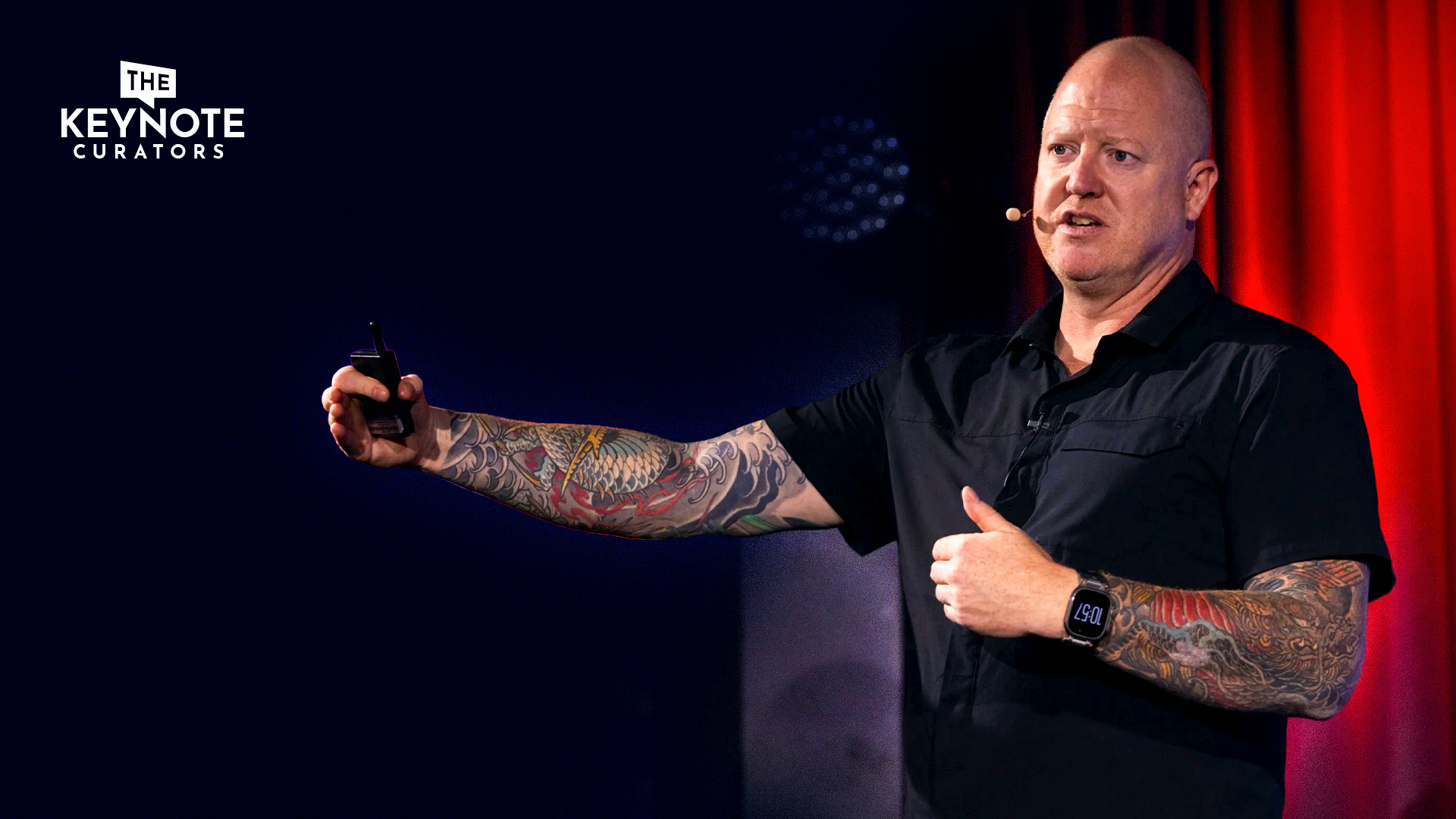
🎤 Explore Nikolas Badminton’s keynote speaker profile here
📞 Schedule a time to talk about booking Nikolas for your event
📩 Or send your audience and event theme to info@thekeynotecurators.com and I’ll tell you if he’s the right fit.
Discover More Insights




Get in TouchContact US
Fill out the form so we can best understand your needs.
A representative from The Keynote Curators will reach out to you.