

August 25, 2026Q4 Isn’t a Marketing Strategy Until Clarity Leads the Way
Q4 isn't a marketing strategy. It's a test of clarity, judgment, and what your brand chooses to remember when the noise fades.
Q4 isn’t a marketing strategy. It’s a mirror, and most teams don’t love what it shows them. Every year, the same pattern repeats itself. The calendar accelerates, the budget suddenly needs to be spent, and everyone in the building starts moving faster without anyone stopping to ask whether they’re moving in the right direction.
I’ve watched this happen inside more organizations than I can count, and I’ve come to believe that Q4 isn’t a marketing strategy at all. It’s a stress test. It reveals whether a company actually had a strategy in the first place, or whether it had a plan for being busy that was mistaken for one.
That distinction matters more this year than it has in a long time, and I want to spend some time unpacking why.
When the Calendar Gets Louder Than the Strategy
What struck me most, thinking back on the conversations that shaped this piece, is how predictable the Q4 scramble has become. The pipeline needs movement, so the emails multiply. The event needs to feel important, so the production budget grows. The team needs proof that the work is paying off, so the dashboards fill with numbers that look encouraging even when nobody is entirely sure what they mean. None of this happens because people are careless. It happens because urgency has a way of disguising itself as strategy, and very few people are willing to stand in a room full of anxious stakeholders and ask whether the plan actually makes sense.
I’ve seen this same pattern play out across industries that have nothing else in common. A software company padding its pipeline with discount offers nobody asked for. A retail brand doubling its ad spend on messaging that was already underperforming in Q3. A services firm throwing together a year-end event because the calendar said it was time, not because they had anything meaningful to say. In every case, the activity looked like momentum from the outside. From the inside, it was closer to panic wearing a nice outfit. This is the heart of why Q4 isn’t a marketing strategy on its own. Activity is not the same thing as direction, and volume is not the same thing as value.
The uncomfortable truth is that Q4 doesn’t create these problems. It exposes them. A team with a clear strategy and a strong point of view doesn’t need to get louder in November and December. They already know who they’re for and what they’re trying to make people believe. The teams that panic in Q4 are usually the ones who never fully answered that question earlier in the year, and now they’re trying to manufacture clarity under a deadline. That almost never works, because clarity isn’t something you can rush into existence. It’s something you build.

The Trap Hiding Inside More
Here’s what I’ve been thinking about since revisiting this topic. The instinct to add more during Q4 isn’t irrational. It comes from a genuine place. Teams want to prove effort. They want to show leadership that the fourth quarter push is real, and the easiest way to demonstrate effort is to point at volume. More emails. More posts. More offers. More segmentation. More dashboards tracking more metrics that may or may not connect to anything that actually matters to the business.
But more content has never been the same thing as more connection, and this is precisely where Q4 isn’t a marketing strategy reveals its sharpest edge. You can produce fifty versions of a message and still not have said anything worth remembering. You can build a campaign that looks polished in every deck review and still be built around an idea nobody would miss if it disappeared. Sometimes the busiest quarter of the year is really just the quarter where a weak idea gets the most expensive delivery system.
What makes this especially interesting is how much cover “more” provides. It’s much easier to defend fifteen campaigns than to defend one idea you actually believe in, because the campaigns give you something to point to when someone asks what the team has been doing. A single strong idea forces you to stand behind it. That kind of exposure is uncomfortable, and discomfort is exactly what most Q4 planning is built to avoid. Teams reach for volume because volume feels safer than conviction, even when conviction is the thing that would actually move the needle.
What AI Can Do and What It Was Never Meant to Decide
I don’t think it’s controversial anymore to say that AI has made it easier than ever to produce content without producing meaning. That’s not an argument against the technology. AI genuinely helps teams test variations, summarize customer signals, personalize outreach at a scale that used to be impossible, and move through tedious work faster than any team could manage on their own. I’m not interested in pretending that isn’t valuable, because it clearly is.
But there’s a difference between using a tool to move faster and using a tool to avoid making a decision. AI can give you fifty subject lines. It cannot tell you which idea deserves to be in front of your audience in the first place. It can polish language endlessly. It cannot tell you whether the underlying offer is actually relevant to the person receiving it, or whether it’s just last year’s message wearing a seasonal costume. This is another place where Q4 isn’t a marketing strategy shows up in the details. A tool that accelerates weak thinking doesn’t fix the weak thinking. It just delivers it faster and with better grammar.
The question worth asking isn’t what a team can automate this quarter. It’s what should still require a human being willing to make a judgment call. Is the message clear enough to survive a distracted audience scrolling past it in the middle of a busy afternoon? Is the offer built around what the customer actually needs, or dressed up to look seasonal because December makes urgency feel acceptable? Are teams using AI to sharpen a strategy they already believe in, or using it to multiply noise because multiplying noise is easier than deciding what’s worth saying?
The market doesn’t need more automated confidence. It needs relevance. It needs trust. It needs a reason to believe the message in front of them was actually built for them, not generated at scale and pointed in their general direction. That’s not a small distinction, and it’s one that separates brands people remember from brands people simply tolerate until the unsubscribe button becomes irresistible.
The more I think about it, the more convinced I am that this stopped being purely a marketing conversation a while ago. It became a leadership conversation, because the decision about what deserves human judgment versus automation is ultimately a values decision, not a tactical one. Leaders who understand that Q4 isn’t a marketing strategy problem but a judgment problem are the ones who end up protecting their brand’s credibility when everyone else is racing to publish one more thing before the year closes.
Your Event Is Not Separate From the Strategy
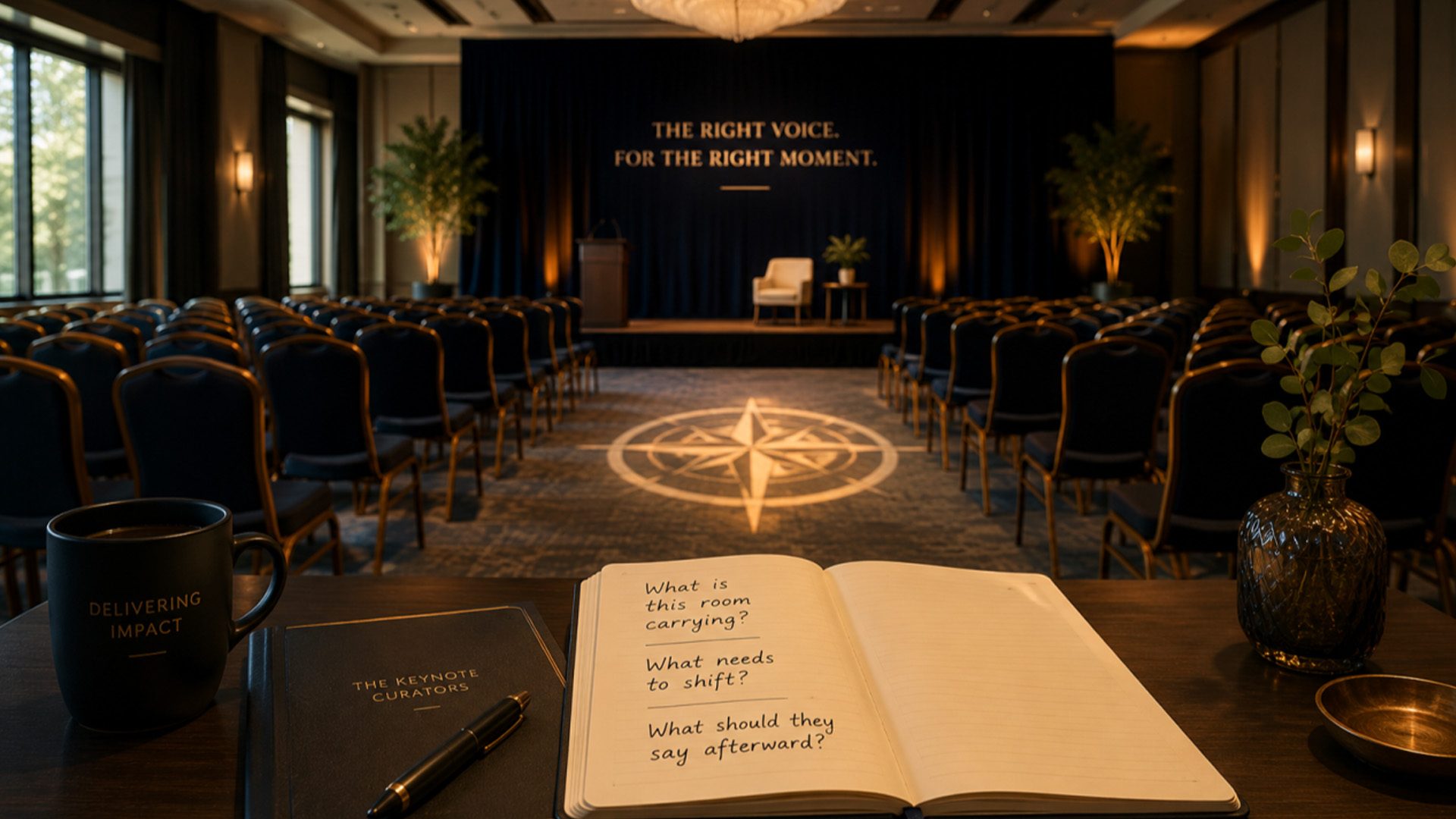
This is where I think events deserve more credit than they usually get inside these conversations. A conference isn’t a side project sitting outside your marketing strategy. It might actually be the most expensive, most visible, most emotionally loaded expression of that strategy that your organization produces all year. Everything about it communicates something, whether anyone planned for it to or not.
The room says something about how much the company values the people in it. The keynote says something about what the leadership team believes is worth their audience’s time. The way people are welcomed at the door says something about the culture behind the brand. The follow-up, or the lack of it, says something about whether the relationship actually mattered or whether the event was just a box to check before year-end reporting. A speaker who challenges the room communicates one message. A speaker who plays it safe communicates a different one entirely, whether or not that was the intention.
I’ve sat through events where every choice reinforced the brand’s promise, and I’ve sat through others where every choice quietly undercut it. The gap between those two experiences isn’t about production budget. It’s about whether anyone asked the harder question before booking the room: what are we actually trying to make people believe, feel, remember, and do differently once they leave?
If that answer stays vague, everything downstream gets vague with it. The campaign gets noisy because nobody had a filter for what belonged in it. The event turns decorative because nobody decided what the room needed to accomplish. The keynote becomes a slot on an agenda instead of the emotional center of the day, and the audience walks out with a tote bag, a page of notes nobody will reread, and no real reason to think differently on Monday morning.
That might have been survivable when attention was cheap and forgiving. It isn’t anymore. This is exactly why Q4 isn’t a marketing strategy question and a Q4 event strategy question are really the same question wearing two different outfits.
The Voices I Keep Coming Back To
When I think about who belongs at the center of this conversation, a handful of people come to mind immediately, and I keep returning to their work because each one attacks a different piece of the same underlying problem.
Seth Godin belongs at the center of any serious conversation about strategy because he keeps pulling people back to the question most teams skip when they’re rushing toward a deadline: who is this actually for, and what change are you trying to create in them? In a crowded fourth quarter, that isn’t a philosophical exercise. It’s the difference between earning someone’s attention and simply interrupting their day with a nicer font than the last interruption. His perspective reinforces exactly why Q4 isn’t a marketing strategy built on reach alone.
Denise Lee Yohn brings the discipline that a lot of year-end marketing campaigns are missing entirely. Her work is a reminder that brand isn’t only expression; it’s execution. When the outside promise and the inside reality don’t match, customers find out quickly, and Q4 puts every weak internal handoff under a much brighter light than the rest of the year does.
David Meerman Scott is useful for teams that want attention to become something more durable than a passing click. His thinking around real-time connection and audience loyalty is a good reminder that the goal was never simply to reach people. It’s to give them a genuine reason to care, to return, and to bring someone else along with them the next time.
Ryan Estis speaks directly to the momentum side of all this. Q4 can genuinely energize a team, but it can just as easily turn into speed without any substance underneath it. His work connects growth, customer experience, and performance in a way that keeps the human stakes visible, which matters enormously when people are being asked to deliver under pressure while still making the work feel meaningful rather than mechanical.
Shelley Paxton brings the brand conversation back to the person standing behind it. That matters because marketing becomes mechanical fast under deadline pressure: campaign, metric, deadline, repeat. Her voice is a reminder that audiences can feel it when a brand has lost contact with its own conviction, even if they can’t always name what’s missing.
And Kyle Scheele is the creative voice every crowded quarter genuinely needs. Most messages disappear because they were never built to travel in the first place. His work helps audiences understand how a story, an unexpected idea, or a surprising creative choice can make people stop scrolling long enough to actually remember something. In a Q4 flooded with sameness, that isn’t a gimmick. That’s survival.
What ties all six of these perspectives together is a shared belief that clarity, conviction, and human judgment can’t be outsourced, automated, or rushed into existence under a deadline. Each of them, in their own way, is making the same case I keep coming back to: Q4 isn’t a marketing strategy problem that more content solves. It’s a clarity problem that only better thinking solves.
Restraint as a Competitive Advantage in Marketing
The lesson that stayed with me longest, out of everything I’ve reflected on here, is how counterintuitive real strategy can feel in the moment. The easy question every team asks in October is what campaign to run next. The harder, more useful question is what a team is willing to stop doing so the message that actually matters has room to land without competing against six other things fighting for the same attention.
That’s a much harder question to sit with. It requires saying no to the familiar activity that makes everyone in the room feel productive, even when it isn’t moving anything forward. It requires resisting the campaign that checks a box on a planning document but doesn’t change anything in the room where it counts. It requires admitting, sometimes publicly, that more content was never automatically more connection, no matter how good it felt to hit publish one more time.
I think Q4 will reward some teams for speed this year, the same way it always has. But it will reward the best teams for restraint. For actually knowing what matters before the calendar starts making decisions for them.
For making the path easier for a distracted, skeptical audience instead of harder. For building trust before asking for action, rather than asking for action and hoping trust follows along behind it. For using AI to sharpen an idea instead of outsourcing the taste required to know whether the idea was any good in the first place. For treating the event, the message, the brand, and the customer experience as one connected system, instead of four separate departments quietly pretending to be aligned in the same all-hands meeting.
Because when the year gets loud, and it always does in these final months, clarity becomes the real competitive advantage. Not cleverness. Not volume. Not another clever subject line generated in ten seconds by a tool that has no idea whether the offer behind it is any good. Clarity. That’s the entire argument underneath Q4 isn’t a marketing strategy, and it’s the one most teams discover too late to use it.
The Marketing Question That Actually Matters
What caught my attention most, looking back across all of this, is how simple the underlying questions actually are once you strip away the noise. What do you want people to remember once the campaign ends and the event lights come down? What do you actually want them to do next, specifically, not vaguely? And what will make them believe you enough to genuinely follow through on that action instead of scrolling past it like everything else competing for their attention that week?
Those three questions are not complicated. They’re just uncomfortable, because answering them honestly usually means admitting that some of what’s currently planned for Q4 doesn’t actually serve any of them. That’s a hard thing to say out loud in a planning meeting where everyone has already committed budget and calendar space to the existing plan. But I’ve never seen a team regret asking the question early. I’ve seen plenty regret discovering the answer in January, after the results came in flat and nobody could explain why the effort didn’t translate into anything lasting.
Clarity Is the Marketing Strategy Your Q4 Is Missing
If there’s one thing I want readers to carry out of this, it’s that Q4 isn’t a marketing strategy, and it never was meant to be one. It’s a season, a deadline, a burst of urgency that has a way of exposing whatever was already true about a team’s thinking the rest of the year. Teams with a clear point of view use that urgency to sharpen their message. Teams without one use it to hide behind volume, hoping nobody notices that the noise was covering for a decision that never actually got made.
The organizations that come out of this quarter stronger won’t be the ones who published the most. They’ll be the ones who knew, with real conviction, what deserved to be remembered once the noise finally settled. That’s the whole argument. Q4 isn’t a marketing strategy on its own, but the clarity a team brings into it absolutely can be.
I’m happy to compare notes if your team is wrestling with what your Q4 event or campaign should actually say. Reply and tell me the message you’re trying to land, and let’s figure out together whether it’s built to survive a distracted audience or just built to fill a calendar slot.
Delivering impact,
Seth
🎯 Need a speaker to give your marketing group fresh ideas for the holiday push? Let’s schedule a conversation and find the perfect fit for your next event.
📩 Tell us about the audience you’re trying to reach at info@thekeynotecurators.com.
💡 Learn how to build events that drive results when you subscribe to our weekly newsletter.
Discover More Insights


Get in TouchContact US
Fill out the form so we can best understand your needs.
A representative from The Keynote Curators will reach out to you.
Our Services
Keynote Speakers Topics
© 2026 The Keynote Curators. All Rights Reserved | Terms and Conditions
The Keynote Curators, 8275 South Eastern Avenue, Suite 200, Las Vegas, NV 89123
Local (310) 299-4595 | Toll Free (888) 585-8715 | info@thekeynotecurators.com
The Keynote Curators - Top Keynote Agency, USA.