
August 18, 2026A Keynote Speaker Search Starts with Your Audience
A keynote speaker search shouldn't start with a shortlist. Discover why the room, not the topic, should shape every keynote speaker decision.
There is a moment in almost every event planning process where someone asks for a list. A client wants keynote speaker recommendations, and the request feels simple enough.
There is a theme. A date. A budget. Maybe a topic like leadership or change.
And the easiest response, the one that looks like service, is to send five or eight names with a few links and a sentence explaining why each one might fit.
What I have learned, after years of sitting inside these conversations, is that a keynote speaker search that starts with speakers usually starts too late. Before I can recommend the right voice for a stage, I need to understand the room that voice is about to walk into. Not just who is sitting in the seats, but what they are carrying into the event, what they are tired of hearing, and what they actually need to feel before they are ready to act on anything a keynote speaker says.

Why “Send Me Some Names” Feels Like Progress
I understand why the request for a quick list happens so often. Planners are busy. Timelines compress fast. Executive sponsors want options on a page they can react to, and committees want something tangible to debate. A list of keynote speaker names creates the feeling of momentum. Names can be reviewed, compared, forwarded, and shortlisted in an afternoon. It looks like work is happening.
But here is what I have come to believe, and it is the belief that shapes everything else in this piece. A list can create the illusion of progress before the real brief has even been written. When someone says they need a keynote speaker who can talk about leadership, that phrase can mean five completely different things depending on the room.
It might mean morale has quietly eroded and people need to believe in something again. It might mean trust between leadership and staff has thinned to the point where the wrong tone from a keynote speaker will be read as tone deaf. It might mean the organization is changing faster than its culture can absorb, or that the senior team wants something bold while the audience in the seats needs reassurance before they can hear anything bold at all.
Same topic. Same request for a keynote speaker on leadership. Entirely different assignment underneath it. That difference is the whole game, and it is the difference most fast searches skip past.
The Keynote Speaker Isn’t Content, It’s a Moment Entering a Room
I think the industry has quietly trained itself to treat a keynote speaker like a content delivery mechanism. Someone stands on a stage for forty five minutes and talks about a topic that has been pre-approved. Match the topic, book the keynote speaker, move on to the next line item on the run of show.
That is sorting, not curation. And sorting is where a lot of well-intentioned searches quietly go wrong. A voice entering a room is not neutral. It carries tone, pace, credibility, and risk. If we do not understand the emotional and cultural state of the room before we recommend a keynote speaker, we are essentially matching words on a page. Leadership to leadership. Innovation to innovation. Resilience to resilience. It looks accurate on paper, and it can still miss the room entirely, because a keynote speaker who is technically correct for the topic can still be wrong for the moment.
This is the part of the job that does not show up neatly in a planning email, and it is almost always the part that decides whether a keynote speaker lands with a room or politely disappears somewhere around lunch.
The Room Is the Real Brief
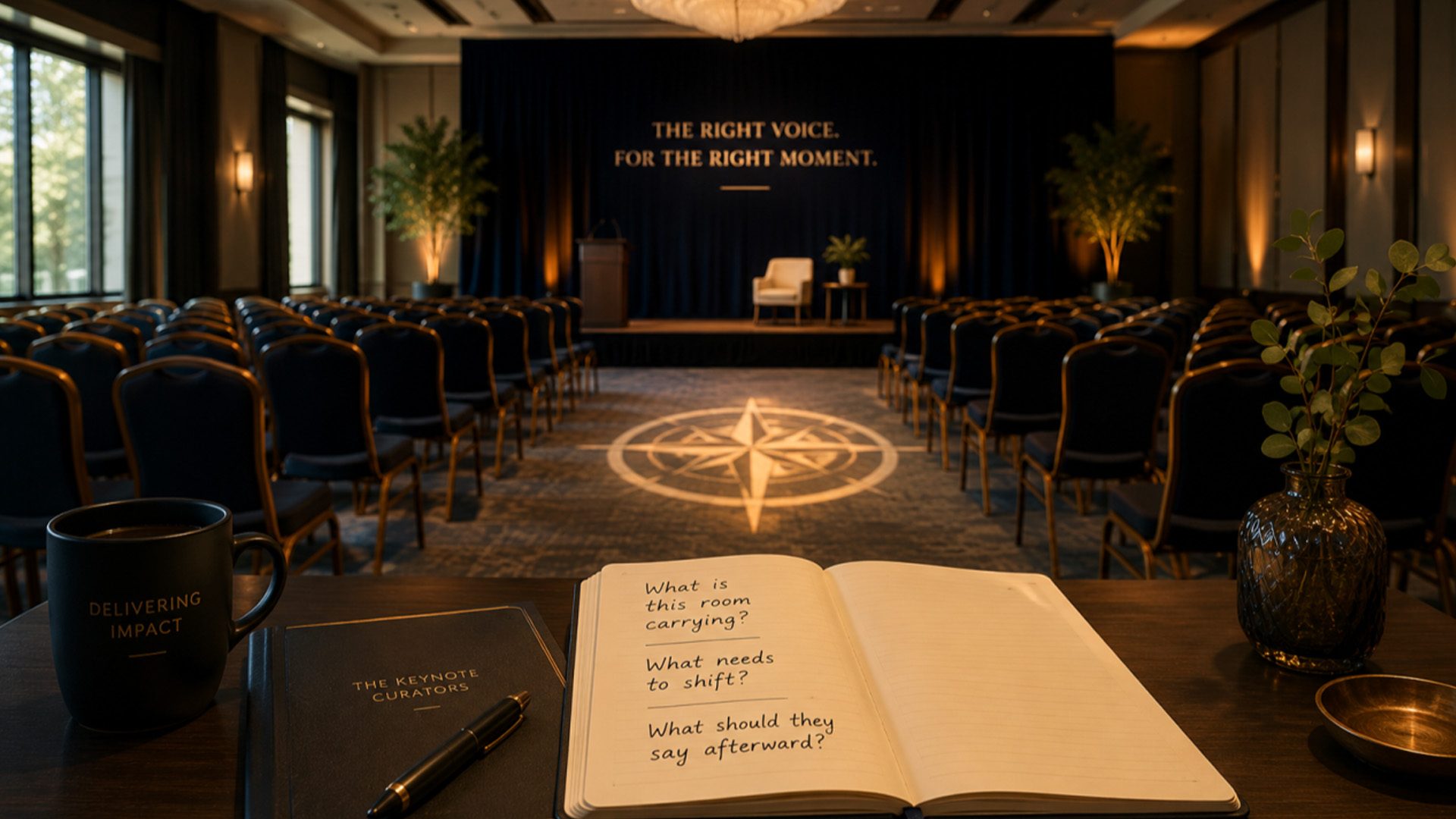
This belief is exactly what led to building the Keynote Compass.
It was not built because the industry needed another intake form to fill out before a proposal call. It exists because most buyers, even experienced ones, do not always have the language yet for what they actually need from a keynote speaker. They know the event matters. They know the audience matters. They may even have a topic in mind. But the real assignment is often still hiding underneath the request, waiting for someone to ask the right question.
So instead of collecting the basics and moving straight to names, the Compass asks questions designed to open the room a little wider.
If this keynote speaker could shift something inside the audience, what would that shift actually be? Is this room asking for calm and contemplation, or does it need full-body goosebumps? How much does name recognition genuinely matter, and how much of that is about internal optics that nobody wants to say out loud? What would get someone in trouble if it happened on stage? What would success sound like in the hallway afterward, not in the survey? What would prove, ninety days later, that the keynote speaker did more than fill a slot on the agenda.
I will not lay out the entire framework here, partly because some of its value lives in the experience of answering it honestly rather than skimming it as a list. But the underlying principle is one I would ask anyone booking a keynote speaker to sit with. The better the questions asked up front, the better the shortlist that comes out the other end. Not longer. Better. More precise, more defensible, and more aligned with the actual room a keynote speaker is about to stand in front of.
Permission to Tell the Truth Changes the Whole Search
What I like most about a tool like the Compass is that it gives people permission to say the honest version of what they want, instead of the polished version they think they are supposed to say. A buyer might want a keynote speaker who feels bold, but still safe enough for a mixed audience that includes people at very different comfort levels. That is not a contradiction. That is real.
A buyer might want a recognizable name because an executive sponsor needs confidence in the choice before they will approve the budget. That is not shallow. That is part of the actual assignment, whether anyone says it plainly or not. A buyer might want a personal story from their keynote speaker, but not one so heavy it overwhelms the rest of the agenda. They might want humor without fluff, practical tools without turning the session into a workshop, and energy without noise.
I have stopped treating these as contradictions that need to be smoothed over before a shortlist gets built. I treat them as clues. Real audiences carry tension. Real events carry tension. The job is not to pretend that tension does not exist so the search feels tidier. The job is to understand the tension well enough to recommend a keynote speaker who can actually hold it in the room, rather than one who simply performs well on a highlight reel. That is where the right fit lives. Not in the biggest name on the list. Not in the safest name either. In the fit between the voice and the moment.
What Trust Actually Looks Like in This Work
A keynote speaker I deeply respect, Alison Levine, recently introduced me to another speaker and said something that stopped me for a minute. She said I am not a typical bureau president, that I make it a point to really know my clients, stay involved in their events, and become a trusted advisor rather than someone who simply books a keynote speaker and moves on to the next deal. She said that in an era of fast transactions, that is what makes the difference.
I will admit that comment landed with me. Partly because of who said it. But mostly because she named the exact part of the work I care about most. The calls that happen before a shortlist is ever sent. The questions that make a buyer pause and think harder about what they actually need. The honest read on whether a keynote speaker is right for a specific room or simply impressive on paper. The willingness to say a name is not the right fit, even when that name is the shiniest option on the list.
It also includes the follow-through. Being on site. Understanding that a keynote speaker booking is not a transaction to close and forget. It is a moment someone has trusted me to help shape, and that trust is the actual job description, whether or not it appears in a contract.
The Compass is one expression of that trust, built to carry the same care into a tool that scales beyond a single phone call.
Common Understanding Is the Real Deliverable
A buyer recently used the Compass and sent back a note I have returned to several times since. She wrote:
“Seth — thank you! This is such a great tool, never seen it before. I actually love the Compass and the analysis you provided, and think it illustrates our perspective in our search as it relates to Summit, with common understanding.”
Common understanding. That phrase is doing a lot of work, because it names exactly what most keynote speaker searches are missing. Not interest. Not urgency. Not a longer list of options to sort through. Understanding, specifically between the planner and the executive sponsor, between the stated theme and the real underlying need, between what the audience expects walking in and what might actually move them once a keynote speaker starts talking, and between the safe choice and the right one.
A strong shortlist should not just hand someone names to pick from. It should make the decision clearer than it was before the search began. It should explain why one voice belongs in the room more than another, and it should help the buyer feel understood in the process, not just served. Buyers are carrying real pressure of their own. They are protecting the room, the budget, the brand, and the experience their audience will remember long after the event ends, along with the emails that arrive if a keynote speaker misses the mark. That kind of pressure deserves more than a quick list of options with a fee attached to each name.
Speed Is Not the Problem, But It Is Not the Whole Answer Either
We are living in a moment where almost everything can be generated faster than ever before. Names, summaries, comparisons, and shortlists can all be produced in seconds. I use tools that help me move faster through noise too, and I am not interested in pretending speed is the enemy.
But the decision about who stands on a stage in front of an organization’s people should not be outsourced to the noise. Every keynote speaker I recommend has been argued for internally, weighed against the audience, the culture, the optics, the energy in the room, the organization’s risk tolerance, and the outcome everyone is actually trying to create. Not because I want the process to feel precious or slow for its own sake, but because the room deserves a recommendation that has genuinely been thought through rather than generated.
There are plenty of places to find keynote speaker names quickly now. That part of the industry has been solved. The harder part, the part that still requires judgment, is knowing which voice can challenge a room without alienating it, move people without manipulating them, bring real energy without overwhelming the moment, and earn trust before asking an audience to stretch beyond their comfort zone. That is not something a database can determine on its own. It is a discernment problem, and discernment is still, stubbornly and thankfully, human work.
Curation as a Discipline, Not a Transaction
I have thought a lot about why this distinction matters so much to me, and I keep landing in the same place. Curating a keynote speaker for a room is closer to matchmaking than it is to procurement. Procurement optimizes for price, availability, and topic match. Curation optimizes for something harder to measure, which is whether the specific combination of voice, timing, tone, and audience will actually create the shift a client is hoping for.
This is where topics like AI, culture, and customer experience get interesting, because each one carries its own version of the same trap. Ask ten planners for a keynote speaker on AI, and you will get ten different underlying needs. Some rooms are anxious and need someone to make the technology feel less threatening. Some rooms are behind and need someone to create urgency without triggering panic. Some rooms have already invested heavily and need validation that they are on the right path. A keynote speaker who nails one of those rooms can completely miss another, even while covering the exact same slide deck.
The same is true of culture and customer experience as topics. They sound like categories, but underneath each one is a specific organizational story that a keynote speaker either understands or does not. Curation is the discipline of refusing to treat any of these topics as generic, and it is the discipline that a tool built around better questions is designed to protect.
A Better Beginning Changes the Ending
The Compass is not magic, and I would never present it that way. The keynote speaker still matters enormously. The story they tell still matters. The delivery, the pacing, the willingness to read a room in real time, all of that still matters exactly as much as it always has. Logistics still matter too.
But I have learned that the quality of the beginning tends to determine the quality of the recommendation that follows it. Start with a topic, and you will likely get a list. Start with the room, and you have a real chance at finding the right keynote speaker instead of simply the most available one. That is the difference I care about in this work. Not more names, but more alignment. Not more options, but more clarity. Not a shortlist dressed up to look like strategy, but a more honest beginning that leads somewhere more meaningful.
So before the next search begins with the familiar question of who should we book, I would gently push toward a harder one. What do we need this room to feel, understand, believe, or do differently once the keynote speaker walks off stage. That question is where the real search should start, and in my experience, it is the question that determines whether a keynote speaker becomes a memorable part of the event or simply another line on the agenda.
The Room Decides, Not the List
If there is one thing I hope stays with you after reading this, it is that the best keynote speaker for your event is rarely the first impressive name that comes to mind. It is the voice that matches the emotional truth of the room, even when that truth is harder to name than a topic on a proposal. A great keynote speaker search protects that truth instead of rushing past it, and every recommendation I make is built on the belief that the room, not the request, is the real brief.
If you are shaping a room that matters right now, reply COMPASS, and I will send you the first question I ask before recommending a single keynote speaker.
Delivering impact,
— Seth
🧭 Before you start building your agenda, run your event through the Keynote Compass
🎯 Want to talk it through directly? Grab 15 minutes and let’s find the one who fits your moment
📩 Or send your dates and budget to info@thekeynotecurators.com
💌 Stay tuned for more on how proper curation makes your job easier when you subscribe to our weekly newsletter
Discover More Insights






Get in TouchContact US
Fill out the form so we can best understand your needs.
A representative from The Keynote Curators will reach out to you.