
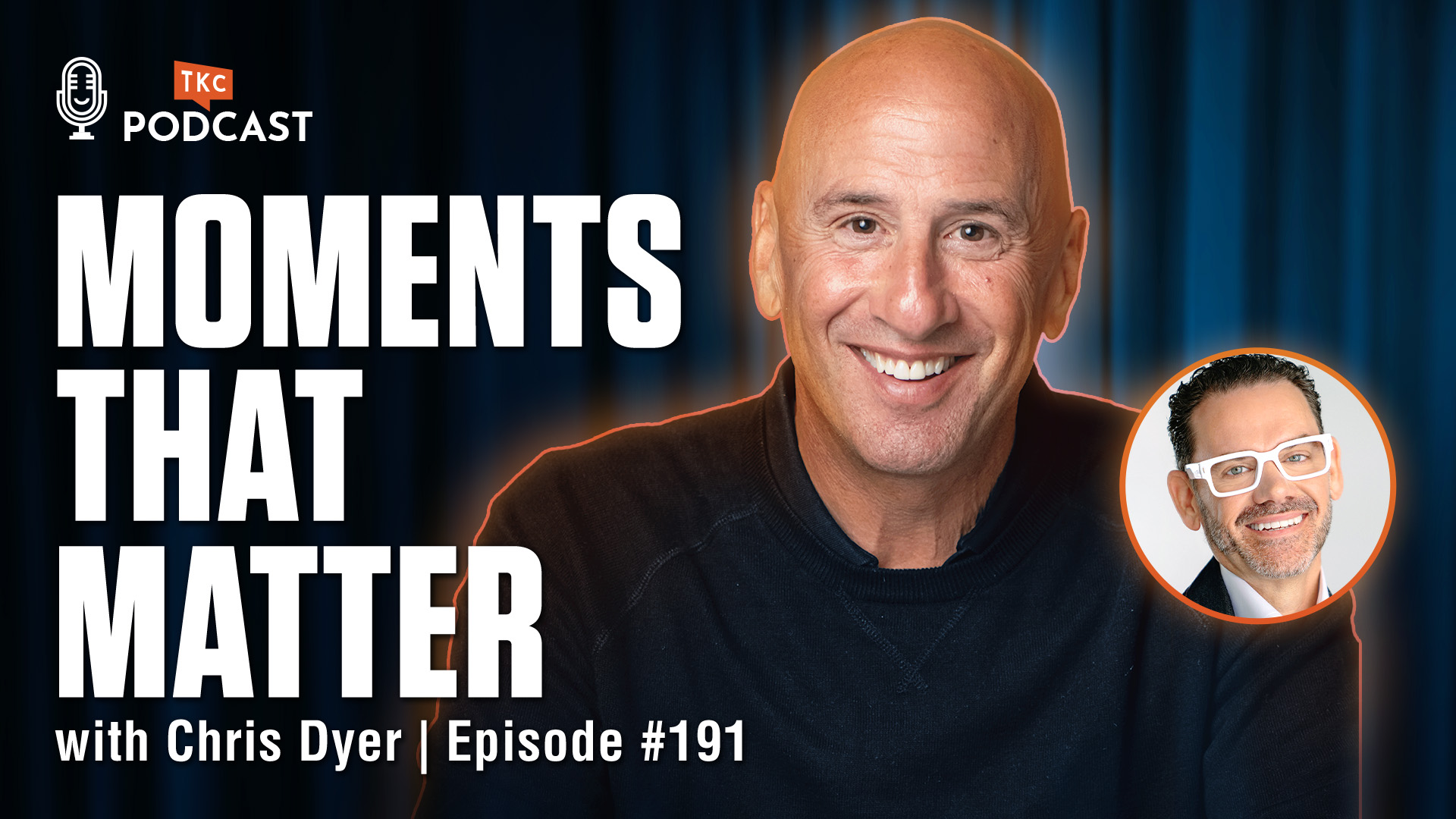
September 10, 2026Business Culture Is Built in Small Moments, with Chris Dyer
Chris Dyer explains how everyday leadership moments shape business culture, trust, and whether employees choose to stay.
I used to think business culture was something you designed. You’d write a mission statement, hang it on a wall, and hope people lived up to it. After talking with Chris Dyer, I don’t believe that anymore.
Culture isn’t a poster. It’s a pattern. It shows up in the moments nobody plans for: the mistake that gets made, the new hire’s first awkward morning, the meeting that runs long for no good reason. Chris Dyer has spent years studying exactly these moments, and what he told me changed how I think about business, leadership, and what actually makes people want to stay somewhere.
I sat down with Chris Dyer for an episode of The Keynote Curators Podcast, and the conversation kept circling back to one idea: business culture isn’t what you say it is. It’s what people experience when things get uncomfortable. If you want to understand a business, don’t read its values statement. Watch what happens when someone messes up. That’s the kind of thought leadership I keep coming back to when I think about what actually separates a good business from a struggling one.
🎧 Watch and listen to the podcast episode: YouTube • Spotify • Apple Podcasts • Amazon Music
The Real Test of a Business Culture
Every business has a culture, whether anyone designed it or not. That’s the part people miss. You don’t get to opt out of having a culture. You only get to decide whether you’re shaping it on purpose or letting it happen by accident.
Chris Dyer made a point that stuck with me. He said the real test of a business’s corporate culture isn’t the good days. It’s what happens when something goes wrong. Does a mistake get hidden or admitted? Does a leader react with blame or curiosity? Those small reactions, repeated over months and years, become the actual culture of a business, no matter what the handbook says.
I’ve seen this play out in businesses I’ve worked with directly. Two companies can have nearly identical mission statements and produce completely different employee experiences. The difference isn’t the words. It’s the follow-through. A business that talks about trust but punishes honest mistakes is teaching its people to hide problems, not solve them. And once people learn to hide problems, the business loses the one thing it actually needs to grow: accurate information about what’s really happening.
Why Letting Go of Control Builds Stronger Teams
One of the more surprising parts of our conversation was Chris Dyer’s take on control. Most leaders think tighter control means better results. Chris Dyer argues the opposite. In a healthy business, letting go of control often produces stronger teamwork and better outcomes.
This isn’t about being hands-off. It’s about trust. When a leader controls every decision, they’re sending a quiet message: I don’t trust you to get this right without me. Employees pick up on that message fast, even if it’s never said out loud. And once people believe they’re not trusted, they stop bringing their best thinking to the table. They wait for instructions instead of solving problems.
What struck me most about this part of the conversation is how counterintuitive it feels in practice. Letting go of control can feel like a risk to a leader who’s used to being the one with all the answers. But Chris Dyer’s experience running a fully remote business through two recessions and a pandemic backs this up, and it says a lot about how the future of work actually functions once you strip away the office and the assumptions that come with it. Businesses that trust their people to make decisions build resilience. Businesses that centralize every decision build bottlenecks.
This connects directly to leadership development more broadly. A leader’s job isn’t to be the smartest person in every room. It’s to build a business where good decisions can be made without them in the room. That’s a different skill entirely, and it’s one a lot of leaders never get trained on as part of their own professional development.
The Leadership Moments Employees Never Forget
Chris Dyer’s Moments That Matter framework is built on a simple but powerful observation: a handful of moments in someone’s time at a business shape their entire relationship with that business. Not the average day. Not the routine tasks. The specific moments where a leader had a choice and made it visible.
I asked Chris Dyer what these moments tend to look like, and his answer was more human than I expected. It’s the moment an employee makes a costly mistake and the manager’s first response is concern for the person, not anger about the cost. It’s the moment someone asks for help and gets it without being made to feel small for needing it. It’s the moment a leader admits they were wrong in front of the team instead of quietly correcting course and hoping nobody notices.
These moments matter because people remember how they were treated far longer than they remember what was said in a meeting. A business can have excellent strategy and still lose good people if the moments that matter go badly too often. This is why I think Chris Dyer’s framework is so useful for any business trying to improve employee engagement and retention. It’s not asking leaders to be perfect all the time. It’s asking them to be intentional about the moments that carry the most weight.
There’s a leadership lesson buried in here that goes beyond any single business. The moments people remember aren’t the ones you plan for. They’re the ones that catch you off guard. Which means the real test of a leader’s character isn’t the prepared speech. It’s the unscripted reaction.
How a Bad First Day Can Break Trust Before It Starts
We spent a good chunk of the conversation on something that seems small but isn’t: the first day of employment. Chris Dyer pointed out that a lot of businesses spend enormous energy recruiting someone, then completely drop the ball the moment that person actually shows up.
Think about how often this happens. A new hire arrives excited, and their laptop isn’t set up. Nobody knows where they’re supposed to sit. Their manager is in back-to-back meetings and doesn’t say hello until lunch. None of this is intentional. But intention doesn’t matter to the new employee. What matters is what they experienced.
Chris Dyer’s point is that this first day sets the tone for the entire employment relationship. If a business can’t get the basics right on day one, when everyone is supposedly paying the most attention, the new hire draws a quiet conclusion: this is probably how things work around here. That conclusion is hard to undo later, even if the business genuinely does better once the new hire settles in.
This is a business growth issue as much as it’s a culture issue. Losing an employee in the first ninety days is expensive, and a rough first day is one of the most preventable causes. Any founder or entrepreneur who wants to grow sustainably has to treat onboarding as a moment that matters, not an afterthought squeezed in between other priorities.
Transparency as the Foundation of Trust
Transparency came up again and again in our conversation, and Chris Dyer was direct about why. A business that withholds information from its people, even with good intentions, is teaching those people not to trust leadership. And once trust erodes, everything else gets harder: communication, collaboration, even basic day-to-day productivity.
I asked him where businesses tend to get transparency wrong, and his answer was that most leaders think transparency means sharing more information. Chris Dyer’s view is that it actually means sharing the right information at the right time, including the uncomfortable stuff. A business struggling financially doesn’t build trust by hiding it and hoping nobody notices. It builds trust by being honest early, even when the news is hard to deliver.
This reminded me of something I’ve noticed across a lot of businesses I’ve talked to on this podcast. Leaders often avoid transparency because they’re afraid of the reaction. But employees can usually tell when something is being hidden, even if they don’t know exactly what. The silence itself becomes the problem. Ambiguity breeds worse assumptions than the truth usually does.
Transparency also connects to how a business handles change. Any business going through a shift, whether it’s a leadership change, a restructuring, or a new strategic direction, will move through that change more smoothly if people understand why it’s happening. A business that explains its reasoning, even imperfectly, keeps more trust intact than one that simply announces decisions and expects compliance.
What Too Many Meetings Reveal About a Business
This part of the conversation made me laugh, mostly because it hit close to home. Chris Dyer argued that meeting overload isn’t just a scheduling problem. It’s a symptom of deeper issues inside a business, often rooted in a breakdown of basic communication.
His reasoning goes like this. Businesses schedule excessive meetings when there’s a lack of trust in written communication, a lack of clarity about decision rights, or a simple habit that nobody has questioned in years. If a leader doesn’t trust that people will read an email carefully, they call a meeting instead. If nobody’s sure who’s actually allowed to make a decision, more people get pulled into the room just in case. Neither of these fixes the underlying problem. Both just add more meetings.
What I found most useful here is how Chris Dyer reframes meeting overload as a diagnostic tool. Instead of asking “how do we reduce meetings,” a business should ask “why do we feel like we need this many meetings in the first place?” That question usually points to a communication gap, a trust gap, or an unclear process. The meetings are the symptom, not the disease.
For any business serious about improving productivity, this is worth sitting with. Cutting meetings without fixing the underlying trust or clarity issue just pushes the same confusion into a different format. The real fix is upstream of the calendar.
Why Smaller Groups Solve Problems Better
One of the more practical insights from Chris Dyer had to do with group size. He’s found that smaller groups consistently outperform both large meetings and endless one-on-ones when it comes to actually solving problems inside a business.
Large meetings tend to flatten conversation. People hold back opinions in front of a crowd, and the loudest voice often wins by default rather than by being right. One-on-ones, on the other hand, isolate information. A leader ends up having the same conversation five separate times instead of letting five people build on each other’s thinking.
Chris Dyer’s preference for small groups, somewhere around three to five people, strikes a balance. There are enough perspectives in the room to challenge assumptions, but not so many that people go quiet. This is a simple structural choice, but it has a real effect on how a business makes decisions, and it tends to open the door to more genuine innovation than either extreme allows. Better input at the decision-making stage tends to produce better outcomes down the line, and fewer costly corrections after the fact.
I think this idea applies well beyond formal meetings. Any business trying to build a culture of open communication should pay attention to group size as a lever, not just an afterthought. Who’s in the room shapes what gets said in the room.
Scaling Moments That Matter Across an Entire Business
The hardest part of Chris Dyer’s framework isn’t recognizing a moment that matters. It’s scaling that awareness across an entire business, especially as the business grows. A founder can personally get onboarding right for the first ten employees. That same founder can’t personally shape the first-day experience for the five hundredth employee.
This is where Chris Dyer‘s 7 Pillars of Amazing Culture framework becomes useful. Instead of relying on one leader’s instincts, a business needs systems that make good moments repeatable. That means training managers to recognize these moments themselves, building onboarding processes that don’t depend on any one person remembering to be thoughtful, and creating feedback loops that catch it when a moment gets missed.
The businesses Chris Dyer has studied as Best Place to Work honorees didn’t get there by accident. They built systems around the human moments that matter most, so that culture didn’t depend entirely on any single manager having a good day. That’s the difference between a business with a nice culture on paper and a business with a culture that actually holds up under pressure.
I think this is the piece a lot of businesses miss when they try to improve engagement. They focus on perks and events, thinking that’s what builds a good culture. Chris Dyer’s research suggests something different: the moments that matter most are usually free. They cost attention, not budget. A business doesn’t need a bigger perks program. It needs leaders who notice when a moment is unfolding and choose to handle it well.
Culture as an Ongoing Choice, Not a Finished Project
The more I sit with this conversation, the more I think the biggest mistake a business can make is treating culture as something you finish. You don’t build a business culture once and move on. You rebuild it every day, in every mistake handled with grace or handled badly, every meeting that respects people’s time or wastes it, every new hire welcomed well or left to figure it out alone.
Chris Dyer’s whole body of work, from The Power of Company Culture to Moments That Matter, comes back to this same idea from different angles. As a best-selling author and one of the most sought-after business speakers working today, he’s built a career on the idea that a business is a living system made up of thousands of small human interactions. You can’t shortcut your way to a good culture with a slogan. You earn it, moment by moment, and you can lose it the same way.
That’s a harder truth than most leadership advice offers, but it’s also more useful. It means any business, at any size, can start improving its culture today, not by launching a new initiative, but by paying closer attention to the next moment that matters. The next mistake someone makes. The next new hire’s first morning. The next meeting that could have been an email.
Culture isn’t a slogan on a wall. It’s the sum of a thousand small moments, and every business gets to decide how it shows up in each one.
If there’s one thing I’ll carry forward from this conversation with Chris Dyer, it’s that a business doesn’t need a perfect culture. It needs leaders willing to notice the moments that matter and handle them with a little more honesty, a little more trust, and a little more care than the day before. That’s not a program you launch. It’s a practice you keep choosing, one moment at a time, for as long as the business exists.
🎤 Explore Chris Dyer’s keynote speaker profile on our website.
📞 Schedule a time here and let’s talk about bringing Chris Dyer to your next event.
📩 Send your audience and event theme to info@thekeynotecurators.com, and I’ll tell you if Chris Dyer is the right fit.
Discover More Insights



Get in TouchContact US
Fill out the form so we can best understand your needs.
A representative from The Keynote Curators will reach out to you.
Our Services
Keynote Speakers Topics
© 2026 The Keynote Curators. All Rights Reserved | Terms and Conditions
The Keynote Curators, 8275 South Eastern Avenue, Suite 200, Las Vegas, NV 89123
Local (310) 299-4595 | Toll Free (888) 585-8715 | info@thekeynotecurators.com
The Keynote Curators - Top Keynote Agency, USA.