
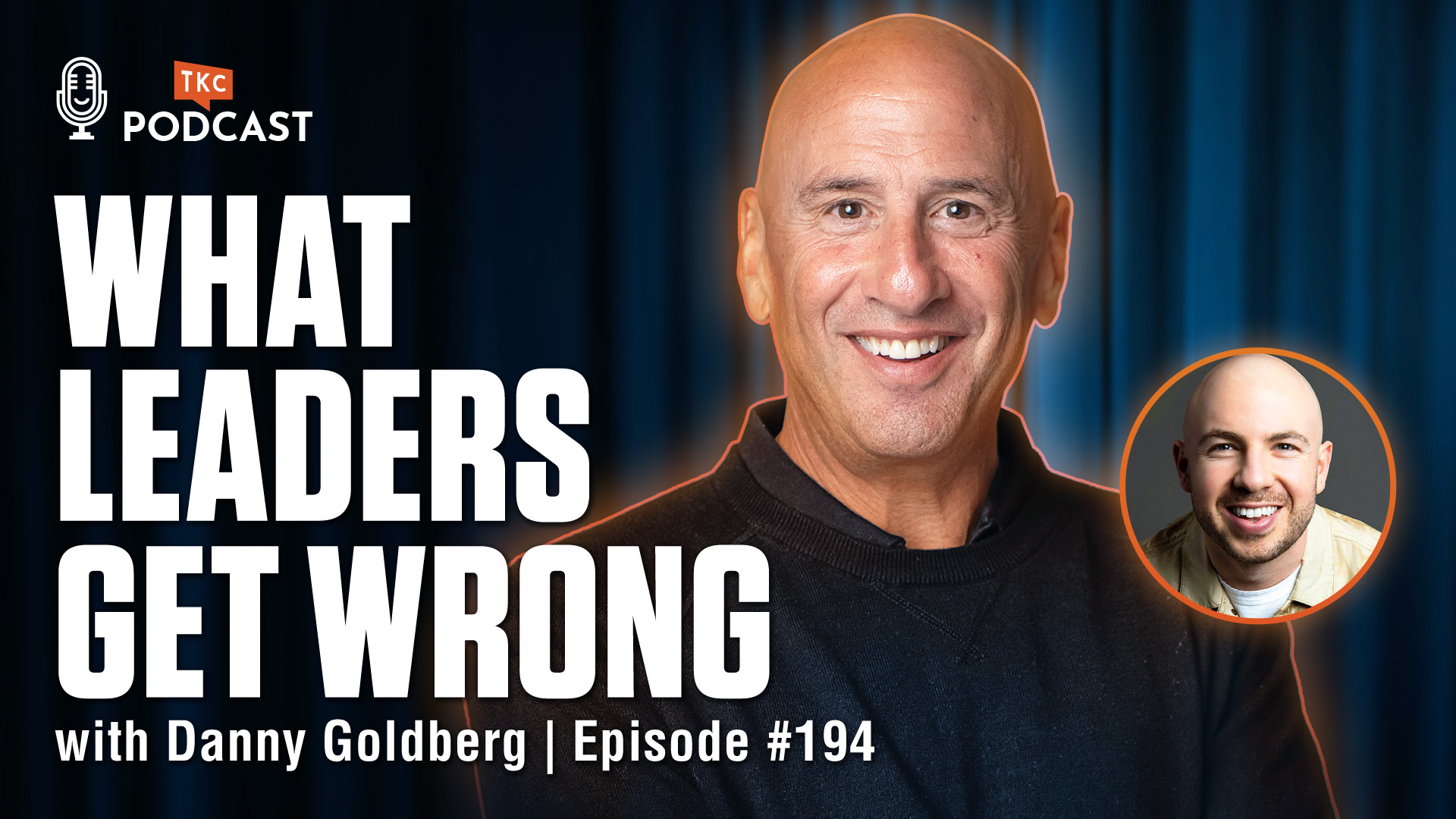
October 1, 2026Workplace Culture Lessons on Trust and Safety with Danny Goldberg
Danny Goldberg explains how leaders can close the gap between the workplace culture they intend and the one employees actually feel.
Ask a leadership team how their workplace culture is doing, and you will almost always hear the same answer. “Great.”
Now ask the employees. That is where it gets interesting.
That gap is where Danny Goldberg spends much of his time. Before his keynotes, he talks with both groups. And about nine times out of ten, he finds the same thing. The workplace culture leaders believe they have created is not the workplace culture employees actually experience. Danny calls it the perceived gap.
I sat down with Danny on The Keynote Curators Podcast to talk about what closes that gap. His answer was simple, and I have kept thinking about it since. It is not better perks. It is not another values statement. It is not telling people you care. It is making sure they actually feel it.
That one word, feel, carries the whole conversation. A leader can design a workplace culture on paper. Only the people inside it can tell you what it feels like. And what they feel decides whether they speak up, stay engaged, and do their best work.
I want to share what stayed with me and go a step further. I want to look at what these ideas mean for anyone who leads people. Every team has a workplace culture, whether the leader shaped it on purpose or not. The real question is whether your team experiences the workplace culture you think you are leading.
🎧 Watch and listen to the podcast episode: YouTube • Spotify • Apple Podcasts • Amazon Music
The Perceived Gap in Workplace Culture
The first thing I want to say about the perceived gap is that nobody is lying. When a leader says the workplace culture is great, they mean it. They see the town halls, the team events, the values on the lobby wall, and the open door policy they sincerely believe in. From where they sit, the evidence is everywhere.
Employees sit somewhere else. They see how their manager reacts when they bring bad news. They see who gets heard in meetings and who gets talked over. They see whether the open door is really open. Their view of leadership is built from small moments, not from announcements. So both groups are telling the truth. They are just looking at different evidence.
What I value most about Danny’s approach is that he does not treat the gap as a flaw in someone’s character. He treats it as a blind spot that comes with the job. The higher a person rises, the more filtered the information becomes. People tell senior leaders what they think those leaders want to hear. Over time, a comfortable picture forms at the top that does not match life on the ground. That is how a well-run company can have a workplace culture that looks healthy in the boardroom and feels tense in the hallway.
The gap also explains why so many corporate culture programs fail to land. A company launches a new initiative, leaders feel good about it, and nothing changes for the person doing the work. The effort was real, but it was aimed at the leader’s picture of the workplace culture, not the employee’s.
The lesson that stayed with me is simple. You cannot close a gap you refuse to look at. Before you change anything, you have to ask the people who live inside your workplace culture, and you have to make it safe enough for them to answer honestly. Asking is the first act of leadership, and many of us skip it because we assume we already know the answer.
Why Pay and Perks Are Now Table Stakes
For a long time, many companies treated pay and perks as the answer to every people problem. Raise the salary, add the snacks, offer flexible hours, and people will stay. Danny made a point that many leaders need to hear. Those things are now the baseline. They are table stakes. They get people in the door, but they do not explain why anyone stays or why anyone gives their best effort.
I found that idea freeing. If pay and perks are the baseline, then a strong workplace culture cannot be bought. It has to be built through how people are treated on an ordinary Tuesday. That moves the work from the budget to behavior, and every leader controls behavior. You can start shaping your workplace culture today without asking anyone for money.
Think about what this means for the future of work. People have more options than ever. They can work remotely, change industries, or start something of their own. When the market offers everyone decent pay and decent perks, the thing that separates one employer from another is what it feels like to work there. In that world, workplace culture becomes the real product a company offers its people. Companies that treat it as a side project will lose talent to companies that treat it as the main project.
There is also a trap here. Perks can hide problems. A company can offer free lunches and a game room while people are afraid to disagree with their boss. The perks look like care, but they are only decoration. This is one reason employee engagement scores often stay flat even after a company spends more. When leaders lean on perks to fix a weak workplace culture, employees notice. They see the distance between the gesture and the experience, and that distance wears down trust faster than having no perks at all.
Why Workplace Culture Makes People Turn Down More Money
One of the most striking parts of our conversation was about people who turn down more money to stay. A recruiter calls with a higher salary and a bigger title, and they say no. That seems to go against everything we are told about how people make career choices. But the more I thought about it, the more it made sense.
People stay where they feel three things: growth, voice, and understanding. Danny framed it as something bigger than compensation. When a workplace gives people all three, a higher offer elsewhere stops looking like a win. It starts looking like a risk. They would be giving up something real for something uncertain. A healthy workplace culture makes leaving expensive in a way that no salary can match.
Growth matters because people want to feel they are becoming more than they were. Professional development is not a perk to be handed out once a year. It is a signal that someone believes in where you are going. The same is true of personal development, which tells an employee that the company sees them as a whole person with a future, not just a role to fill.
Voice matters because being heard is one of the most basic human needs at work. When people share an idea and see it taken seriously, they start to feel like owners. When they share an idea and hear nothing, they learn to keep their ideas to themselves. Being understood sits underneath both. People want a manager who knows how they think, what they care about, and what gets in their way.
I have seen this same pattern in many teams. The best people rarely leave because of one bad paycheck. They leave because they stopped feeling seen. That is why I believe workplace culture is the strongest retention tool a company has, and it costs far less than most leaders expect.
Understanding the Whole Person Behind the Employee
Danny did not learn these ideas from a textbook. Before he ever spoke about high-performing teams, he had to build one. By his early twenties, he was running a global manufacturing agency out of Hong Kong, working with brands like Peloton, Traeger, and Gravity Blankets. His team was remote, spread across cultures and time zones, and made up of several generations. As an entrepreneur, he could not rely on the usual tools of office life. He could not walk the floor or read the room. He had to lead differently.
That pressure left him with one question: what creates a high-performing team? He and his team grew the business to eight figures. After he left, he wanted to know whether what he had lived was unique to his group or true everywhere. So he started asking. Years of research and hundreds of interviews followed, with executives, managers, and frontline employees. The same patterns kept showing up. His conclusion is one I keep returning to: “Performance isn’t a talent problem. It’s a conditions problem.”
That sentence changes how I think about workplace culture. If performance is a conditions problem, then leaders are not only hiring and firing. They are gardeners. They create the soil, and the soil decides what grows. A workplace culture is simply the sum of those conditions. Danny now runs Groundwork, a diagnostic platform that measures the conditions shaping how teams perform, which is really another way of measuring workplace culture.
One of the conditions he stressed is understanding the whole person, not just the employee. A person comes to work with a life attached to them: a sick parent, a new baby, a quiet fear of failing, a goal they have told no one. Leaders who take time to learn those things begin to see behavior differently. The teammate who seems withdrawn might be carrying something heavy. This is emotional intelligence in practice, and it is not soft. It gives a leader better information, and better information leads to better decisions.
What makes workplace culture keynote speaker Danny Goldberg so credible to me is that he did not start with theory. He started with a real team, real pressure, and real results, and then he tested his experience against hundreds of other people’s stories.
Psychological Safety Is the Foundation of Workplace Culture
Psychological safety sounds like a technical term, but the idea is simple. It is the belief that you can speak up, ask a question, admit a mistake, or disagree without being punished or embarrassed. Danny was direct about why it matters. Psychological safety does not lower standards. It improves performance.
Many leaders fear the opposite. They worry that if they make it safe to speak up, people will get comfortable, and standards will slip. I think that fear mixes up two different things. Safety is about how people are treated when they raise a problem. Standards are about what the team is expected to achieve. You can hold a very high bar and still welcome bad news. In fact, you need to welcome bad news to hit a high bar, because problems you hear about early are problems you can fix.
Danny pointed to Google’s well-known study on what makes teams effective, where psychological safety stood out as the most important factor. I think that finding deserves more attention than it gets. It says that a group of brilliant people can underperform if they are afraid, and an ordinary group can do remarkable work if they trust each other.
That is why teamwork depends on safety more than on skill. A team is only as strong as the information that flows between its members. When people hold back, the team loses its best thinking without ever knowing it. A strong workplace culture protects that flow. And when it flows, productivity follows, because people spend less energy protecting themselves and more energy solving the problem in front of them. A workplace culture built on safety turns fear into focus.
The Small Behaviors That Teach a Team to Stay Quiet
The story that hit me hardest in our conversation was about a quarterly meeting. Danny described how something small in that meeting ended up teaching a whole team to stay quiet. No one announced a rule against speaking up. Nobody had to. The team watched what happened, and they learned.
What I take from that story is that people learn a workplace culture by watching consequences, not by reading policies. A sigh at the wrong time, a dismissive reply, an eye roll, a question answered with sarcasm: the team notices every one of them. They run a quiet calculation. Was that person punished for speaking? Then it is safer to say nothing next time. After a few rounds of this, silence becomes the norm, and leaders often mistake that silence for agreement.
This is what makes psychological safety so fragile. Danny was clear that it is built slowly and can be lost fast. It can take months of steady behavior to earn trust and one careless reaction to undo a large part of it. A workplace culture can look solid and still be fragile. I find this both sobering and useful. It is sobering because leaders are always being watched, even when they do not know it. It is useful because it means small, good behaviors also add up. Thanking someone for a hard question, staying curious when you hear something you dislike, and admitting your own mistake in front of the team all teach the opposite lesson.
The practical question I now ask myself after a meeting is this: what did I just teach the room? Leaders rarely think about that. But the answer shapes whether the next meeting has real conversation or polite quiet. Over a year, those small lessons become the workplace culture.
When Toxic Behavior Becomes Workplace Culture
Danny was blunt on one topic: yelling has no place in the workplace. I appreciated that he did not soften it. Many of us have worked somewhere that excused raised voices and cruel comments because the person doing it was a top performer, or a founder, or just “intense.” Danny’s position is that none of that is a reason to accept it.
Here is the idea that stuck with me most. Toxic behavior becomes culture the moment everyone accepts it. The first incident is a behavior. The second, when no one responds, is a pattern. By the tenth, it is part of the workplace culture, and new employees learn it in their first week by watching how others cope. What a leader tolerates is what a leader teaches.
This is why silence from leadership is never neutral. When someone yells at a colleague and nothing happens, everyone in the room learns something. The target learns that they are on their own. The bystanders learn that speaking up is risky. The person yelling learns that it works. Each of those lessons makes the next incident more likely and the next honest conversation less likely.
I think this is where many organizations quietly break their own promises. They publish values like respect and integrity, and then they allow behavior that contradicts them. Employees do not believe the poster. They believe what they see. A workplace culture is not what a company says it values. It is what a company is willing to let happen.
Holding to standards does not mean being cold. It means being clear. Leaders can be warm and firm at the same time. In fact, the warmest thing a leader can do for a team is to protect it from behavior that makes people afraid.
Building Workplace Culture for the Majority, Not the Outliers
Another idea from Danny that I keep thinking about is that leaders should build for the majority, not for the outliers. It is easy to design rules, policies, and even meetings around the one person who causes trouble. A single bad experience can lead to a rule that affects everyone, and the majority ends up paying for the behavior of a few.
The better approach is to shape your workplace culture around what most people need and to deal with outliers directly. If one person breaks trust, have a real conversation with that person. Do not punish the whole team with a new layer of control. Most people are trying to do good work. They respond well to clarity, respect, and trust. A workplace culture designed for them will feel very different from one designed around suspicion.
The second half of this idea is one of my favorites: every person shapes the culture they step into. This is a powerful reminder that workplace culture is not only the job of the CEO or the HR team. A new hire walks into a culture that already exists, but from day one, they add to it. Each time someone thanks a colleague, admits an error, or asks a question, they nudge the workplace culture in a better direction. Each time someone rolls their eyes or stays silent, they nudge it too.
I think this matters because it gives everyone some power. You do not need a title to influence the team around you. That is a real form of thought leadership inside an organization: showing through daily behavior what good looks like, until others follow. It is also closely tied to success, because teams that share ownership of their culture tend to hold it together under pressure.
What the Best Leaders Have in Common
When I asked Danny what the best leaders have in common, his answer came back to care. Not care as a slogan, and not care as an occasional gift basket. Care that is felt consistently, in ordinary moments, by the people being led. That word, felt, came back again.
He shared the example of a Chief Care Officer, and I have not stopped thinking about it. What struck me was the idea that care can be owned by someone, made visible, and practiced on purpose. Most organizations leave care to chance. They hope managers are naturally kind, and they hope the workplace culture takes care of the rest. Hope is not a system. When care has an owner, it gets attention the way revenue or safety gets attention.
The best leaders understand that care is a skill, not a mood. They ask how people are doing and listen to the real answer. They notice when someone goes quiet. They give credit freely and take responsibility quickly. They are consistent, which might be the most important part. A leader who is kind on Monday and dismissive on Thursday teaches people that kindness cannot be trusted. Consistency is what turns a good intention into a workplace culture people can rely on.
I often hear that business leadership is about results, and that care is a separate topic. Danny’s work, and my own observations, say the opposite. Care is how results are produced. People who feel safe, understood, and valued bring more of themselves to the work. A leader who builds that kind of workplace culture is not trading performance for kindness. They are getting both.

Care Only Counts When It Is Felt
Go back to where we started. Leaders say the workplace culture is great, employees say something else, and the space between them is the perceived gap. After my conversation with Danny, I am convinced that closing it does not take a big program or a large budget. It takes attention, honesty, and consistency.
It means asking employees what their experience really is and believing the answer. It means understanding the whole person, protecting psychological safety, refusing to accept toxic behavior, and making care something people can feel. Each of these choices is small. Together, they decide whether your workplace culture is something you describe or something your people live.
What I keep coming back to is Danny’s point that performance is not a talent problem, it is a conditions problem. That is both a challenge and an invitation. It is a challenge because it removes the excuse that we just need better people. It is an invitation because conditions are something we can change, starting this week. Every leader can decide what the room feels like. A better workplace culture begins the day a leader agrees to look at the real one.
So here is the question I will leave with you, the same one that has stayed with me. Does your team experience the workplace culture you think you are leading? If you are not sure, the best next step is to ask. Then listen, and let what you hear change how you lead.
🎤 Explore Danny Goldberg’s keynote speaker profile
📞 If your audience needs a message on workplace culture, psychological safety, leadership, and creating the conditions for teams to perform at their best, Danny delivers. Let’s talk
📩 Or send your audience and event theme to info@thekeynotecurators.com and I’ll tell you if he’s the right fit
Discover More Insights





Get in TouchContact US
Fill out the form so we can best understand your needs.
A representative from The Keynote Curators will reach out to you.