
Book Joe Navarro through The Keynote Curators
Biography
Joe Navarro is a former FBI special agent, internationally recognized expert in nonverbal communication, bestselling author, and sought-after keynote speaker. Recruited by the FBI at just 23 years old, he became one of the youngest agents to join the agency. During his distinguished 25-year career, Navarro served as both an agent and supervisor in the areas of counterintelligence and counterterrorism, where he developed an unparalleled understanding of human behavior and the subtle nonverbal signals that reveal what people think, feel, and intend.
Navarro’s success as a spy catcher led him to train fellow FBI agents and members of the intelligence community in the practical application of behavioral analysis and nonverbal communication. Since retiring from the FBI in 2003, he has worked with corporations and senior executives around the world, helping leaders communicate with greater confidence, build trust, strengthen their influence, and better understand the people around them. He is widely regarded as one of the world’s foremost authorities on applying nonverbal intelligence in business.
An engaging educator known for combining science with compelling stories from his FBI career, Navarro has presented throughout the United States, South America, Europe, and Asia. He has worked with CEOs and senior leaders from major global organizations, lectured annually at Harvard Business School for a decade, and serves on the Global Advisory Board of The Libra Group, where he provides strategic guidance to its executive team and board of directors.
Navarro is the author of 14 books published in 32 languages. His works include the international number-one bestseller What Every BODY Is Saying, Be Exceptional: Master the Five Traits That Set Extraordinary People Apart, The Dictionary of Body Language, Dangerous Personalities, and Three Minutes to Doomsday. Through fascinating real-world examples and immediately useful techniques, he teaches audiences how to read behavior, recognize hidden signals, communicate more effectively, and develop the qualities that distinguish exceptional leaders.
Contact us for Joe Navarro fees and availability
Videos
Speech TopicsExpand each topic to learn more
• How to master nonverbal intelligence in business to assess and influence others
• How to use nonverbal communication as a tool for change, for better communication, for collaboration, influence and success
• How to decode what’s really being said in meetings, negotiations, due diligence settings and interviews
• How to manage your “curbside appeal” to ensure lasting and meaningful impressions
• Draws on compelling firsthand accounts from his FBI career, experience working with foreign governments and major corporations, and cutting-edge science on nonverbal communication
• Joe distills a lifetime of experience into five principles that outstanding leaders live by
• Learn effective strategies that have proven transformative for those with leadership aspirations and those seeking to achieve a higher level of excellence through their leadership
• Based on Joe’s lectures at the Harvard Business School over a decade, he explores how nonverbals factor in negotiations to establish trust, to create cooperation, to evince information, to establish order, and to garner greater acceptance
• Learn how to detect if there are issues or concerns
• Learn how to establish harmonious relationships, respect, greater collaboration, and empathetic understanding
• An in-depth look at influence and how to achieve it, from your “curbside appeal” to lasting impressions that inspire and attract
• How we use time, colors, space, touch, distance, simplicity, manners, words and gestures to better connect with others
• How we can better communicate empathy, trust, and care. Will divulge what truly influences and motivates others
• Based on his book, Be Exceptional, Joe takes a powerful and insightful look at how exceptional individuals evoke trustworthiness and how that translates into changing perceptions and more effective leadership.
• With a focus on experienced professionals, this lively keynote examines for the first time what it really takes to convey trustworthiness and influence in a truly transformational way, why this is so important, and how you can use it to differentiate yourself from your peers and competitors.
• Examines the four most common toxic personality types most disruptive to organizations
• Explores their common traits, how to best identify them through their behavior, and how to better understand them
• Provides guidance on what can be done to deal with toxic personalities if and when they become a problem
Booksby Joe Navarro
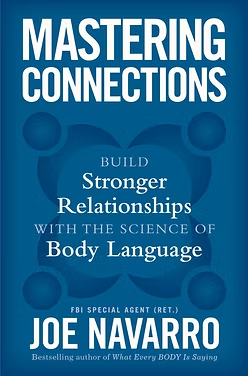
Mastering Connections

Be Exceptional

The Dictionary of Body Language

What Every Body is Saying
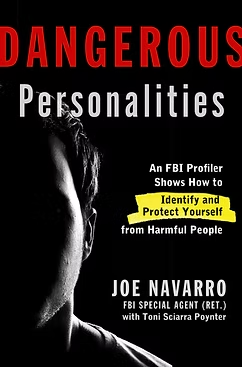
Dangerous Personalities
For Meeting Planners
Get in TouchContact US
Fill out the form so we can best understand your needs.
A representative from The Keynote Curators will reach out to you.
Blog Posts

Your Career Path Doesn’t Have to Be a Straight Line
Melissa Proctor's career went up, sideways, and back again. See how her jungle gym path shaped the way she leads.
Read More
How to Master AI to Deliver High-Value Results with Sam Richter
Learn how to master AI and deliver high-value results. Sam Richter explains where AI ends and human judgment begins.
Read More
Leading Through Uncertainty Starts With One Forward Step at a Time
Leading through uncertainty does not require the whole path. A story of loss, a marker, and the next step that keeps leaders moving.
Read More
Leadership Lessons From a Futurist on Hope and Resilient Teams
Leadership feels heavier right now. Almost every leader I talk with says some version of the same thing. The pace is faster, the news is louder, and the people they lead are tired. Many of...
Read More
Why ‘Better Problems’ Are Better Than Perfect Plans
Learn why better problems beat perfect plans. Jason Feifer shares how to judge ideas by the problems you trade, not the ones you avoid.
Read More
Change Starts When You Embrace Your Emotions, with Cassandra Worthy
Change starts when you embrace your emotions. Cassandra Worthy shows how to read your feelings as signals and turn discomfort into forward movement.
Read More
Breast Cancer Awareness Needs More Than Pink Ribbons and Good Intentions
Breast cancer awareness doesn't end in October. Here is what real workplace support and easier access can look like all year.
Read More
How to Create Event Experiences People Will Always Remember
What makes an event memorable? Dr. Robyne Hanley-Dafoe explains why full presence beats polls, phones, and gadgets in any live room.
Read More