
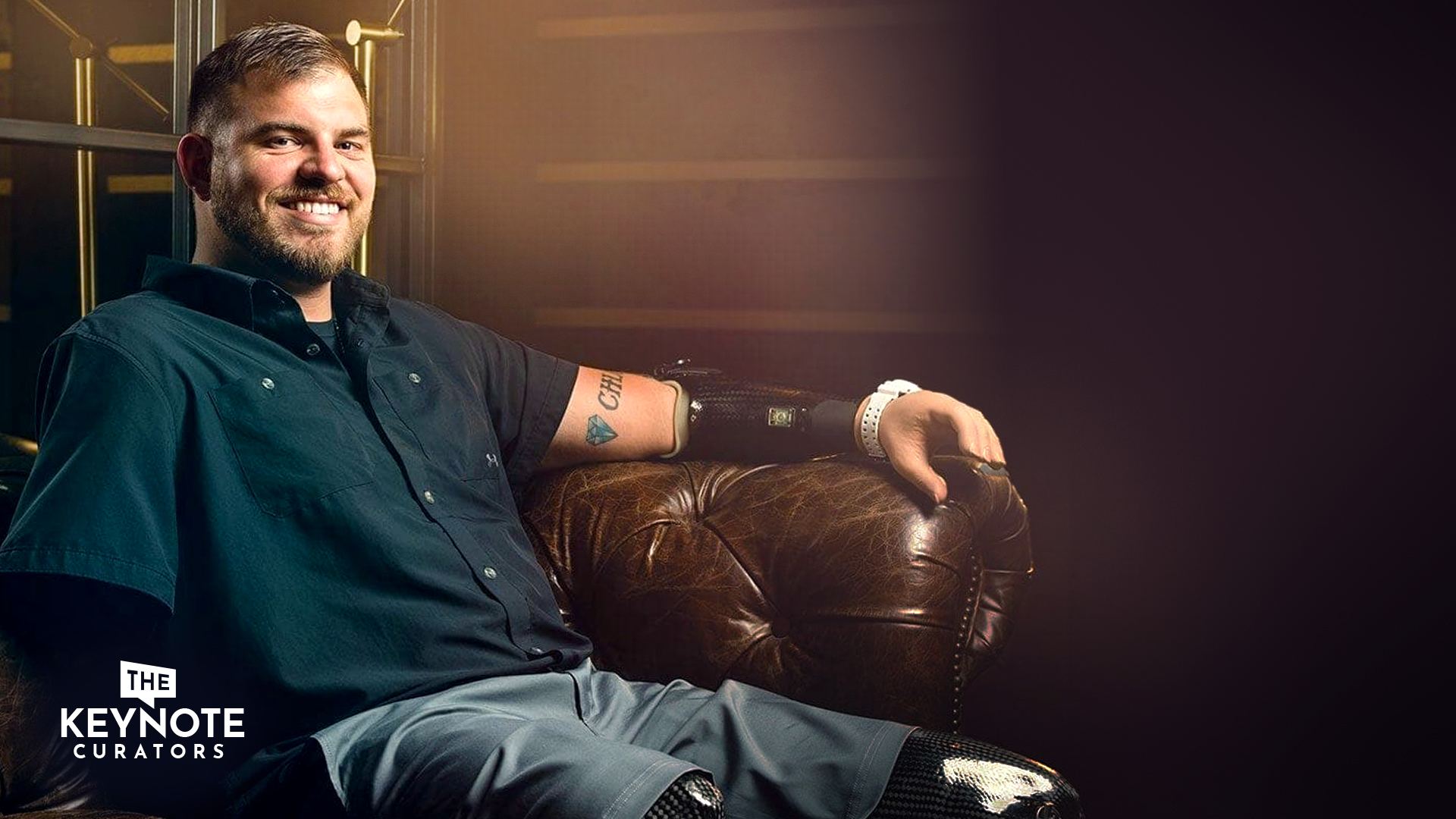
May 11, 2026Never Give Up, Never Quit: Lessons on Resilience from Travis Mills
Resilience keynote speaker Travis Mills shares how surviving as a quadruple amputee teaches us to find strength in gratitude and keep going.
What do you do when you’ve lost almost everything and still have to find a reason to keep going? That’s not a hypothetical question for Travis Mills. It’s the reality he woke up to after an IED in Afghanistan took portions of both his arms and both his legs. The answer he’s built his life around, and now shares with audiences everywhere, is one of the most grounded, honest, and practical takes on resilience I’ve encountered.
I had the chance to sit down with resilience keynote speaker Travis Mills, a retired U.S. Army Staff Sergeant from the 82nd Airborne and one of only five quadruple amputees from the wars in Iraq and Afghanistan to survive his injuries. He’s a New York Times bestselling author of Tough as They Come, a veterans advocate, and the founder of the Travis Mills Foundation, which provides all-expenses-paid retreats for injured post-9/11 veterans and their families. More than any title or credential, though, Travis is a man who chose to keep showing up, every single day, on the hardest terms imaginable.
What I walked away with wasn’t a motivational speech wrapped in abstractions. It was a clear, human framework for how real resilience actually works: not as a feeling you have on good days, but as a decision you make on the hard ones. If you’re navigating your own difficult stretch right now, or if you lead a team that needs to hear this kind of message, keep reading.
🎥 Watch and listen to the full interview about resilience here
Resilience Doesn’t Mean You’re Okay All the Time
The first thing Travis said that stopped me in my tracks was this: he has rough days, too. Not in a therapeutic, performative way. In a real, honest, matter-of-fact way.
He was on vacation with his family at the ocean. Everything around him was beautiful. His family was healthy, the weather was good, and the day was exactly what it was supposed to be. And he still felt the weight of what he’s lost. He couldn’t climb the ladder to board the snorkeling cruise. He can’t put his toes in the water anymore. And in that moment, those truths hit him.
This is important because it reframes what resilience actually means. We’ve been sold a version of resilience that looks like someone who never breaks, never flinches, never feels the sting of loss. Travis doesn’t fit that version, and I think that’s exactly why his message lands so hard. He isn’t pretending the hard days don’t come. He’s showing you what to do when they arrive.
Resilience, for Travis, isn’t the absence of grief or difficulty. It’s the presence of a counter-force: a conscious decision to look at what remains rather than dwell exclusively on what’s gone. That distinction sounds small until you try to live it, and then it becomes one of the most demanding mental disciplines there is.
For anyone leading people through change, through loss, through uncertainty, this reframe is essential. Pretending resilience is cheerfulness sets people up for shame when they inevitably have a hard day. Travis’s version gives people something more durable: a practice they can actually return to when motivation runs dry.
The Phrase That Changes How You Start Each Day
Travis uses a phrase in his daily life that I think is genuinely worth stealing: “At least I get to.”
It’s deceptively simple. On the surface, it sounds like generic gratitude talk, but the mechanics of it are different. It’s not about counting your blessings in the abstract. It’s about reframing what feels like a burden into access.
“At least I get to call my parents today.” Not: I have to make this call. “At least I get to watch my son run through the water.” Not: I wish I could be out there with him. “At least I get to be married to my wife going on 18 years.” Not: I’ll never be the same person she married.
What Travis is doing is transforming the grammar of his resilience experience. The same facts apply. The same limitations are real. But the story he tells himself about those facts shifts from deprivation to access. From loss to presence.
In a professional context, this is one of the most transferable ideas he brings to audiences. The personal development application is obvious: people who reframe their circumstances around what they still have access to are more likely to persist through difficulty than those who frame their circumstances around what they lack. This isn’t wishful thinking. It’s a cognitive practice, and Travis lives it in one of the most demanding contexts imaginable.
When the day is hard, and when motivation is nowhere to be found, “at least I get to” is a lever. It doesn’t erase the difficulty. It gives you a resilience direction to face when everything else feels like it’s falling apart.
Why Gratitude Is the Engine, Not the Result
There’s a version of resilience that’s passive. You feel it after things go well. After you get the promotion, after the health scare turns out fine, after the project lands. That’s gratitude as a byproduct. Travis operates with a completely different version: gratitude as a starting point.
He described sitting at the ocean, unable to join his family in the water, and choosing, in that moment, to shift his attention to his son running through the waves. “But how lucky am I to still be here and watch my son out there?” That’s not something that came naturally after things turned out fine. That’s a deliberate mental move made in the middle of genuine loss.
The reason this matters for resilience is that it makes the engine internal. If your ability to keep going depends on external circumstances improving, your resilience is always at the mercy of things outside your control. But if gratitude is something you generate from what already exists, it becomes a resource that doesn’t depend on the situation changing first.
Travis didn’t get better circumstances before he found his footing. He found his footing because he made a choice about where to direct his attention inside the circumstances he already had. That is a fundamentally different model than “things will get better and then I’ll feel better.” It’s: “I’ll find what’s worth holding onto right now, and that will carry me forward.”
For anyone in a leadership role, this has significant implications for corporate culture. A culture that waits for the good news before it celebrates what it has will always lag behind the current reality. A culture that practices gratitude and builds resilience as its starting points, not a reward, builds a different kind of team.
Using Other People’s Stories as Resilience Fuel
One of the most moving parts of our conversation was when Travis talked about how he carries the stories of friends who didn’t come home. Not to feel sad, and not to create a performance of survivor’s guilt. But to remind himself that he has an opportunity they didn’t get.
He talked about a soldier who was seventeen when he joined, nineteen when he was injured, and who never came home. That soldier left behind a daughter, seven months old, who only knows her father through photographs. Travis talks about another friend, Frankie, whose daughter was four when he was killed. She won’t have a daddy-daughter dance. She won’t have a father to call.
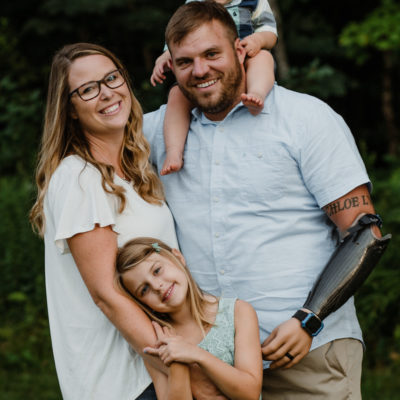
Travis’s daughter, who is fourteen now, was six months old when he was injured. They learned to walk at the same time: her taking her first steps, him relearning his. He gets to watch her grow up. He gets to be there for those moments. And when he thinks about Frankie’s daughter, or that nineteen-year-old’s little girl, the thought isn’t why me in either direction. It’s: I have a chance they didn’t get. What am I going to do with it?
This is a form of motivational thinking that goes well beyond inspiration. It’s borrowed purpose. When your own reserves run low, the stories of people who didn’t get to be here can provide a kind of external moral fuel. You’re not just living for yourself. You’re living for the chance they never had.
For audiences in corporate settings, this resilience story translates into something powerful about legacy and responsibility. Why does your work matter? Who is affected by whether you show up fully, whether you push through, whether you choose to keep going? Travis’s framework says: find the faces. Find the specific people whose lives are connected to your effort. That’s where the real fuel is.
Your Problem Is Real, Even If It Isn’t a Bomb
Travis said something in our conversation that I’ve thought about more than almost anything else he shared. He said: “Your biggest problem is your biggest problem.”
He went on to clarify that just because someone didn’t get blown up and lose their arms and legs doesn’t mean what they’re going through isn’t real. It doesn’t mean their pain is lesser, their fear is unjustified, or their struggle is unworthy of serious attention. What they’re going through is real. It’s relevant. It’s another obstacle to get past so they can keep living, and they build resilience to do so.
This matters enormously for how we approach empowerment in any human context. One of the most common barriers to seeking support, leaning on community, or even acknowledging your own difficulty is the comparison trap. Someone else has it worse, so what am I complaining about? Travis, who by any standard has lived through one of the most severe losses imaginable, explicitly refuses that framework.
He isn’t telling people their problems are small. He’s telling them their problems are real, and that the skills he’s developed, including the gratitude reframe, the borrowed purpose, the daily choice to keep going, apply across the full spectrum of human difficulty. You don’t have to have survived a bomb blast to have resilience and to need a mental framework for getting through hard things. You just have to be human.
This is part of what makes him such an effective keynote speaker across industries and audiences. He doesn’t position himself as a superhero whose resilience lessons only apply to extreme situations. He positions himself as someone who found tools that work, and who genuinely wants to share them with anyone who’s navigating something hard.
What “Never Give Up, Never Quit” Actually Means
Travis is known for the phrase never give up, never quit. It’s his motto, the organizing principle of his public life, and the thing people quote back to him constantly. But sitting with him, I got a much richer sense of what that phrase actually means in practice.
It doesn’t mean you don’t feel like quitting. It doesn’t mean there aren’t days when you’d give almost anything to be done with the difficulty. It means that in spite of those feelings, you find something to return to. A person. A memory. A phrase. A face. Something that tethers you to the decision to continue.
For Travis, those tethers are concrete and specific. His wife of nearly eighteen years. His daughter who helped him learn to walk again. His son running through the ocean water. His parents he calls every day. These aren’t abstract reasons to keep going. They’re specific, named, daily reasons. And that specificity is part of what makes them powerful.
Storytelling is central to how Travis communicates all of this. His speeches aren’t structured around frameworks or five-step models. They’re structured around people and moments. The nineteen-year-old soldier. Frankie. Kelsey. His daughter is learning to walk. His son in the water. These stories do the work that arguments can’t: they create emotional access to ideas that would otherwise stay abstract.
When he says never give up, never quit in the context of those stories, the phrase stops being a motivational poster and becomes something heavier and truer. It becomes a practice that real people have had to execute under real pressure. And that’s exactly what makes it worth taking seriously.
The Role of Attitude When the Situation Won’t Change
Something Travis comes back to repeatedly, both in his keynotes and in our conversation, is attitude as a choice. Not a feeling. A choice.
His situation isn’t going to change. He will always be a quadruple amputee. He will always be unable to climb that ladder or put his toes in the water or do the things that once came effortlessly. Those facts are fixed. What isn’t fixed is how he orients himself toward those facts on any given day.
This is the domain where resilience lives. Not in controlling outcomes, but in choosing orientation. And the specific orientation Travis returns to, again and again, is presence over absence, access over loss, gratitude over comparison.
The word attitude can sound soft or vague in a business context, but what Travis demonstrates is that it’s actually one of the most high-stakes disciplines a person can develop. Because circumstances are never fully within your control. Attitude is. And when your circumstances are as demanding as his, the gap between a crippling orientation and a sustaining one can mean the difference between getting out of bed and not.
For teams navigating uncertainty, for individuals facing setbacks, for leaders trying to model something worth modeling, this is the practical resilience upshot: you may not be able to change what’s happening, but you always have some agency over how you’re facing it. Travis has tested that proposition under conditions most of us will never face. He’s proof that it holds.

How Travis Built a Life Larger Than His Injury
What I find most remarkable about Travis’s resilience story isn’t just that he survived. It’s what he built afterward. The Travis Mills Foundation, which he founded with his wife Kelsey in September 2013, provides all-inclusive, all-expenses-paid, barrier-free vacations in Maine for injured post-9/11 veterans and their families. Veterans and their families participate in adaptive activities, bond with other veteran families, and get rest in a genuinely welcoming outdoor environment.
This is a military community service operation built by a man who had every reason to spend the rest of his life focused on his own recovery. Instead, he chose to extend the support he received to others who needed the same thing.
That choice, to turn personal experience into communal service, is itself a model of resilience applied outward. Travis didn’t just survive. He used what he went through to create something that helps others survive too. And that outward application of hard-won experience is, in a very real way, the fullest expression of never give up, never quit: not just continuing for yourself, but continuing in a way that creates possibility for other people.
For business audiences, this arc from personal adversity to community contribution is a powerful model of purpose-driven leadership. The most enduring organizations aren’t built around products or profits alone. They’re built around a reason that runs deeper than the bottom line, often one forged in the crucible of real difficulty.
What Happens When You Actually Hear Travis Speak
There’s something important I want to name about what it’s like to hear Travis Mills tell these resilience stories in person, or even in an interview. It doesn’t feel like a keynote address. It feels like a conversation with someone who has genuinely figured something out and genuinely wants to share it.
He laughs. He makes jokes. He talks about wearing his hook because it’s more versatile, and calls himself an Army matey. He’s not performing gravitas. He’s not manufacturing emotion for effect. He’s just a person who has been through something extraordinary, found a way through it, and has the kind of clarity that only comes from actually living what you’re teaching.
That quality, the sense that nothing is manufactured or performed, is what makes him credible not just as a speaker but as a guide. When Travis says at least I get to, it’s not a line from a script. It’s the actual phrase he uses to get through actual hard days. When he says your biggest problem is your biggest problem, he genuinely means it as respect, not consolation.
For event planners and companies considering bringing in a keynote speaker who covers DE&I and diversity, resilience, veterans’ stories, and personal empowerment, Travis sits in a rare category: someone whose message is both deeply personal and genuinely universal. He can speak to a room full of executives, a room full of veterans, or a room full of people who’ve simply had a hard year, and something in what he shares will reach each of them.
That’s the mark of a truly exceptional communicator. Not versatility for its own sake, but a message so grounded in real human experience that it finds its way into every room it enters.
If Travis’s resilience story resonates with you, or if you’re looking to bring a message like this to your next event, here’s how to take the next step.
🎧 Watch the full interview with resilience keynote speaker Travis Mills on YouTube
🎤 Book resilience keynote speaker Travis Mills for your next event here
📅 Schedule a 15-minute call with The Keynote Curators to discuss your event
✉️ Have questions? Reach us at info@thekeynotecurators.com
Discover More Insights





Get in TouchContact US
Fill out the form so we can best understand your needs.
A representative from The Keynote Curators will reach out to you.
Our Services
Keynote Speakers Topics
© 2026 The Keynote Curators. All Rights Reserved | Terms and Conditions
The Keynote Curators, 8275 South Eastern Avenue, Suite 200, Las Vegas, NV 89123
Local (310) 299-4595 | Toll Free (888) 585-8715 | info@thekeynotecurators.com
The Keynote Curators - Top Keynote Agency, USA.