
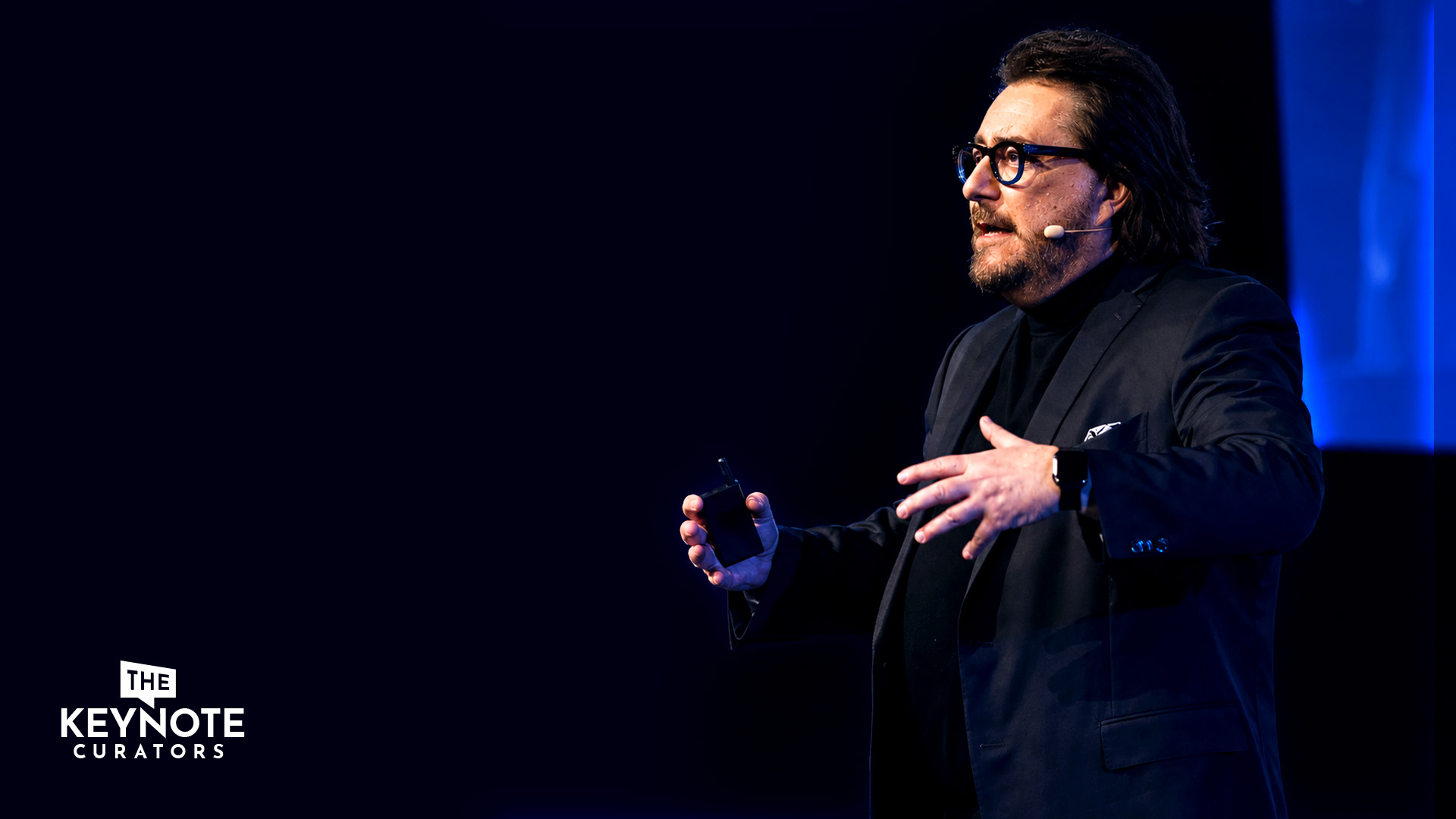
August 10, 2026The Customer Experience Mistake Most Companies Keep Making
Scott McKain explains why customer experience fails when it lives in one department and how leaders build a culture that lasts.
Most companies talk about customer experience the way they talk about a software rollout. It has a launch date, a training deck, a department that owns it, and eventually a quarterly report that tells leadership whether it worked. I sat with that idea for a long time after my conversation with Scott McKain, because he said something early on that quietly dismantled it. Customer experience, he told me, is not a department. It is not an initiative. It is not something a company does. It is something a company either is or is not, expressed in every touchpoint, every handoff, every interaction between a human being and the organization asking for their trust.
Scott McKain has spent more than three decades studying why some companies become impossible to leave and why others become impossible to remember. He is a Hall of Fame keynote speaker, a member of the Sales and Marketing Hall of Fame alongside names like Dale Carnegie and Zig Ziglar, and the author of ICONIC, a book Forbes named one of its Top 10 Picks of the Year. His client list, which includes Cisco, BMW, SAP, John Deere, and Bank of America, reads like a roll call of organizations that understood, at some point, that customer experience is not a line item. You can learn more about Scott McKain and the scope of his work through his speaker profile, but what stayed with me from our conversation was not his resume. It was the simplicity of the mistake he described, and how many organizations are still making it without realizing it.
🎙️ Watch and listen to the full interview about customer experience here
Why Customer Experience Cannot Survive as a Department
There is a specific kind of organizational chart that reveals how a company actually thinks about its customers. Somewhere on it, usually a few boxes down from the C-suite, sits a box labeled customer experience or customer service. It has its own budget, its own leader, and its own metrics. On paper, this looks like accountability. In practice, McKain argues, it is often the very thing that guarantees mediocrity, because it tells every other department that customer experience is somebody else’s job.
What struck me most about this part of our conversation is how quietly this belief spreads through an organization. Nobody in procurement wakes up and decides they are exempt from customer experience. Nobody in manufacturing or invoicing consciously opts out. But when a company structures customer experience as a department rather than a value, that exemption happens anyway, by default, because responsibility that isn’t explicitly shared is responsibility that eventually belongs to no one. McKain’s point is that a real customer experience culture has to be woven into procurement, into the supply chain, into reception, into the invoice that lands in someone’s inbox weeks after the sale. Every one of those moments either reinforces the promise a company made or quietly breaks it.
This is where the conversation moved from an idea about business into something closer to a truth about human systems in general. Any value that lives in a single department is a value that can be reorganized, deprioritized, or defunded. A value that lives in the culture itself, in the daily decisions of every person regardless of title, is far harder to erode. That distinction alone explains why some companies can survive leadership changes, market downturns, and competitive pressure without losing what makes them special, while others collapse the moment the person who championed customer experience leaves the building.
The Trust Problem Hiding Inside Service After The Sale
McKain shared a line he used to hear constantly when he started in this business: service is the first step of the next sale. He rejected it immediately, and the more I sat with his rejection, the more it made sense. Service is not the first step of the next sale. It is the first step of the first sale. If a company is not taking care of a customer before that customer has handed over any money, why would that customer trust the company to take care of them afterward?
This applies whether you are talking about a business selling to consumers or a business selling to other businesses. In both cases, the logic of customer experience does not start at checkout. It starts at the first interaction, the first email response time, the first moment someone from the outside gets a read on how this organization treats people who have not yet proven their value as customers. I have seen this same pattern play out across industries connected to sales, where the strongest closers are not the ones with the sharpest pitch but the ones whose entire pre-sale process already feels like being taken care of. Trust is not something you earn after the transaction. It is something you either establish or fail to establish before the transaction ever happens, and customer experience is the mechanism through which that trust gets built or quietly lost.
What makes this especially interesting is how often organizations get the sequencing backwards. They pour resources into loyalty programs, retention teams, and win-back campaigns while the earliest moments of the relationship, the ones that actually determine whether loyalty is even possible, go unmanaged. McKain’s reframing suggests that if you want to understand how a company will treat you after the sale, you should pay very close attention to how it treats you before the sale even closes. The behavior rarely changes. It simply reveals itself sooner if you know where to look.
People as Assets, Not Expenses
One of the sharpest moments in my conversation with McKain had nothing to do with customers directly. It had to do with how leaders talk about their people. He pointed out how often executives say their people are their most important asset, and then proceed to manage those same people like an expense. The distinction he drew is deceptively simple. An expense is something you try to minimize. An asset is something you invest in because you expect it to grow in value.
This reminded me of how many customer experience failures actually begin as employee experience failures wearing a different name. A frontline employee who has never been trained, developed, or trusted with real decision-making authority cannot manufacture warmth or judgment in the moment a customer needs it. You cannot instruct your way into empathy. Genuine customer experience requires people who feel invested in, because people who feel like an expense tend to behave like one: cautious, disengaged, and unwilling to go beyond the script. McKain’s argument is that professional development is not a perk companies offer when budgets allow. It is the mechanism by which a company’s stated values about people actually become visible in how those people treat everyone else.
The lesson that stayed with me here is about the direction of culture. Culture does not flow upward from the front line to the executive suite. It flows downward, and it flows fast. If leadership treats its people as a cost to be controlled, that posture eventually reaches the customer, disguised as understaffing, high turnover, or a certain flatness in how service gets delivered. If leadership treats its people as an asset worth developing, that posture reaches the customer too, usually in ways that are harder to name but easy to feel. Customer experience, in other words, is downstream of employee experience almost every single time.
What The C Suite Signals, The Front Line Repeats
McKain was direct about where accountability for customer experience ultimately sits. If the C-suite is not fully committed to it, he said, it will not happen on the front line, no matter how good the training materials are or how inspiring the mission statement sounds. This is one of those observations that seems obvious once stated and yet is violated constantly in practice.
I think what makes this hard for leaders is that commitment to customer experience does not show up in a single decision. It shows up in a thousand small ones: which metrics get reviewed in the weekly leadership meeting, which budget line gets cut first when revenue softens, whether a frontline employee’s judgment gets trusted or second-guessed after a customer complaint. Business leadership that is serious about customer experience treats these small decisions as the actual strategy, not as operational noise beneath the strategy. Every one of them is a signal, and employees are remarkably good at reading signals, even the ones leadership never intended to send.
This is also where I think the word culture, which McKain acknowledged is overused, earns its place back. Culture is simply the accumulated pattern of what an organization actually rewards, tolerates, and ignores. A company can print customer experience on its values poster and still build a culture that punishes the very behaviors that customer experience requires, like slowing down to solve a problem properly instead of closing a ticket quickly. Leadership that wants a genuine customer experience culture has to be willing to audit its own incentives honestly, because incentives, not intentions, are what people actually respond to.
Southwest Airlines And The Cost Of Abandoning Distinction
Few examples in our conversation carried more weight than the one McKain offered about Southwest Airlines. For decades, Southwest built a reputation as the airline that did things differently. Under Herb Kelleher’s leadership, the guiding logic was straightforward: take care of customers in ways no competitor was willing to match, and customers will take care of you in return through loyalty that is very hard for competitors to replicate. Free checked bags became one of the clearest symbols of that philosophy, a small operational choice that carried an outsized signal about what the company stood for.
McKain’s concern, voiced with real hesitation about naming a specific company, was that Southwest has drifted from that original logic under pressure to raise its share price, and the recent move to end free bags is, in his reading, a symptom of that drift rather than an isolated business decision. Whether or not every reader agrees with that specific read, the underlying principle is worth sitting with. A company can build genuine distinction through customer experience over decades, and still erode it in a fraction of that time once short-term financial pressure starts making the decisions instead of long-term philosophy. Distinction is not a permanent asset. It has to be actively defended, especially when the market starts rewarding the opposite instinct.
I have watched this pattern repeat across industries far beyond airlines. A company builds its identity on some form of innovation, some willingness to do the thing competitors consider unprofitable, and that willingness becomes the entire reason customers choose them. Then leadership changes, or investors demand different priorities, and the very behaviors that created the loyalty get quietly phased out because they no longer show up favorably on a quarterly earnings call. What gets lost in that transition is rarely announced. It just becomes noticeable, slowly, as customers stop feeling like there is any real reason to stay.
Chick-fil-A And The Culture That Doesn’t Need Reminding
Against that cautionary example, McKain offered Chick-fil-A as a case where the opposite happens with remarkable consistency. He noted that no matter which location he visits, anywhere in the country, the experience is reliably superior, and the reason has nothing to do with any single employee having an unusually good day. It has to do with a culture where everything, from hiring to training to how managers coach their teams, reinforces the same standard, so consistently that the standard no longer requires active enforcement.
This is the outcome every leader claims to want and very few organizations actually build. When customer experience genuinely lives in the culture rather than in a manual, you do not need to remind your team to care. Caring becomes the default because it has been modeled, reinforced, and protected long enough that it no longer feels like a rule being followed. It feels like identity. I think this is the deepest implication in everything McKain shared with me. The goal of building a customer experience culture is not better compliance. It is arriving at a point where compliance is no longer the operative word at all, because the behavior you want has become simply how the organization behaves.
There is also something worth noting about how rare this actually is. McKain admitted that examples like Chick-fil-A get cited constantly in business conversations partly because there are so few genuine alternatives to point to. That scarcity should be uncomfortable for any leader reading this. If the same two or three companies keep getting named whenever someone wants an example of exceptional customer experience, that tells you less about those companies and more about how uncommon this level of consistency actually is across the broader business landscape.
Why Customers Choose You Instead Of Someone Else
Perhaps the single idea from our conversation that I have not stopped thinking about is McKain’s correction of a phrase most leaders use without questioning it. Customers, he said, do not simply choose to do business with a company. Customers don’t choose to do business with us. That’s too simplistic. They choose us instead of the other options that are available to them in the marketplace, he explained. It sounds like a subtle reframe, but it changes the entire question a leadership team should be asking.
Most companies benchmark themselves against an abstract standard of quality. Are we good. Are we responsive. Are we competitively priced. McKain’s framing replaces that question with a sharper one: What do we stand for that would make a customer choose us instead of this myriad of options that are out there? That question cannot be answered with generic assurances about quality or service, because every competitor is making the same claims. It requires a company to articulate something specific and defensible about what it offers that genuinely cannot be replicated by the next option a customer is considering.
McKain admitted this is a hard question for a lot of leaders to answer honestly, and I think the difficulty itself is diagnostic. A leadership team that can immediately and specifically explain why a customer would choose them instead of every reasonable alternative has almost certainly already built the kind of customer experience culture this entire conversation has been circling. A leadership team that stumbles on that question, or answers it with language so broad it could apply to any competitor, has probably confused activity for distinction. Real customer experience is not about doing customer service tasks competently. It is about making a case, continuously and specifically, for why you and not someone else.
This connects directly back to something McKain said about his own career, almost as an aside. He mentioned an organization that has brought him back as a speaker for ten consecutive years, and the reason, in his telling, is not that his content is unmatched by every other keynote speaker in the world. It is that his clients know him, know his intent comes from genuine care about their growth, and trust that relationship enough to keep choosing him instead of someone else. That is customer experience in its purest form, applied to his own business as a thought leadership voice and best-selling author. He is not describing a theory he read about. He is describing the mechanism by which his own career has sustained itself for three decades.

The Case Every Organization Has To Keep Making
The more I reflect on this conversation, the more I think the real mistake most companies make is not a failure of execution. It is a failure of framing. They treat customer experience as a finish line, something to be achieved, checked off, and maintained at a steady state. McKain’s entire body of work argues the opposite. Customer experience is not a state you arrive at. It is a case you have to keep making, every day, to every customer, in competition with every other option that customer could have chosen instead.
That reframing has real consequences for how a leader should think about business growth. Growth built on genuine customer experience compounds, because every satisfied customer becomes part of the case a company is making to the next one. Growth built on anything shallower, a promotional discount, a temporary service improvement, a marketing campaign disconnected from daily reality, tends to be borrowed rather than earned, and borrowed growth has to be repaid eventually, usually at the moment a company can least afford it.
I keep returning to McKain’s opening correction, the one about service not being the first step of the next sale but the first step of the first sale. It captures something I think every leader intuitively knows but rarely organizes their company around: customers are always watching for evidence, and that evidence starts accumulating long before any transaction occurs. The companies that understand this, the ones that build customer experience into their DNA rather than their org chart, are the ones still being chosen years and even decades later, not because they were once good, but because they never stopped making the case. That, more than any framework or initiative, is what real customer experience actually requires. It is also, quietly, one of the most inspirational and motivational ideas a leader can carry back into their own organization: the case for your company is never finished. It is being made again, right now, in whatever your customer is experiencing this very moment.
🎙️ Watch and listen to the full interview here
🌟 Hire customer experience keynote speaker Scott McKain for your next event
🗓️ Let’s talk about building a culture your customers feel
Discover More Insights


Get in TouchContact US
Fill out the form so we can best understand your needs.
A representative from The Keynote Curators will reach out to you.
Our Services
Keynote Speakers Topics
© 2026 The Keynote Curators. All Rights Reserved | Terms and Conditions
The Keynote Curators, 8275 South Eastern Avenue, Suite 200, Las Vegas, NV 89123
Local (310) 299-4595 | Toll Free (888) 585-8715 | info@thekeynotecurators.com
The Keynote Curators - Top Keynote Agency, USA.