
Book Mario Andretti through The Keynote Curators
Biography
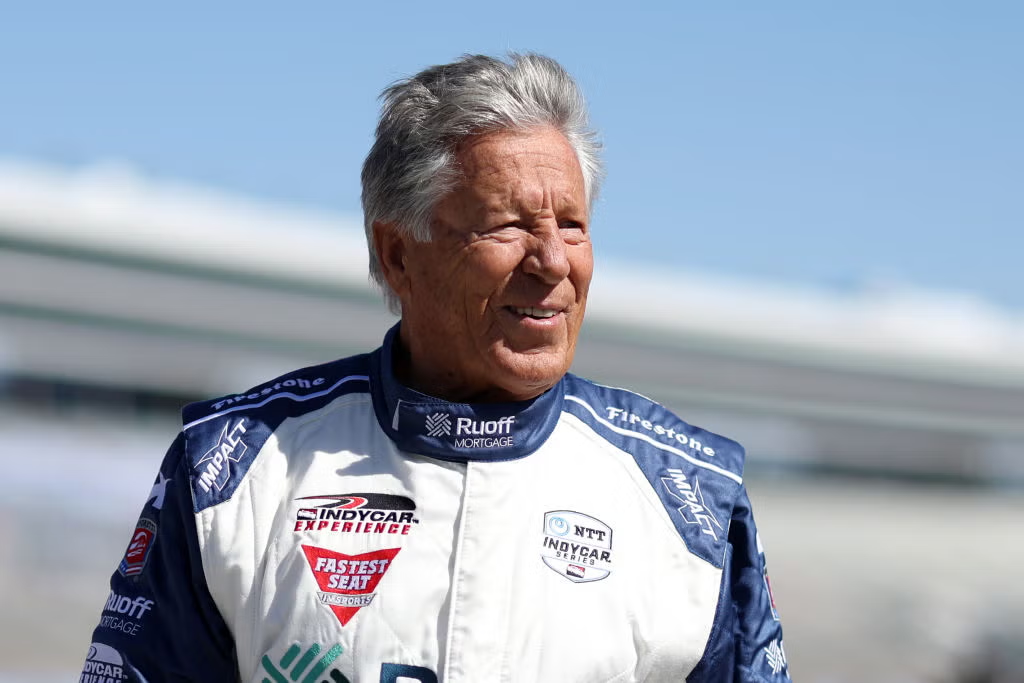
Not many have driven a race car better than Mario Andretti. He could make a bad car competitive and a competitive car victorious. He won the Indianapolis 500, the Daytona 500, the Formula One World Championship and the Pikes Peak Hillclimb. He won the Indy Car National Championship four times and was a three-time winner at Sebring. He won races in sports cars, sprint cars and stock cars – on ovals, road courses, drag strips, on dirt and on pavement. Mario Andretti won at virtually every level of motorsports since he arrived in America from his native Italy at age 15. He is a racing icon, considered by many to be the greatest race car driver in the history of the sport.
Assessing Mario Andretti’s legacy is easy…he drove the careers of three men. He drove with a passion and joy that few have equaled – and he won. Mario Andretti took the checkered flag 111 times during his career – a career that stretched five decades. And he was competitive all of those years: He was named Driver of the Year in three different decades (the 60s, 70s, 80s), Driver of the Quarter Century (in the 90s), and the Associated Press named him Driver of the Century in January, 2000.
The admiration for Mario Andretti has been for his achievements on the race track. He is in the very elite, top-superstar category of his game. Yet, if you look at his whole life, he has seen the world that most people will never see. And the journey he has made is what made him a very rich man.
Contact us for Mario Andretti fees and availability
Speech TopicsExpand each topic to learn more
His speeches center around four main points around racing and his personal history, which inspire attendees to overcome obstacles, persevere, and be more adaptable to change.
1) Mario grew up in a refugee camp in Italy under communist rule, till he was 15. This portion focuses on how you can become a victim or victor. His idol was Alberto Ascari. He used to climb and peer through fences to see him race. (Choosing to be a victim or victor)
2) The second portion of his speech is when he moves to America, and he doesn't even speak English. He and his twin brother Aldo both had the same dream to become successful race car drivers. However, his brother had a terrible accident and was in a coma for 84 days, and never was able to live his dream. However, Mario was able to help his brother with his own success. (Overcoming Obstacles)
3)Mario began his now-famous racing career in Indy and Formula One Racing. Mario talks about his rise to success, and how he was able to go back to the same where he watched Alberto Ascari as a child, and win. (How to Achieve Success, Perseverance)
4) Now, how he changed and adapts to retirement from racing and is following another dream, as he has founded his own winery. He talks about his family, and how to enjoy and seek out change (Adapting to Change)
For Meeting Planners


Get in TouchContact US
Fill out the form so we can best understand your needs.
A representative from The Keynote Curators will reach out to you.
Blog Posts

What Your Audience Really Want From Your Events
Jason Feifer explains how to best spot what your audience really wants, and how to design events, media, and talks around they need.
Read More
Self-Talk Only Works Under Pressure If It’s Rooted in Reality
Self-talk only works if you have lived it. Dr. Jannell MacAulay explains why credible self-talk beats generic positivity under pressure.
Read More
Team Culture Beats Raw Talent Every Time, with David Burkus
Team culture always beat raw talent. David Burkus explains the trust loop, real listening, and why a toxic high performer hurts every team.
Read More
Disability at Work Is Easy When Access Is Built In From the Start
Disability inclusion works best when access is built in, not requested. Explore how design, not exceptions, makes work ordinary for everyone.
Read More
Culture vs. Leadership: Which One Is Actually Driving Your Team?
Is company culture really the problem, or is it leadership? Chris Dyer says most culture issues start at the top.
Read More
Your Career Path Doesn’t Have to Be a Straight Line
Melissa Proctor's career went up, sideways, and back again. See how her jungle gym path shaped the way she leads.
Read More
How to Master AI to Deliver High-Value Results with Sam Richter
Learn how to master AI and deliver high-value results. Sam Richter explains where AI ends and human judgment begins.
Read More
Leading Through Uncertainty Starts With One Forward Step at a Time
Leading through uncertainty does not require the whole path. A story of loss, a marker, and the next step that keeps leaders moving.
Read More